


Most field service companies lose good technicians within 90 days. Not because the techs can't handle the work, but because the onboarding process throws them into the field before they're ready. The result? A cascade of callbacks, bad reviews, and resignation letters.
When rushed training costs you $47,000 per technician per year
Month two is where everything falls apart. Partially-trained technicians start working solo, making seemingly small mistakes that compound fast. A misdiagnosed HVAC issue here, an improperly installed water heater there—suddenly you're dealing with warranty callbacks that eat into margins while your new tech's confidence crumbles.
The competency gap nobody talks about
The competency gap nobody talks about
Field service onboarding follows a predictable pattern: two weeks of ride-alongs, a basic safety test, then straight to solo jobs with fingers crossed. What gets missed is the massive competency gap between "watched someone do it" and "can handle it alone under pressure."
Eliminate field service chaos with Romrly.
Romrly helps you assign, track, and complete service jobs efficiently and on time.
- Unified job scheduling
- Technician dispatch & tracking
- Customer notifications & updates
No credit card required
Take diagnostic skills. A new HVAC tech might watch a senior technician diagnose a refrigerant leak five times during shadowing. They'll nod along, maybe take notes. Put them alone in a customer's basement with an intermittent cooling issue and vague symptoms? That's where the real gaps show.
The difference between successful technician retention and the revolving door most companies experience comes down to measurable competency gates at specific intervals. Not just "did they show up for training" but actual performance metrics tied to field readiness.
Building competency milestones that predict success
Competency-based onboarding means breaking down every field task into observable, measurable skills. Not theoretical knowledge, but practical abilities you can verify before someone works alone.
-
Diagnose three common furnace failures without assistance
-
Complete a full system inspection in under 45 minutes
-
Explain technical issues to customers in plain language
-
Navigate pricing discussions without defaulting to discounts
These aren't arbitrary milestones. They're based on the actual tasks that cause problems when done incorrectly in the field. Each milestone connects directly to reducing callbacks and improving customer satisfaction scores.
The evaluation happens through structured scenarios, not multiple-choice tests. Set up a furnace with a specific issue. Give the technician 30 minutes to diagnose it, explain it to a mock customer, and propose the right fix. Either they can do it or they can't—no ambiguity.
The shadowing schedule that builds confidence, not dependency
Traditional shadowing creates watchers, not doers. New technicians spend weeks observing but rarely get hands-on practice with real accountability. They become dependent on having someone else make decisions.
A progressive shadowing model flips this approach completely:
Visualizing the progressive shadowing workflow helps teams implement it consistently.
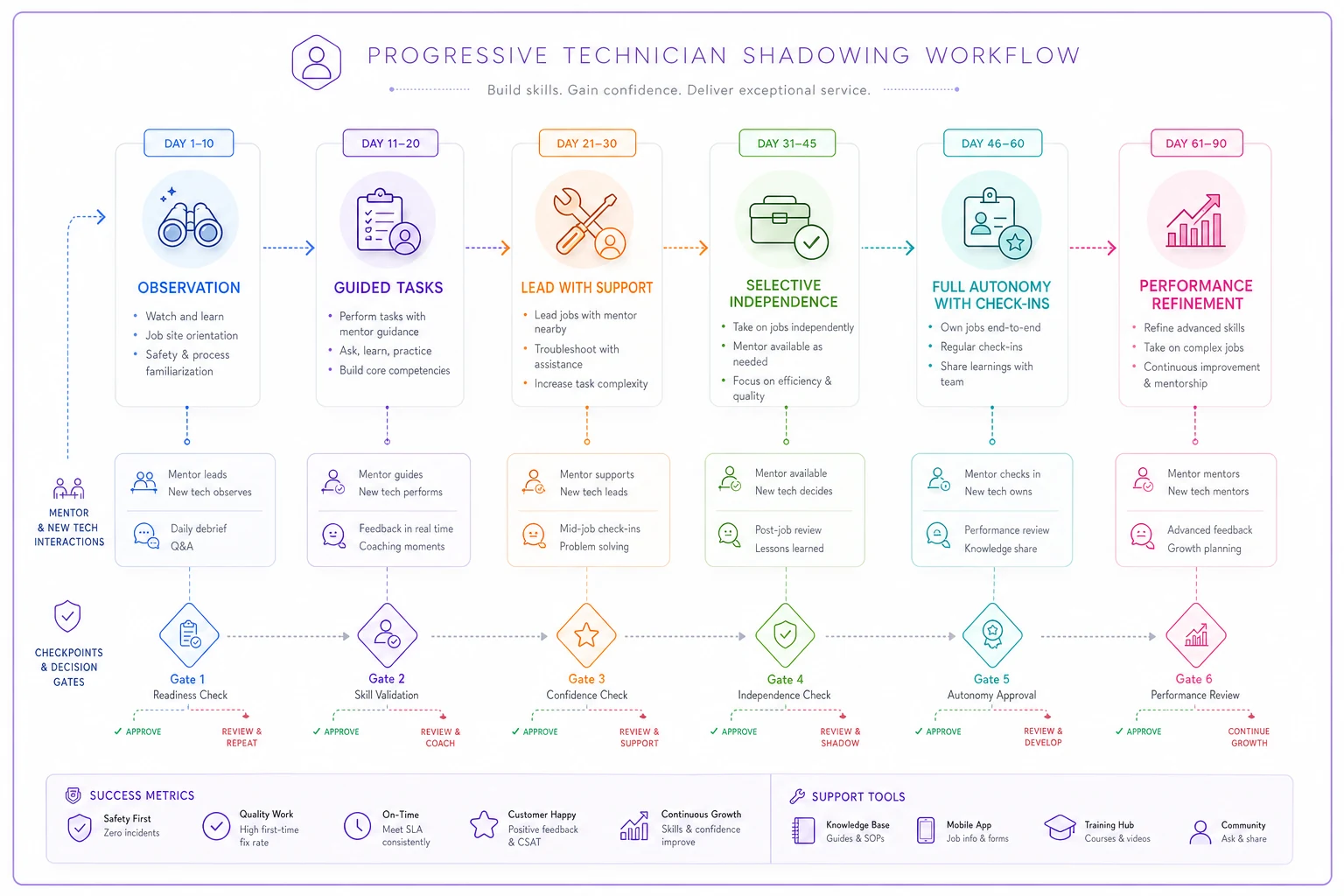
``[Day 1-10: Pure Observation] → [Day 11-20: Guided Tasks] → [Day 21-30: Lead with Support] → [Day 31-45: Selective Independence] → [Day 46-60: Full Autonomy] → [Day 61-90: Performance Refinement]``
Days 1-10: Pure observation New tech shadows senior technician on 15-20 calls, focusing on workflow and customer interaction patterns. No hands-on work yet.
Days 11-20: Guided participation Tech handles specific tasks under supervision. Senior tech assigns one component of each service call—maybe running diagnostics while the senior handles repairs, or vice versa. Gradually increasing complexity.
Days 21-30: Reversed roles New tech leads the service call while senior observes. Senior only intervenes if safety or major customer issues arise. This builds decision-making muscles while maintaining a safety net.
Days 31-45: Selective shadowing New tech works solo on basic calls (preventive maintenance, simple repairs) but shadows complex diagnostics and installations. This prevents overwhelming them while building independence.
Days 46-60: Full autonomy with check-ins Tech handles full range of standard calls independently. Senior reviews job notes daily and does weekly ride-along spot checks. Problems get caught before they become patterns.
Days 61-90: Performance refinement Focus shifts from basic competency to efficiency and upselling. Shadow calls specifically chosen to demonstrate advanced techniques or challenging scenarios.
Each phase has specific exit criteria. Can't diagnose basic issues by day 30? Extended guided participation. Struggling with customer communication at day 45? Targeted coaching sessions. The timeline flexes based on actual competency, not arbitrary dates.
Daily task progression that prevents overwhelm
New technicians often fail because they get thrown into complex situations before mastering basics. Daily task progression creates stepping stones from simple to complex work.
-
Week 1-2 daily tasks - Inventory management and truck organization - Basic safety procedures and documentation - Tool identification and usage - Customer communication scripts
-
Week 3-4 daily tasks - Preventive maintenance procedures - Basic diagnostic processes - Parts ordering and warranty registration - Simple repair procedures under supervision
-
Week 5-6 daily tasks - Independent preventive maintenance calls - Supervised diagnostic work - Customer education and upselling basics - Documentation and reporting requirements
-
Week 7-8 daily tasks - Mixed call types with decreasing supervision - Complex diagnostic scenarios - Pricing and payment collection - Technical troubleshooting via phone support
-
Week 9-12 daily tasks - Full service call autonomy - Complex installations with support available - Customer complaint resolution - Mentoring newer technicians
This progression ensures technicians build confidence through success, not failure. Each week's tasks prepare them for the next level of complexity.
The KPI gates that predict long-term success
Traditional onboarding measures attendance and test scores. Competency-based onboarding measures actual field performance through specific KPI gates at 30, 60, and 90 days.
30-day KPI gates:
-
Complete 10 supervised calls with zero safety violations
-
Achieve 90% diagnostic accuracy on common issues
-
Maintain average call time within 20% of team average
-
Document all calls correctly in system
60-day KPI gates:
-
Zero callbacks on preventive maintenance work
-
Customer satisfaction score above 4.5/5
-
Revenue per call within 15% of team average
-
First-call completion rate above 85%
90-day KPI gates:
-
Callback rate under 5%
-
Customer satisfaction maintained above 4.6/5
-
Revenue per call at or above team average
-
Technician efficiency rating in top 50% of team
Missing a gate doesn't mean termination. It triggers specific interventions. Low diagnostic accuracy at 30 days? Additional shadowing on complex calls. Poor customer scores at 60 days? Communication coaching and role-playing sessions.
These gates also protect the company. A technician who can't meet basic competency standards after targeted support probably won't improve with more time. Better to identify this at 30 days than after six months of callbacks and upset customers.
Creating evaluation templates that remove subjectivity
Evaluation without clear criteria becomes popularity contests. Structured templates create consistency across evaluators and give technicians clear targets.
A diagnostic evaluation template might include:
| Competency Area | Specific Skill | Rating (1-5) | Evidence Required | Notes |
|---|---|---|---|---|
| Initial Assessment | Gathers complete symptom history | ___ | Documents all customer-reported issues | |
| Safety Protocol | Follows lockout/tagout procedures | ___ | Demonstrates proper shutdown sequence | |
| Diagnostic Process | Uses systematic troubleshooting | ___ | Eliminates possibilities methodically | |
| Tool Usage | Operates meters/gauges correctly | ___ | Takes accurate readings consistently | |
| Problem Identification | Identifies root cause | ___ | Diagnosis matches senior tech assessment | |
| Documentation | Records findings completely | ___ | All fields populated in system | |
| Customer Communication | Explains issue clearly | ___ | Customer confirms understanding | |
| Solution Proposal | Recommends appropriate fix | ___ | Matches company pricing guidelines |
Each skill gets evaluated during real service calls, not artificial scenarios. The evaluator (usually the shadowing senior tech) provides specific examples for any rating below 4. This creates a paper trail of exactly what needs improvement.
Templates exist for each major competency area: diagnostics, repairs, installations, customer service, sales, and safety. Technicians know exactly what they're being measured on, removing the mystery from performance evaluations.
When technicians fail early warning checkpoints
Not every technician will hit every milestone on schedule. Having clear escalation paths when someone struggles is crucial.
A technician who can't diagnose basic issues after 30 days might have several underlying problems. Maybe they're struggling with the technical concepts. Maybe they're second-guessing themselves under pressure. Maybe they need glasses but haven't mentioned it. The intervention depends on the root cause.
Technical knowledge gaps get addressed through additional training modules and practice scenarios. Confidence issues might require adjusted shadowing where they lead easier calls first. Physical limitations need accommodation or role adjustment.
The 60-day checkpoint often reveals customer service problems. A technically competent technician who generates complaints needs different support than one who struggles with repairs. Communication coaching, role-playing exercises, and recorded call reviews help technicians who know the work but can't explain it well.
By day 90, patterns become clear. Technicians who've responded well to support but still miss targets might need more time. Those who haven't improved despite interventions probably aren't the right fit. Having three months of documented performance makes these decisions objective, not personal.
Certification protocols that ensure field readiness
Field readiness certification should mean something. Not just "completed training" but "proven ability to handle real-world situations independently."
-
Basic Certification (Day 30) Covers safety, basic diagnostics, preventive maintenance, and customer interaction. Technician must demonstrate competency in controlled scenarios with clear pass/fail criteria.
-
Intermediate Certification (Day 60) Includes complex diagnostics, standard repairs, upselling, and problem resolution. Based on actual field performance metrics from supervised calls.
-
Full Certification (Day 90) Comprehensive evaluation covering all job types, customer situations, and technical challenges. Includes peer review, customer feedback analysis, and efficiency metrics.
Each certification level unlocks different work types. Basic certification allows preventive maintenance and simple repairs. Intermediate adds diagnostic calls and standard installations. Full certification opens up complex jobs and solo on-call shifts.
This protects both technicians and companies. New techs don't get overwhelmed with complex work before they're ready. Companies don't send underprepared technicians to high-value customers.
The hidden cost of rushing technician readiness
Every callback from a new technician's mistake costs more than just the return visit. There's truck time, parts, senior tech oversight, potential discounts to save the relationship, and the opportunity cost of that senior tech not taking new revenue calls.
A single botched installation might trigger $2,800 in direct costs:
-
Return visit labor
$400
-
Senior tech oversight
$400
-
Replacement parts
$600
-
Customer discount
$500
-
Lost revenue from senior tech
$900
Multiply that across multiple mistakes from multiple rushed technicians, and you're looking at significant margin erosion. One HVAC company tracked this and found rushed onboarding cost them $47,000 per technician in the first year through callbacks, bad reviews, and early turnover.
The competency-based approach takes longer upfront—maybe 90 days versus 30 for traditional onboarding. But it eliminates most of these hidden costs while building technicians who stay longer and perform better.
Building the feedback loop between field performance and training
The best onboarding programs evolve based on actual field outcomes. When multiple technicians struggle with the same issue at the 60-day mark, that's a training gap, not a people problem.
Track patterns in missed competencies. If three technicians in a row can't properly diagnose heat pump reversing valve issues, your training needs more hands-on practice with that specific problem. If customer complaint rates spike at the 45-day mark, the transition to independence might be too abrupt.
Use job management software to track callback rates by technician tenure. Plot when mistakes cluster. Most companies see spikes around day 20 (first solo work), day 45 (complex jobs start), and day 75 (complacency sets in). These become focus points for additional support.
Survey technicians at 30, 60, and 90 days about their confidence levels. Where do they feel underprepared? What situations still make them nervous? This feedback shapes the next iteration of the program.
Reducing rework through systematic skill verification
Rework kills profitability in field service. A callback rate above 10% for new technicians indicates systematic onboarding failures, not individual performance issues.
The competency-based approach reduces rework by verifying skills before technicians work independently. But verification means more than watching once. It means consistent demonstration across multiple scenarios.
-
Braze in tight spaces
-
Handle different pipe sizes
-
Work in hot attics and cold basements
-
Maintain quality when rushed
-
Explain the process to curious customers
Only when they've demonstrated competency across various conditions do they get certified for that skill. This might seem excessive, but it's far less expensive than callbacks for leaking refrigerant lines.
The same applies to customer service skills. Can they handle an angry customer while maintaining professionalism? What about explaining a $4,000 repair to a skeptical homeowner? These scenarios get practiced and evaluated before they happen for real.
Technology's role in scaling competency-based onboarding
Manual tracking of competencies, shadowing schedules, and KPI gates becomes overwhelming at scale. AI-powered operational software becomes essential for growing field service companies managing complex onboarding workflows.
Modern field service management platforms can automate much of the competency tracking process. Digital checklists ensure every evaluation covers the same criteria. Automated reports flag when technicians miss KPI gates. Scheduling algorithms pair new technicians with appropriate mentors and job types based on their current certification level.
Map certification levels to allowed job types in your scheduling system to prevent premature solo assignments.
The onboarding workflow might automatically assign shadowing partnerships, schedule evaluation calls at specific intervals, and restrict job types based on certification status. When a technician hits their 30-day mark, the system triggers the evaluation protocol and won't assign solo calls until certification is complete.
Performance data feeds back into the training program automatically. High callback rates on specific job types trigger additional training modules. Customer complaints about communication generate coaching session tasks. The system becomes smarter about predicting which technicians need which support.
This systematization ensures consistency as you scale. The 50th technician gets the same thorough onboarding as the 5th, without requiring proportional management overhead.
Making the economic case for extended onboarding
CFOs often resist 90-day onboarding programs. The carrying cost of unproductive technicians seems excessive compared to traditional 2-week programs. But the math tells a different story.
Traditional 14-day onboarding:
-
Training cost
$2,800
-
Callbacks in first 90 days
$8,400
-
Customer churn from bad experiences
$12,000
-
Early turnover replacement cost
$15,000
-
Total first-year cost
$38,200
Competency-based 90-day program:
-
Extended training cost
$11,200
-
Callbacks in first 90 days
$2,100
-
Customer churn
$3,000
-
Early turnover replacement
$5,000
-
Total first-year cost
$21,300
The extended program costs more upfront but saves $16,900 per technician in the first year alone. The second-year savings are even greater as properly trained technicians generate higher revenue and require less supervision.
Beyond pure economics, there's the cultural impact. Technicians who feel properly prepared stay longer. They refer other good technicians. They take pride in their work and generate positive reviews. These soft benefits compound over time but don't show up in quarterly reports.
The path forward
Implementing a competency-based onboarding program doesn't happen overnight. Start with one role, document every competency required for success, and build your evaluation templates. Run a pilot with your next 2-3 hires, tracking their performance against traditionally-trained peers.
The differences become obvious within 60 days. Lower callback rates, higher customer satisfaction, better technician retention. Use this data to expand the program to other roles and refine the competency milestones based on actual outcomes.
Most importantly, commit to the full 90 days. The temptation to rush technicians into the field will be strong, especially during busy seasons. But every shortcut in onboarding creates exponentially more problems in the field.
The companies that build systematic, competency-based onboarding programs aren't just training better technicians. They're building sustainable competitive advantages that compound over time. In an industry where good technicians are increasingly hard to find, developing them internally through proper onboarding becomes the only scalable path to growth.
The companies that build systematic, competency-based onboarding programs aren't just training better technicians. They're building sustainable competitive advantages that compound over time. In an industry where good technicians are increasingly hard to find, developing them internally through proper onboarding becomes the only scalable path to growth.
Ready to optimize your field operations?
Join 2,000+ service teams using Romrly to boost productivity, reduce downtime, and enhance customer satisfaction.