


Your dispatcher gets the call at 11:47am. A property manager's HVAC unit failed, the building's full of tenants, and they need someone there before close of business. Your schedule's already packed tight with preventive maintenance visits and a complex installation that'll run into overtime.
The dispatcher knows this dance. They start calling techs, disrupting lunch breaks, asking who can "maybe fit one more in." Someone agrees reluctantly. The 2pm preventive maintenance gets bumped to tomorrow. That customer calls angry at 3:15pm wondering where their tech is. Meanwhile, the emergency job takes longer than expected because the tech arrived without the right diagnostic tools, having rushed over from a completely different type of service call.
By 5pm, you've got one grateful emergency customer, two frustrated customers whose appointments got shuffled, an exhausted tech who skipped lunch, and a dispatcher who spent three hours playing schedule Tetris instead of handling tomorrow's route optimization.
This pattern shows up in practically every field service operation I've looked at. Companies handling 40-50 calls daily lose roughly 12-15% of their productive capacity to emergency response chaos. Not because emergencies themselves take that much time, but because the ripple effects destroy carefully planned routes, create communication gaps, and force reactive decisions that compound into a real mess.
Why Traditional Emergency Handling Breaks Down
Most field service operations treat emergencies like exceptions to handle case-by-case. The dispatcher makes judgment calls based on whoever's yelling loudest, which tech seems least busy, or pure geographical convenience.
This fails because emergencies aren't actually exceptions in field service — they're a predictable operational pattern. HVAC companies see emergency spikes during the first heat wave and cold snap. Plumbing operations get slammed after heavy rains. Commercial maintenance providers face equipment failures every Monday morning when systems fire back up after the weekend.
The problem starts when dispatchers lack clear decision frameworks. Without a same-day emergency dispatch policy, every emergency becomes a negotiation. The dispatcher debates internally: Is this really an emergency? Can we push the scheduled maintenance to tomorrow? Should we call in the on-call tech? Which existing customer will be least angry if we reschedule?
These micro-decisions eat time and create inconsistency. One dispatcher might bump a residential customer for any commercial emergency. Another might prioritize based on contract value. A third just sends whoever's closest. Your techs never know what to expect, customers get different treatment based on who answers the phone, and planned work becomes the casualty of whoever complains loudest.
One electrical contractor's operation I spent time with had emergency calls consuming nearly 20% of dispatch time but representing only 8% of actual service hours. The administrative overhead of managing emergencies without structure was literally more expensive than the emergencies themselves.
Building Your Emergency Triage Rubric
A functional triage system starts with clear severity definitions that your entire team understands. Not vague categories like "urgent" or "priority," but specific operational criteria tied to real business impact.
Eliminate field service chaos with Romrly.
Romrly helps you assign, track, and complete service jobs efficiently and on time.
- Unified job scheduling
- Technician dispatch & tracking
- Customer notifications & updates
No credit card required
Here's the framework that actually works:
Level 1: True Emergency (Immediate Response Required)
-
Safety hazard present (gas leak, electrical fire risk, flooding)
-
Complete operational shutdown for commercial client
-
Regulatory compliance violation that triggers immediate penalties
-
Contract-specified response time with financial penalties
Level 2: Same-Day Critical (4-Hour Window)
-
Partial operational impact for commercial client
-
Residential without primary heating/cooling in extreme weather
-
Security system failure for retail/financial clients
-
Time-sensitive equipment preventing business operations
Level 3: Same-Day Standard (Before COB)
-
Quality-of-life impact for residential (one bathroom out of service)
-
Non-critical commercial equipment with workaround available
-
Preventive maintenance with compliance deadline today
-
Follow-up from yesterday's incomplete emergency
Level 4: Next-Day Priority
-
Everything else that the customer insists is an emergency
The classification alone means nothing without enforcement rules. Your dispatchers need explicit authority to reject or downgrade requests. A residential customer without AC when it's 72 degrees outside isn't a Level 2 emergency just because they're upset. A commercial kitchen with one of three ovens down has a workaround and belongs in Level 3, not Level 1.
Each level needs different resource allocation rules:
| Triage Level | Response Time | Can Bump | Can't Bump | Resource Pool |
|---|---|---|---|---|
| Level 1 | < 2 hours | Any non-contracted work | Contracted time-sensitive | Any available + on-call |
| Level 2 | < 4 hours | Preventive maintenance | Contracted service, installs | Designated emergency slots |
| Level 3 | Same day | Non-revenue maintenance | All scheduled work | Reserve capacity only |
| Level 4 | Next day | Nothing | Everything | Standard scheduling |
Your dispatchers need explicit authority to reject or downgrade requests. A residential customer without AC when it's 72 degrees outside isn't a Level 2 emergency just because they're upset. A commercial kitchen with one of three ovens down has a workaround and belongs in Level 3, not Level 1.
Reserved Capacity Rules That Protect Planned Work
The biggest mistake field service companies make is running at 100% scheduled capacity. When every tech is fully booked, emergencies always require disrupting planned work. The solution isn't hiring more techs — it's building intelligent capacity reserves into your scheduling.
Start with the 85% rule for standard operations. If a tech can complete 8 jobs in a standard day, schedule them for 7. That sounds like leaving money on the table until you run the real math. Those 7 scheduled jobs now complete on time at a much higher rate. First-call resolution improves because techs aren't rushing. Customer satisfaction scores jump because appointments don't get bumped.
But flat capacity reserves waste resources. Tuesday mornings rarely see emergencies. Friday afternoons get slammed. Smart operations build variable reserve capacity based on historical patterns.
Track your emergency patterns for 90 days. You'll find clear trends:
-
Monday mornings
40% higher emergency volume (weekend failures discovered)
-
Friday afternoons
35% higher (businesses panicking before the weekend)
-
Day after holidays
50% spike (deferred issues)
-
Extreme weather days
200-300% increase for HVAC/plumbing
Build your reserve capacity around these patterns. Monday morning needs two techs with only morning appointments scheduled. Friday keeps one tech completely unscheduled after 1pm. Standard Tuesday through Thursday might only need 15% reserve capacity spread across the team.
For every 10 field techs, designate one as the daily "emergency rover." They start with a light schedule — maybe two preventive maintenance visits that can shift if needed. When emergencies hit, the rover responds first. When no emergencies come in, they handle overflow work, callbacks, or help other techs running behind. This role rotates weekly so no one gets burned out being the permanent emergency responder.
The key is protecting this capacity from erosion. Sales teams always want to book more. Dispatchers feel pressure to squeeze in "just one more quick job." Set hard rules:
-
Emergency capacity can't be scheduled more than 24 hours in advance
-
Only the dispatch supervisor can override reserve capacity rules
-
Track capacity utilization weekly — if reserves get used more than 60% of the time, you need more capacity
-
Measure the financial impact
revenue from emergency response vs. cost of maintained capacity
One commercial HVAC operation I looked at maintained 20% reserve capacity and charged 1.5x rates for same-day emergency response. The premium pricing more than offset the "lost" capacity, and their on-time performance for scheduled work hit 91% — industry average hovers somewhere around 70%.
Dispatcher Scripts That Manage Expectations
Your dispatchers need exact language for emergency triage. Vague responses cause problems. When a dispatcher says "we'll try to get someone out today," the customer hears "someone will definitely come today." When they say "this is high priority," the customer expects an immediate response.
Level 1 Emergency Confirmation: "I understand you have [specific safety/operational issue]. This qualifies as an emergency response. Our emergency technician will arrive within 2 hours. The service call starts at $[emergency rate]. Are you authorized to approve this emergency service charge?" That script confirms the issue, sets the timeline, states the pricing, and gets approval — all in four sentences.
Level 2 Same-Day Critical: "Your [specific issue] requires same-day service. I can confirm a technician between [specific 4-hour window]. This is scheduled as same-day priority service at $[same-day rate]. The technician will call 30 minutes before arrival. Does this timeframe work for you?"
Level 3 Downgrade Conversation: "I understand this is frustrating. Based on what you've described, we can schedule this as a same-day standard service, which means our technician will arrive before 6pm today. If the situation worsens and becomes a safety hazard, call us immediately and we'll upgrade to emergency response. Otherwise, we'll have someone there before close of business. Does that work?"
Level 4 Redirect: "I hear that this is urgent for you. Based on our emergency criteria, this is a next-business-day priority service. I can schedule you for first thing tomorrow morning at 8am, or if you prefer, I have a 10:30am slot that might work better with your schedule. Which would you prefer?"
The critical element in each script is removing negotiation space. The dispatcher states facts, not opinions. They offer specific alternatives, not vague promises. They document the customer's acceptance of the service level.
Train dispatchers to handle the predictable pushback:
"But this IS an emergency!" "I understand this feels urgent. Let me review our emergency criteria with you. For safety hazards or complete operational shutdowns, we dispatch immediately. Your situation with [specific issue] allows for same-day service, which means we'll have someone there before 6pm. If the situation changes and becomes a safety hazard, call us back immediately."
"I'll call someone else then!" "I understand, and you should do what's best for your situation. If you'd like, I can put you on our cancellation list — if something opens up sooner, we'll call you immediately. Would you like me to do that?"
"I'm a longtime customer!" "We absolutely value your business, and that's why I want to be transparent about our response times. Your service history qualifies you for our priority scheduling, which is why I can guarantee same-day service instead of pushing to tomorrow. The technician will be there before 6pm."
These scripts work because they acknowledge the customer's concern without accepting their framing. They provide clear information and alternatives, and they document the interaction for future reference.
Rollback Plans When Everything Goes Sideways
Even the best emergency response system breaks down sometimes. Three Level 1 emergencies hit simultaneously. Your emergency rover's van breaks down. A simple diagnostic turns into a three-hour repair. You need predetermined rollback plans that activate automatically, not panic-driven improvisation.
Escalation Level 1: Standard Overflow Triggers when emergency queue exceeds reserve capacity by one job.
-
Dispatch supervisor contacts techs finishing current jobs to assess availability
-
Offer overtime to tech closest to emergency location
-
Begin calling scheduled customers for last appointment to request a morning reschedule
-
Activate on-call tech if available
Escalation Level 2: Multiple Emergency Overlap Triggers when three or more simultaneous Level 1-2 emergencies arrive.
-
Immediately stop accepting Level 3-4 same-day requests
-
Dispatch supervisor takes over all emergency routing
-
Begin systematic rescheduling of preventive maintenance (newest customers first)
-
Contact commercial clients to verify if after-hours response is acceptable
-
Pull supervisor or senior tech from administrative duties
Escalation Level 3: System Failure Triggers when emergency response exceeds capacity by 50% or more.
-
Activate all on-call personnel
-
Stop accepting new non-emergency appointments for next day
-
Partner company reciprocal agreement activates
-
Customer service begins calling to reschedule all moveable work
-
Owner/GM directly contacts key accounts about delays
Each escalation level needs specific rollback procedures once the crisis passes.
The follow-up protocol matters as much as the initial response:
-
Contact every bumped customer within 24 hours
-
Offer priority rescheduling or service credit
-
Document which scheduled jobs got impacted
-
Review why escalation was needed — was it preventable?
One plumbing operation I observed ran rollback drills monthly, like a fire drill. The entire office knew exactly what to do when the dispatcher called "Level 2 escalation." Customer service immediately pulled up the reschedule list. The operations manager started reviewing tomorrow's schedule for flexibility. When real emergencies hit, they handled five simultaneous emergency calls during a freeze event without a single customer complaint about rescheduling.
Integration Points With Existing Systems
Your emergency response framework can't exist in isolation. It needs to connect with your existing scheduling, customer management, and communication systems without creating duplicate work or information gaps.
Start with your scheduling system. Most field service companies use some form of scheduling software, but few configure it for emergency response. Create dedicated emergency appointment types with different color coding, automatic pricing rules, and capacity calculations. If your standard appointment blocks 60 minutes but emergency response averages 90, the system needs to reflect that.
Your dispatchers shouldn't be manually checking emergency criteria during a call. Build the triage rubric directly into your customer service screens. When someone calls claiming an emergency, the system should walk through qualifying questions:
-
Is there a safety hazard? → If yes, Level 1
-
Is this affecting business operations? → If yes, check contract status
-
Is there a temporary workaround? → If yes, Level 3 maximum
Customer history should display automatically during emergency calls. If someone's logged three "emergencies" in the last month that turned out to be standard service calls, your dispatcher needs that information immediately. Contract status, payment history, and account value should all be visible on one screen.
The communication flow needs automation to work without constant manual intervention. When an emergency bumps scheduled work:
-
System automatically texts the affected customer about the schedule change
-
New appointment options are provided via scheduling link
-
Tech receives the updated route on their mobile device
-
Customer service gets a notification to follow up within 24 hours
-
Reports update to track emergency impact metrics
Build automated alerts for capacity thresholds. When emergency capacity hits 75% utilization, supervisors get notified. At 90%, the system alerts the operations manager. At 100%, escalation protocols trigger automatically.
Your inventory system needs emergency integration too. Emergency trucks should carry different parts than standard service vehicles. Track emergency-specific inventory separately. When a tech uses emergency stock, the system should trigger priority replenishment rather than standard reorder points.
Price books need emergency service tiers built in. Don't make dispatchers manually calculate emergency rates or remember which customers get which pricing. Contract customers might get standard rates for emergencies. New customers pay 1.5x. After-hours calls trigger 2x rates. The system should know these rules and apply them automatically.
Measuring Success and Adjusting the System
Track the right metrics to know if your same-day emergency dispatch policy actually works. Most companies measure response time and customer satisfaction, but those don't tell the complete operational story.
Start with capacity utilization metrics:
-
Emergency reserve capacity used (target
40-60%)
-
Scheduled work completion rate (target
>90%)
-
Emergency response time by level (Level 1
<2hr, Level 2: <4hr)
-
Jobs bumped due to emergencies (target
<5%)
Financial impact matters more than operational metrics alone:
-
Revenue per emergency call vs. standard service
-
Cost of maintaining reserve capacity
-
Lost revenue from bumped appointments
-
Customer lifetime value impact from emergency response
One HVAC company found their emergency response generated $850 average tickets versus $340 for standard service. But they were losing around $1,200 in lifetime value from customers whose appointments got bumped for emergencies. They adjusted their policy to protect high-value customer appointments and saw net revenue increase about 8% over the following six months.
Track pattern recognition accuracy too:
-
Predicted vs. actual emergency volume by day/time
-
Triage level accuracy (did Level 2 actually need same-day?)
-
Escalation frequency (how often do you hit Level 2-3?)
-
Seasonal pattern shifts
Review and adjust monthly. If Monday morning emergency capacity sits unused three weeks straight, reduce it. If Friday afternoon consistently triggers escalation, add capacity. If Level 3 emergencies never actually get same-day service, stop offering it.
Customer feedback needs structure beyond satisfaction scores:
-
Emergency response NPS separately from standard service
-
Bumped appointment recovery rate
-
Emergency customer conversion to maintenance contracts
-
Word-of-mouth referrals from emergency response
Your team's feedback matters too:
-
Dispatcher stress levels during emergency periods
-
Tech overtime hours from emergency response
-
On-call utilization and burnout indicators
-
Training gaps identified during emergency calls
Review and adjust monthly. If Monday morning emergency capacity sits unused three weeks straight, reduce it. If Friday afternoon consistently triggers escalation, add capacity. If Level 3 emergencies never actually get same-day service, stop offering it.
Technology Enhancement and Workflow Automation
Modern operational software transforms emergency management from reactive scrambling to systematic response. The same triage rubric and reserve capacity rules become significantly more powerful when backed by intelligent automation.
[GRAPH: Emergency Dispatch Workflow — From Inbound Call to Tech Deployment] Inbound Call/Message → Automated Triage Questions → Level Assignment → Capacity Check → Dispatcher Approval → Tech Routing → Customer Notification → Follow-Up Trigger
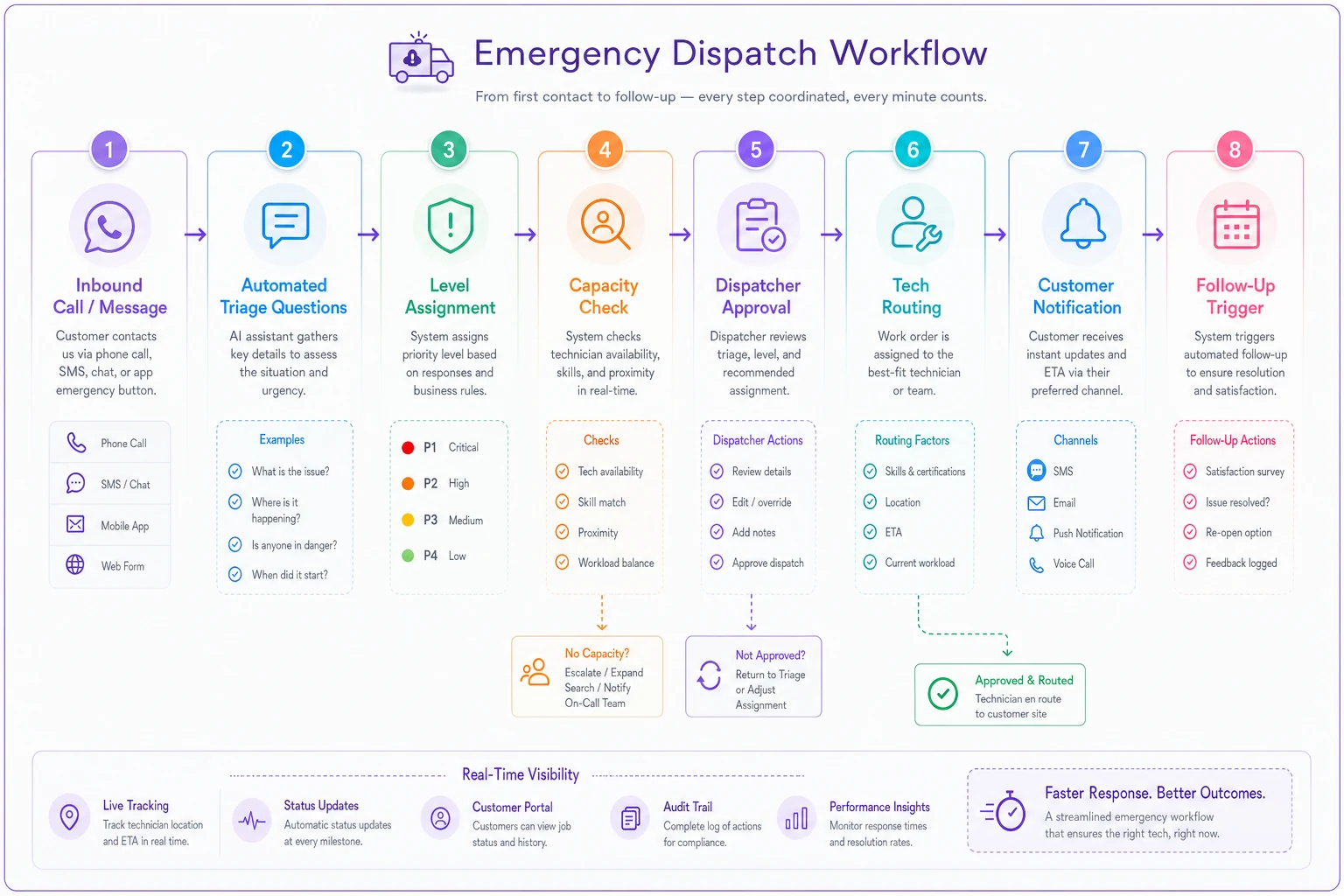
AI-powered dispatch platforms can predict emergency patterns with far greater accuracy than manual historical averaging. Instead of maintaining a flat 20% reserve capacity, the system dynamically adjusts based on weather forecasts, equipment age data, historical failure patterns, and local demand signals that would take a human hours to correlate.
The triage process benefits from conversational automation that handles initial emergency classification. When customers call or message, the system asks diagnostic questions, captures photos if needed, and assigns the appropriate triage level before human dispatchers get involved. This removes the emotional negotiation from emergency classification while speeding up response.
Automated scheduling optimization continuously rebalances routes as emergencies arrive. Instead of dispatchers manually calling techs to figure out who can respond, the system instantly calculates impact scenarios — showing exactly which scheduled jobs could move, what the customer impact would be, and the financial implications of each option. The dispatcher just approves the recommended action.
Smart capacity management prevents the erosion of emergency reserves. When someone tries to schedule into reserved capacity blocks, the system requires override authorization and documents the business justification. It also tracks who overrides reserves most often and whether those decisions proved correct over time — which is useful data when you're trying to figure out whether a pattern is a people problem or a policy problem.
Real-time communication automation keeps everyone informed without manual updates. When an emergency job runs long, affected customers automatically receive updates. When a tech finishes early, the system checks if any bumped customers want their original slot back.
Performance tracking becomes continuous instead of monthly. AI-assisted operational platforms identify pattern shifts as they happen — like emergency calls increasingly coming from a specific equipment model or neighborhood. They surface insights that might otherwise get missed, like a correlation between specific dispatchers and emergency escalation frequency.
The integration also eliminates the information gaps that plague manual emergency response. Customer history, equipment details, parts availability, tech certifications, and contract terms all factor into emergency dispatch decisions without someone checking six different systems. The dispatcher sees one clear recommendation with the relevant context already pulled together.
Predictive analytics help prevent emergencies before they happen. By analyzing equipment age, service history, and failure patterns, the system identifies customers likely to experience issues soon. Proactive outreach for preventive maintenance reduces emergency volume while improving customer satisfaction — which is about as close to a win-win as you'll find in field service operations.
Emergency response doesn't have to destroy your planned operations. The companies struggling with same-day emergencies aren't failing because emergencies are unpredictable — they're failing because they treat each one like a unique crisis instead of a standard operational pattern.
A clear triage rubric eliminates negotiation and inconsistency. Reserved capacity rules protect planned work while maintaining flexibility. Specific dispatcher scripts manage customer expectations without leaving room for confusion. Predetermined rollback plans prevent panic when multiple emergencies hit simultaneously. Proper system integration ensures information flows where it needs to go. Regular measurement keeps the whole thing improving over time.
The field service companies handling emergencies well aren't just responding faster. They've built emergency response into their operational DNA. Their dispatchers don't panic when the phone rings at 2pm with an emergency. Their techs don't constantly get rerouted. Their scheduled customers rarely get bumped. Their emergency customers receive predictable, professional service at premium prices that reflect the value actually being delivered.
Start with the triage rubric. That alone will cut emergency-related chaos significantly. Add reserve capacity rules next. Within 90 days, you'll wonder how you ever operated without a structured same-day emergency dispatch policy.
The goal isn't perfection. It's turning emergency response from your biggest operational headache into a profitable, predictable service line that builds your reputation instead of wrecking your schedule.
Ready to optimize your field operations?
Join 2,000+ service teams using Romrly to boost productivity, reduce downtime, and enhance customer satisfaction.