



On September 29, 2026, the Conference Board reported that consumer confidence fell to 81.9, down 6.7 points and the lowest reading since 2014. Reuters called it a more-than-12-year low, driven by anxiety about prices, jobs, and where things are headed.
For anyone running a service business, that number doesn't hit your P&L on September 29. It hits in waves — usually 3 to 8 weeks out — as homeowners and facility managers quietly push the "nice to have" jobs down the calendar. The HVAC tune-up that was "sure, book me for October" becomes "let me call you after the holidays." The commercial client on a quarterly PM cadence stretches it to semi-annual.
This article isn't about the headline. It's about the operational cleanup that confidence drops force — specifically, how you rebalance capacity, crew mix, and short-horizon pricing before the slowdown eats your margins instead of just your revenue.
What Actually Changes in the Field (and What Doesn't)
The mistake most owners make when demand softens is treating it like a uniform decline. It isn't. Different job types erode at completely different rates, and if you cut capacity evenly across all of them, you'll end up overstaffed on work that's holding steady and understaffed on work that briefly spikes.
-
Deferred/discretionary work falls fast. Upgrades, cosmetic repairs, "while you're here" add-ons, non-urgent replacements. This is where the 15–30% hit usually lands.
-
Break-fix stays flat or rises. When people stop doing preventive maintenance, things break more. Emergency call volume often grows 2–4 months into a slowdown.
-
Contract/SLA work is sticky but renegotiated. Clients rarely cancel outright. They ask for scope reductions, longer intervals, or lower-tier coverage.
That last point matters because it changes your revenue mix without changing your headcount needs much. You keep the account, you keep the obligation to respond, but the per-account revenue drops 10–20%. Your fixed cost to serve them barely moves.
So the real problem a confidence drop exposes isn't "fewer jobs." It's capacity that was sized for the old demand curve and priced for the old willingness to pay. Both assumptions just broke at the same time.
The Two-Variable Trap
Most field-service businesses carry two expensive commitments that are hard to flex quickly:
Eliminate field service chaos with Romrly.
Romrly helps you assign, track, and complete service jobs efficiently and on time.
- Unified job scheduling
- Technician dispatch & tracking
- Customer notifications & updates
No credit card required
-
Owned crew labor — salaried or guaranteed-hours technicians you can't cheaply scale down.
-
Standing route and territory assumptions — schedules built around a job density that no longer exists.
When demand was strong, both of these were fine. Trucks were full, routes were tight, and the fixed cost of a tech got spread across 6–8 billable jobs a day. The moment that drops to 4–5, your cost-per-job quietly climbs 25–40% even though you haven't changed a single thing about how you operate.
A typical example: a regional plumbing and drain company running 9 trucks. In a normal quarter, each truck averages around 6 completed jobs a day at roughly $240 average ticket. During a confidence-driven pullback, completions slide to about 4.5 per truck and the average ticket softens to around $205 as customers decline add-on work. That's not a rounding error — that's the difference between a truck making money and a truck being a liability that just happens to have a logo on it.
The trap is responding to this by discounting to fill the schedule. Cutting price to chase volume in a low-confidence environment is how healthy businesses turn a revenue problem into a margin death spiral. You end up busier and less profitable.
Rebalancing Crew Mix Before You Rebalance Headcount
The first lever — and the one owners reach for too slowly — is the ratio of owned labor to subcontracted or variable labor.
| Demand Signal | Owned Crew Target | Subcontractor Flex | Why |
|---|---|---|---|
| Strong, predictable | 75–85% | 15–25% | Protect quality, maximize utilization |
| Softening / volatile | 60–70% | 30–40% | Shift fixed cost to variable, protect cash |
| Sharp contraction | 50–60% | 40–50% | Preserve core team, flex everything else |
The point isn't to hit an exact number. It's to recognize that demand volatility should move this ratio deliberately, not accidentally. Too many businesses only adjust crew mix reactively — hiring in panic when it's busy and laying off in panic when it's slow. Both are expensive.
Build a small pool of trusted subcontractors before you need them so you can flex quickly without scrambling.
The better move during a confidence drop is to pause subcontractor volume first, pull that work back in-house to protect your owned crew's utilization, and preserve your core team's hours. You're using your variable layer as a shock absorber. It only works if you built that layer before you needed it — which is why this is a planning problem, not a crisis problem.
When pulling work in-house makes sense
-
Your owned techs are dropping below roughly 5 jobs/day
-
The subcontracted work is within your core crew's skill set
-
The margin you were paying the sub is now worth capturing internally
When it doesn't
-
The subbed work is specialized (you'll lose quality or speed)
-
Your owned crew is already near capacity on higher-margin jobs
-
The geographic spread makes in-housing it inefficient
The better move during a confidence drop is to pause subcontractor volume first, pull that work back in-house to protect your owned crew's utilization, and preserve your core team's hours. You're using your variable layer as a shock absorber. It only works if you built that layer before you needed it — which is why this is a planning problem, not a crisis problem.
Short-Horizon Pricing Without Racing to the Bottom
Price sensitivity rises in a confidence drop, but that doesn't mean across-the-board discounting. It means getting surgical about where you hold price and where you create flexibility.
-
Off-peak scheduling incentives — a modest discount (5–10%) for jobs booked into your dead Tuesday/Wednesday midday slots. This fills idle capacity without touching peak-hour pricing.
-
Deferred-maintenance recovery offers — targeted outreach to customers who skipped a PM cycle, with a small bundled rate. You're converting a lost renewal into some revenue.
-
Multi-job bundling — rather than discounting one visit, incentivize combining deferred work into a single trip, which also protects your route density.
The underlying logic: you're not cheaper, you're more flexible about when and how customers spend. That protects your average ticket while still giving price-sensitive customers a reason to say yes now.
A real scenario worth walking through: a mid-size HVAC company facing a soft fall season was staring at roughly 20% fewer maintenance bookings. Instead of cutting their tune-up price, they ran an off-peak fill program for Monday–Wednesday mornings and reached out to about 400 lapsed PM customers. Over roughly six weeks, they recovered close to half of the lost booking volume at near-full margin, and truck utilization climbed back from the low 60s into the mid-70s. Revenue didn't fully recover — but the margin per booked hour held, which was the actual goal.
The underlying logic: you're not cheaper, you're more flexible about when and how customers spend. That protects your average ticket while still giving price-sensitive customers a reason to say yes now.
The Scheduling Problem Nobody Wants to Admit
This is where a lot of it quietly falls apart: your schedule was built for volume you no longer have, and nobody's redrawing it.
-
Techs finishing early with no fill-in work queued
-
Routes zig-zagging because you're no longer dense enough to cluster by geography
-
Dispatchers protecting "just in case" buffers that made sense at high volume and now just create idle time
-
No-show rates creeping up as deferred-mindset customers cancel more, leaving holes nobody backfills
The fix is partly discipline and partly having a capacity model that actually reflects current demand instead of last year's. You need to know — by territory, by job type, by day — what your real expected volume is, so you can size crews and routes to it week over week rather than quarter over quarter. That short-horizon forecasting is exactly the muscle most businesses haven't built, because in good times they never had to.
If you want a deeper framework for this, we laid out how to build the demand profiles, crew-mix rules, and surge-planning logic in our guide to building an operator-facing capacity system. The same system that helps you manage surges protects you in a downturn — it's the same math pointed in the opposite direction.
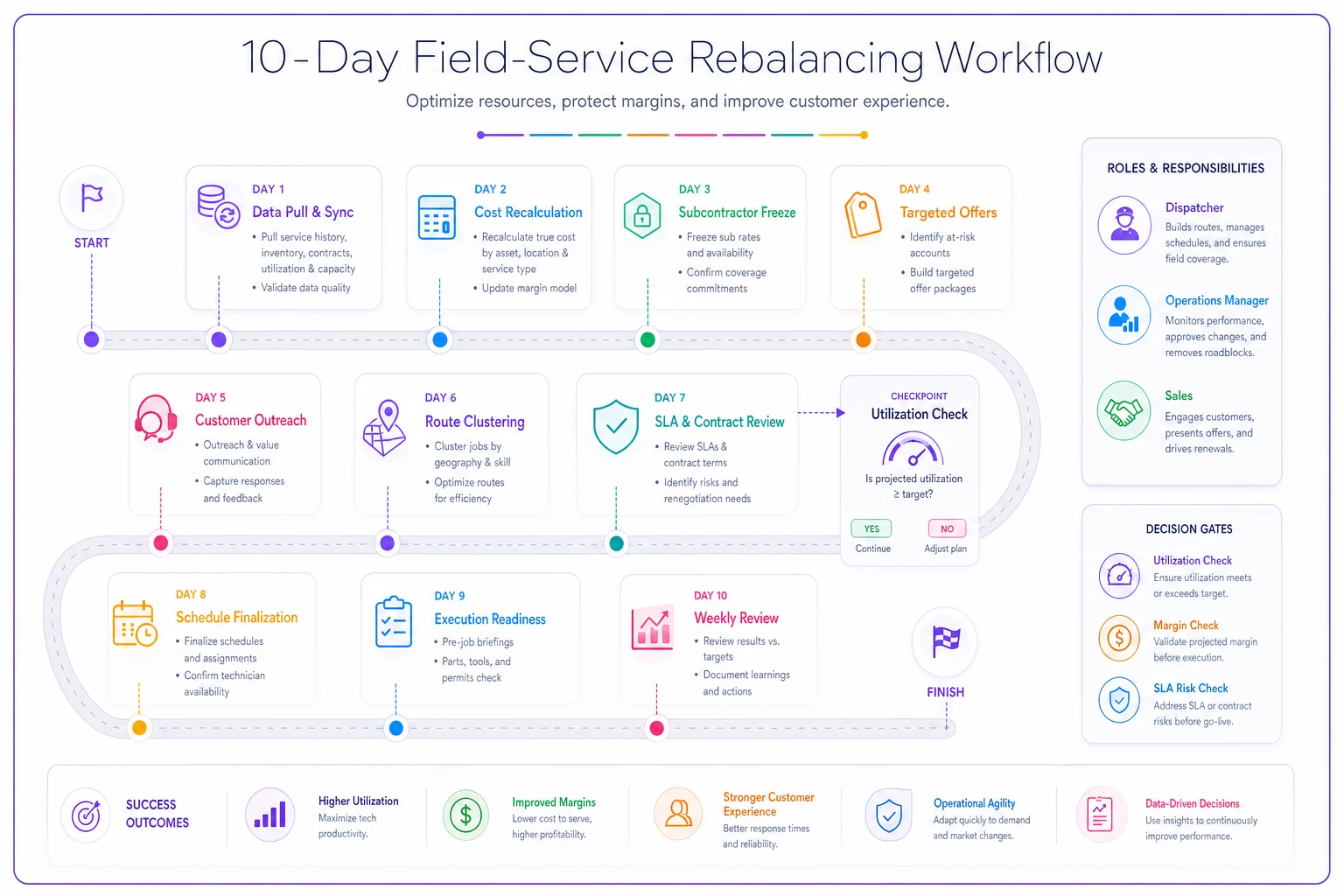
A Practical 10-Day Rebalancing Checklist
If you're feeling the softening now, here's where to focus first:
-
[ ] Pull your last 60 days of completions by job type and flag which categories are falling vs. holding
-
[ ] Recalculate cost-per-job at your current daily completion rate, not your historical one
-
[ ] Freeze or reduce subcontractor volume; reabsorb in-house work to protect owned-crew utilization
-
[ ] Identify your lowest-utilization days/windows and build 1–2 targeted fill offers
-
[ ] Build a lapsed-customer list (skipped PMs, deferred jobs) for direct recovery outreach
-
[ ] Tighten route clustering now that density is lower — stop running yesterday's routes
-
[ ] Review SLA/contract accounts for scope-reduction requests before they churn entirely
-
[ ] Set a weekly (not quarterly) capacity review while volatility is high
-
[ ] Hold standard pricing; create flexibility through timing and bundling, not discounts
-
[ ] Track no-show rate separately — it's an early warning sign of deepening softness
You won't do all ten perfectly. The point is to move faster than your competitors, most of whom will spend the next two months hoping it blows over.
Here's a quick visual to think through the 10-day process and who owns each step.
You won't do all ten perfectly. The point is to move faster than your competitors, most of whom will spend the next two months hoping it blows over.
Who Should NOT Overreact
Not every business should go into contraction mode on one data point. If your work is heavily non-discretionary — emergency repair, regulated compliance maintenance, essential infrastructure — your demand is far more insulated, and slashing capacity could leave you unable to respond when break-fix volume rises. Overcorrecting is its own expensive mistake.
Similarly, if you've got a strong backlog and locked contracts carrying you through the next quarter, this is a moment to prepare your flex levers, not pull them. Build the subcontractor relationships, clean up your capacity model, tighten your scheduling discipline — so that if the softening deepens, you're adjusting from a position of readiness rather than panic.
The Real Lesson Underneath the Number
A confidence drop doesn't create new operational problems. It exposes the ones you were already carrying — capacity sized by habit, routes nobody re-optimized since things were busy, pricing that assumed customers would always say yes to the add-on. Strong demand hides all of that. Weak demand makes you pay for it.
The businesses that come through these cycles with their margins intact aren't the ones who cut hardest or discounted deepest. They're the ones who could see their real cost-per-job within a week, flex their crew mix without gutting their core team, and adjust their schedule to the demand they actually have — not the demand they wish they had. That ability to rebalance quickly is worth building now, while you still have time to do it calmly.
The businesses that come through these cycles with their margins intact aren't the ones who cut hardest or discounted deepest. They're the ones who could see their real cost-per-job within a week, flex their crew mix without gutting their core team, and adjust their schedule to the demand they actually have — not the demand they wish they had. That ability to rebalance quickly is worth building now, while you still have time to do it calmly.
Ready to optimize your field operations?
Join 2,000+ service teams using Romrly to boost productivity, reduce downtime, and enhance customer satisfaction.