


Your service van rolls up to a commercial HVAC repair. The tech opens the back doors and stares at shelves packed with capacitors, contactors, filters, and control boards. Half this stuff hasn't moved in months. The other half? Gone when you actually need it.
Parts forecasting in field service is broken because most managers treat every SKU the same way. You're either overstocked on everything — cash tied up in inventory that expires on the shelf — or understocked on critical items, leaving techs making multiple trips and customers waiting days for repairs.
The real problem isn't that parts forecasting is complicated. It's that nobody teaches you to segment inventory based on actual operational impact. A contactor that'll shut down a customer's entire operation needs completely different rules than a decorative panel cover that can wait a week.
Three tiers that actually match field operations
Most field service businesses carry somewhere between 200 and 800 unique SKUs across trucks and warehouse space. Managing all of them with the same forecasting rules is like using the same wrench for every bolt — technically possible, but you're going to strip threads.
The pattern is consistent across different service operations. There are three distinct categories of parts, and each needs its own forecasting approach:
Critical parts keep customers operational. When these fail, businesses lose money by the hour. Compressors for refrigeration, main control boards for manufacturing equipment, pump motors for irrigation systems. Stock-outs here mean emergency overnight shipping, rental equipment costs, and sometimes contract penalties. You typically have 30–50 of these SKUs — maybe 15% of your total inventory count but closer to 40% of parts revenue.
Tactical parts affect comfort or convenience but not core operations. Thermostats, fan belts, minor sensors, cosmetic panels. Customers notice when these break, but they can usually wait 2–3 days. This middle tier usually covers 100–200 SKUs, around 30% of your items.
Expendable parts are the nice-to-haves. Replacement knobs, non-essential indicator lights, spare mounting brackets. Customers might not even notice these are broken until you point them out. These make up the bulk of your SKU count — often 50–60% of items — but generate minimal revenue and even less urgency.
The mistake that keeps showing up? Managers either treat everything as critical (tying up $30k–$50k in unnecessary inventory) or they wing it on gut feel and end up with techs driving back to the warehouse three times a week.
Reorder point calculations that work in the real world
Forget the complex economic order quantity formulas from business school. Field service parts forecasting needs something you can actually calculate on a spreadsheet during lunch. Here's what works:
Eliminate field service chaos with Romrly.
Romrly helps you assign, track, and complete service jobs efficiently and on time.
- Unified job scheduling
- Technician dispatch & tracking
- Customer notifications & updates
No credit card required
Critical Parts ROP Formula
ROP = (Average Daily Usage × Lead Time) + (Safety Stock Days × Average Daily Usage)
For critical parts, your safety stock should equal your maximum expected lead time. If a compressor typically arrives in 5 days but sometimes takes 8, your safety stock is 8 days of average usage.
Real example: You use roughly 3 capacitors per week for a specific HVAC model. Supplier delivers in 4 days.
-
Average daily usage
3/5 = 0.6 units
-
Lead time
4 days
-
Safety stock
8 days (double lead time for critical items)
-
ROP = (0.6 × 4) + (8 × 0.6) = 2.4 + 4.8 = 7.2, round up to 8 units
When inventory hits 8 capacitors, reorder.
Tactical Parts ROP Formula
Same formula, but safety stock equals 50% of lead time.
Real example: Door sensors for commercial overhead doors. About 2 installs per week, supplier delivers in 6 days.
-
Average daily usage
2/5 = 0.4 units
-
Lead time
6 days
-
Safety stock
3 days
-
ROP = (0.4 × 6) + (3 × 0.4) = 2.4 + 1.2 = 3.6, round to 4 units
Expendable Parts ROP Formula
For expendable items, skip the safety stock entirely. Order when you hit lead time usage.
Real example: Decorative thermostat covers. Maybe 1 per month gets damaged. Supplier delivers in 5 days.
-
Average daily usage
1/20 = 0.05 units
-
Lead time
5 days
-
ROP = 0.05 × 5 = 0.25, which means order when you're down to your last one
A simple workflow for calculating ROPs looks like this.
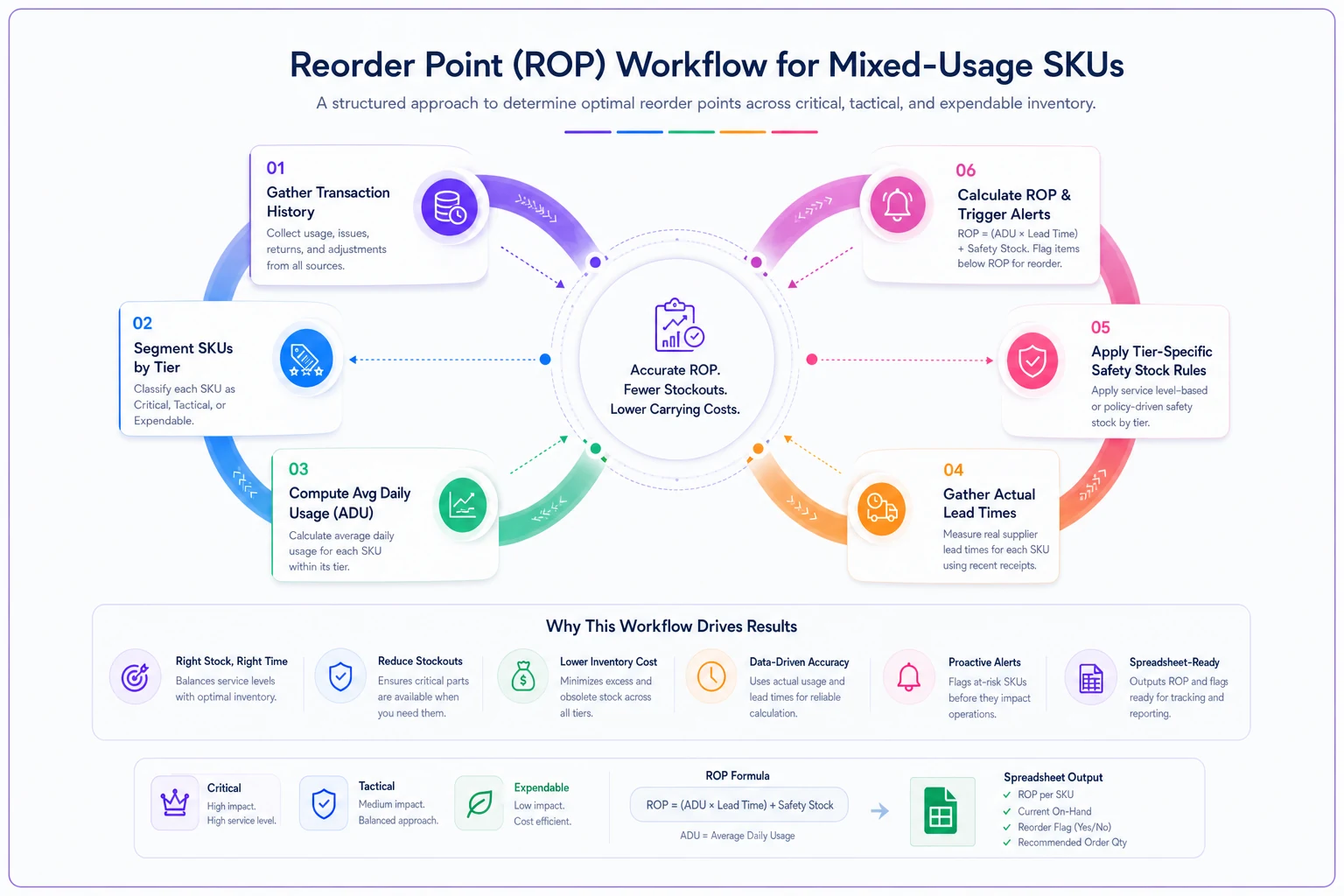
Use the workflow above on a spreadsheet to turn the formulas into reorder triggers.
Mixed-usage patterns kill standard forecasting models
This is where field service parts forecasting gets genuinely messy. Unlike retail or manufacturing, your usage patterns swing wildly based on season, service contract schedules, and random equipment failures.
A single apartment complex HVAC failure might burn through 20 capacitors in a week — your normal monthly usage. Then nothing for six weeks. Standard reorder points assume steady consumption, but field service demand looks more like an EKG readout than a straight line.
The practical fix is tracking usage patterns by customer type, not just overall averages. Commercial customers typically generate predictable, maintenance-driven demand. Residential emergency calls create spikes. Municipal contracts follow seasonal patterns.
Build separate usage calculations for each customer segment:
-
Contract maintenance accounts
steady, predictable
-
Emergency repair customers
sporadic, high-volume
-
Seasonal accounts (pools, irrigation)
concentrated demand windows
Your actual ROP becomes the highest value across all segments. That's what prevents stockouts when your apartment complex customer has their annual HVAC meltdown.
Lead time reality versus supplier promises
Suppliers say 3–5 business days. Reality is more like 4–8 days once you factor in purchase order processing, shipping delays, and receiving. Most forecasting models fail because they use catalog lead times instead of actual performance data.
Track real lead times for six months. A simple table works:
| Supplier | Promised Days | Actual Average | Worst Case | Items Affected |
|---|---|---|---|---|
| HVAC Direct | 3-5 | 6.2 | 11 | Capacitors, contactors |
| Controls Plus | 2-3 | 4.1 | 7 | Thermostats, sensors |
| Generic Parts Co | 5-7 | 8.3 | 14 | Filters, belts |
Use the actual average for standard ROP calculations. For critical parts, consider using the worst-case number during peak season.
The other lead time problem that doesn't get talked about enough: minimum order quantities. Your ROP might say order 5 units, but the supplier requires 25. Now you're either overstocked or combining orders across multiple SKUs, which shifts your entire reorder timeline.
Quarterly review cadence for real operations
Static reorder points assume your business never changes. But every quarter brings shifts — new service contracts, lost customers, seasonal demand swings, different equipment in your territory.
Set up quarterly reviews that take 2–3 hours max. Don't try to analyze all 500 SKUs — that's how reviews turn into annual events that never actually happen.
Quarter 1 (January): Review only critical tier parts. Adjust safety stock based on the previous year's emergency orders. If you had to overnight ship parts more than twice for any SKU, bump the safety stock up.
Quarter 2 (April): Seasonal adjustments. HVAC parts need higher stock going into summer. Pool equipment ramps up. Heating components can drop to minimum levels.
Quarter 3 (July): Dig into the tactical tier. These parts often drift between categories — what was tactical might now be critical if you've added new service contracts. Check whether any expendable items are suddenly moving more frequently.
Quarter 4 (October): Full tier reassignment. Parts you classified as critical a year ago might now be obsolete. New equipment in your territory means new parts to classify. This is also when you purge dead inventory — anything expendable that hasn't moved in 12 months probably won't.
During each review, update three things:
-
Average daily usage (based on last 90 days)
-
Actual lead times (track your last 10 orders)
-
Tier assignment (critical/tactical/expendable)
The businesses that nail parts forecasting don't have complex systems — they have consistent review rhythms. A spreadsheet updated quarterly beats sophisticated software that nobody maintains.
Worked examples across different service types
HVAC Service Company
You service 200 commercial properties with preventive maintenance contracts plus emergency calls.
Critical part example: 5-ton compressor
-
Usage
2 per month across all properties
-
Lead time
7 days typical, 12 days worst case
-
Daily usage
2/20 = 0.1 units
-
ROP = (0.1 × 7) + (12 × 0.1) = 0.7 + 1.2 = 1.9, round to 2 units
Tactical part example: Thermostat displays
-
Usage
8 per month
-
Lead time
4 days
-
Daily usage
8/20 = 0.4 units
-
ROP = (0.4 × 4) + (2 × 0.4) = 1.6 + 0.8 = 2.4, round to 3 units
Commercial Kitchen Equipment Service
You maintain equipment for 75 restaurants and institutional kitchens.
Critical part example: Fryer temperature controllers
-
Usage
3 per week (restaurants can't operate without fryers)
-
Lead time
5 days typical
-
Daily usage
3/5 = 0.6 units
-
Safety stock
10 days (double lead time for critical)
-
ROP = (0.6 × 5) + (10 × 0.6) = 3 + 6 = 9 units
Expendable part example: Oven light bulbs
-
Usage
5 per month
-
Lead time
3 days
-
Daily usage
5/20 = 0.25 units
-
ROP = 0.25 × 3 = 0.75, round to 1 unit
Generator Service Business
You service backup generators for hospitals, data centers, and commercial buildings.
Critical part example: Automatic transfer switches
-
Usage
1 every two weeks (failure means no backup power)
-
Lead time
10 days typical, 18 days worst case
-
Daily usage
0.5/5 = 0.1 units
-
ROP = (0.1 × 10) + (18 × 0.1) = 1 + 1.8 = 2.8, round to 3 units
Notice how the generator business keeps higher safety stock even with lower usage. When a hospital's backup power fails, you can't tell them to wait a week for parts.
Common forecasting mistakes that drain cash flow
These mistakes show up in different forms but create the same problems: cash buried in dead stock while techs can't find the parts they actually need.
Averaging everything together destroys forecast accuracy. You've got one customer who orders monthly maintenance, another who calls only for emergencies. Blending their usage patterns gives you a number that's wrong for both. Track patterns by customer type, then use the highest demand pattern for safety.
Treating all suppliers equally ignores reality. Your primary vendor might be rock solid on delivery, but that secondary supplier you use for specialty items? Maybe they're running a two-person operation that goes dark whenever someone gets sick. Build different safety buffers based on supplier reliability.
Ignoring expiration dates on electronic components and refrigerants turns inventory into waste. That $2,000 circuit board might have a two-year shelf life. If you're using one every 18 months, buying three for "safety stock" means writing off $2,000 when the third one expires.
Forecasting without considering tech behavior misses a huge variable. Some technicians grab extra parts on every call just in case. Others run lean and call for parts delivery mid-job. Your model might be perfect, but if half your techs are hoarding inventory in their vans, warehouse numbers won't match reality.
Building forecast accuracy without complex software
You don't need enterprise resource planning systems to get parts forecasting right. A spreadsheet with actual discipline beats expensive software that nobody updates.
Start with transaction history. Pull your last 6 months of parts usage from whatever system you're currently using — even if that means digging through purchase orders and service tickets. Group by SKU and count monthly usage. That's your baseline.
Add context columns that generic inventory software tends to miss:
-
Customer type that used the part (contract, emergency, residential, commercial)
-
Season when used (critical for HVAC, pool, irrigation services)
-
Tech who installed it (helps identify hoarding patterns)
-
Associated equipment model (helps predict future demand based on equipment population)
The spreadsheet doesn't need to be pretty. It needs three core functions:
-
Calculate current ROP based on your formulas
-
Flag when inventory drops below ROP
-
Track actual versus promised lead times
Update usage weekly (delegate to whoever handles purchase orders), update lead times monthly, do the full review quarterly.
For businesses running 15–30 techs, this manual approach often works better than automated systems because you catch context that algorithms miss. You know that apartment complex just signed for monthly maintenance, which means capacitor usage is about to spike. Software just sees historical averages.
When to break your own rules
Rigid adherence to reorder points creates its own problems. Sometimes you need to override the model.
Bulk purchase opportunities might justify overstocking. If your supplier offers 40% off for ordering 100 units of something you use 5 per month, the carrying cost math might work — but only for parts with no expiration date and stable demand.
End-of-life equipment in your service territory changes everything. You're servicing 30-year-old chillers that the manufacturer discontinued. When you find compatible parts, you buy whatever's available, regardless of reorder points. The alternative is telling customers their equipment can't be fixed.
Seasonal predictability overrides quarterly averages. Pool service companies know May is coming. HVAC companies know about July. Don't wait for your reorder point during the slow season when demand is about to multiply.
New contract wins require immediate adjustment. You just landed a 50-location retail chain for quarterly maintenance. Your historical usage data is now effectively useless. Build new forecasts based on equipment counts at each location, not last quarter's numbers.
Connecting parts forecasting to dispatch efficiency
Poor parts forecasting creates hidden dispatch problems. When techs can't complete jobs due to missing parts, the whole schedule breaks down. That dispatcher shift handover template you built becomes worthless when half the jobs carry over because parts weren't available.
Track "parts-delayed" jobs as a separate metric. If more than 10% of your service calls get delayed for parts, your forecasting model needs adjustment. But dig deeper — which tier of parts is causing the delays? Usually it's tactical parts, where managers got aggressive with inventory reduction.
The connection between parts availability and operational efficiency goes beyond individual jobs. When techs aren't confident parts will be there, behavior changes:
-
Over-ordering to create personal buffer stock
-
Calling dispatchers repeatedly to check inventory before accepting jobs
-
Cherry-picking calls they know they can complete
Good parts forecasting eliminates those trust issues. Techs show up knowing the parts exist. Dispatchers assign jobs without inventory anxiety. The whole operation runs smoother.
Making the quarterly review actually happen
Everyone plans to review inventory quarterly. Almost nobody does. The review gets pushed because something more urgent always comes up. Three years later, you're still using reorder points from when you had half the customers and a different equipment mix.
Block 3 hours on the calendar for the second Tuesday of each quarter. Not the first week — everyone's catching up from month-end. Not the last week — everyone's preparing for quarter close. The second Tuesday is boring enough that it'll actually happen.
Make it a working session, not a meeting. One person owns the spreadsheet and makes updates live. If you built that modular operations playbook, this review becomes one of your documented SOPs.
Assign specific review responsibilities:
-
Service manager
Reviews critical tier, adjusts based on customer feedback
-
Lead technician
Validates usage patterns, identifies hoarding
-
Purchasing coordinator
Updates actual lead times, supplier reliability
The review produces four deliverables:
-
Updated ROP calculations for each tier
-
List of SKUs to move between tiers
-
Dead stock to liquidate
-
New parts to add based on equipment changes
Post the updated reorder points somewhere purchasing and warehouse staff actually see them daily. The best model means nothing if nobody follows it.
Transitioning from reactive to predictive operations
Most field service businesses run in permanent crisis mode. Parts shortages drive emergency orders. Overstocking drains cash. The cycle continues because nobody stops long enough to build a real system.
The tiered approach with simple ROP calculations isn't revolutionary. It's operational discipline applied to a chronic problem. But the impact tends to be real:
-
First-time fix rates climb 15–20% when techs have the right parts
-
Emergency shipping costs drop significantly with proper safety stock in place
-
Cash tied up in inventory decreases when you right-size expendable parts
-
Tech productivity improves when they stop driving back to the warehouse mid-job
Modern AI-powered operational platforms can now handle demand sensing in ways that are genuinely hard to replicate manually. These tools track usage across all your customers, surface seasonal trends automatically, and can even flag potential failures based on equipment age and service history — so instead of waiting for quarterly reviews, reorder points adjust based on real usage patterns.
But even with that kind of automation doing the heavy lifting on calculations, the strategic framework still needs to come from you. The system needs to know which parts are critical versus expendable. It needs your business rules about safety stock. It needs to understand customer priorities. AI handles the pattern recognition; you handle the judgment calls.
The businesses that run clean inventory operations tend to combine both — use the tiered framework to set strategy, let the software handle the number-crunching, and save your human attention for exceptions and edge cases.
Start with your top 50 SKUs
Don't try to overhaul your entire parts operation at once. Pick your 50 highest-volume SKUs and apply the tiered model. Classify each as critical, tactical, or expendable. Calculate reorder points using the formulas above. Track results for one quarter.
That focused approach proves the model works without overwhelming your team. Once stockouts disappear on critical parts and cash frees up from reduced expendable inventory, expanding to the full SKU list becomes an obvious next step instead of a daunting one.
The path from chaos to control in parts forecasting isn't complicated. It just requires picking a system and sticking with it long enough to see results. Whether you're using spreadsheets or an AI-assisted operational platform, the core principle doesn't change: different parts need different rules based on their operational impact.
Stop treating every SKU the same. Stop using gut feel for reorder points. Stop letting parts availability randomly disrupt service delivery. Your techs are counting on parts being available. Your customers are counting on first-time fixes. Your business is counting on cash not being buried in dead inventory.
The framework is here. The formulas work. Make it a system instead of a recurring crisis.
Ready to optimize your field operations?
Join 2,000+ service teams using Romrly to boost productivity, reduce downtime, and enhance customer satisfaction.