

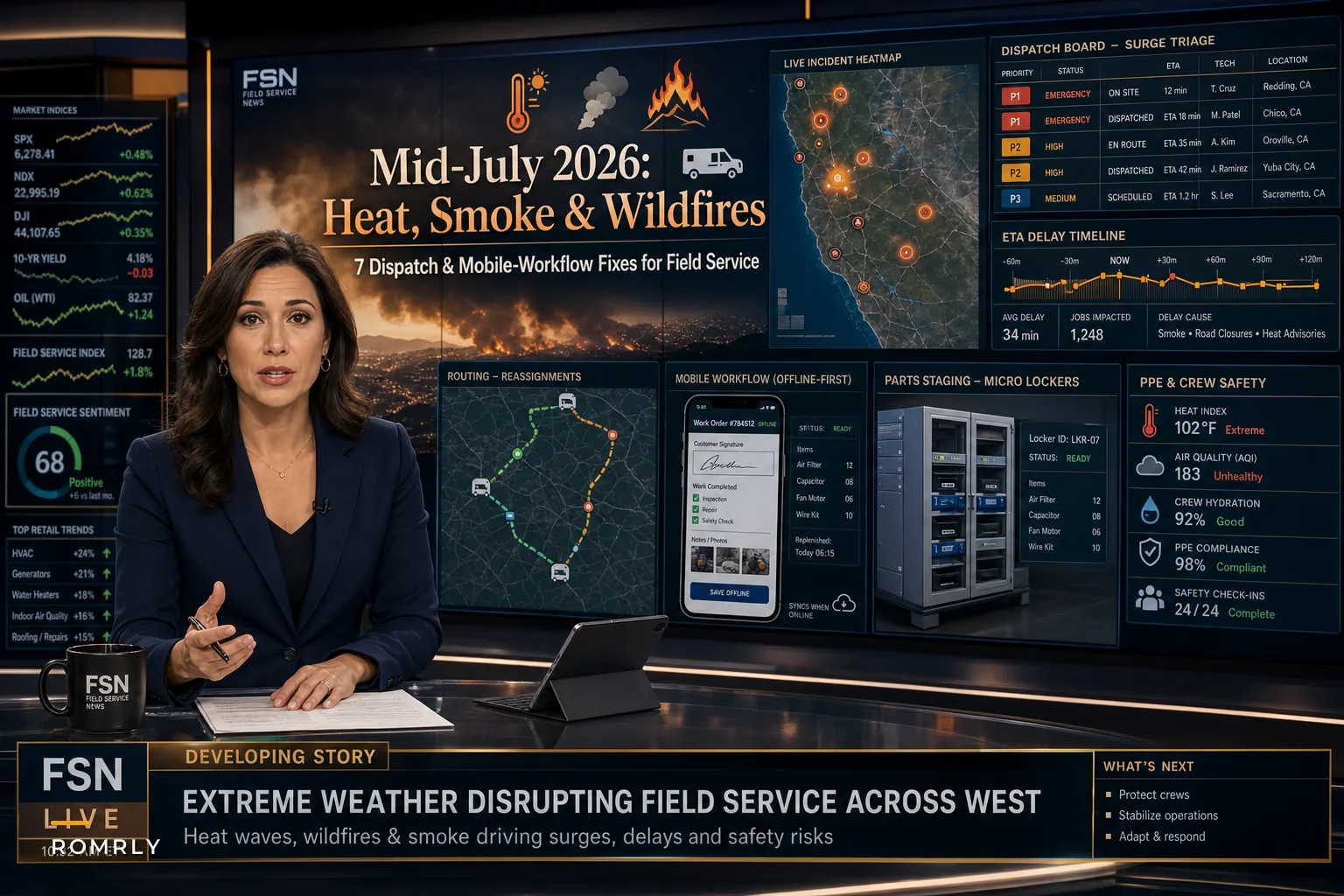

Right now, across multiple states, field service teams are dealing with a brutal combination: heat warnings that shut down outdoor work by 11am, wildfire smoke pushing air quality into hazardous territory, and flash flooding from random storm cells. Reuters reported this week that the simultaneous threats are creating real operational chaos for businesses running outdoor crews. CNN covered the heat wave hitting the mid-Atlantic and Northeast, and CalMatters documented how the Dove Fire exploded during peak heat in California—both situations where field service operations had almost no warning before conditions turned dangerous.
This isn't a bad weather day. This is entire regions where your techs can't safely work normal hours, travel times double from road closures, and emergency calls spike right as your capacity drops.
For field service managers, extreme weather disruptions create an immediate operational crisis: SLAs still need to be met, but half your workforce needs restricted hours, your normal routes don't work, and the dispatch rules you built for normal conditions are suddenly dangerous to follow.
The real problem runs deeper than shuffling a few schedules. When sustained extreme weather hits, every operational assumption breaks at once. Eight-hour tech shifts become five-hour windows. Your 45-minute drive times balloon to two hours. Parts deliveries get delayed. Mobile apps lose connectivity in smoke-affected areas. Meanwhile, HVAC emergency calls triple, electrical failures spike, and every customer wants same-day service.
The cascade failure nobody plans for
Most field service operations handle occasional weather disruptions fine. A thunderstorm rolls through, you shuffle some appointments, everyone adapts. Sustained extreme weather is different—it creates compound failures that standard procedures weren't built for.
Take heat restrictions. OSHA guidelines kick in around 80°F heat index for outdoor work. Above 90°F, mandatory rest breaks every hour. Above 100°F, many insurers require stopping outdoor work entirely. Now layer wildfire smoke on top—AQI above 150 means respirators or work stoppage. Combine both and your normal 40-tech workforce might effectively shrink to 15 available techs during peak hours.
The scheduling impact alone breaks most dispatch systems. You've got techs who can only safely work 6am to 10am. Others stuck in evacuation traffic. Some dealing with power outages at home. Your dispatch board turns into chaos as automated routing fails, emergency calls flood in, and nobody's sure which rules to follow.
Meanwhile, field techs face impossible situations—checking air quality apps between jobs, making judgment calls on their own safety, dealing with customers who are angry about delays. Without clear protocols from the top, some push through unsafe conditions to hit targets. Others stop work entirely, unsure what's acceptable.
This breakdown costs more than overtime and missed SLAs. One HVAC company in Phoenix lost three experienced techs to heat exhaustion in a single week—not just the immediate medical costs, but months of recruiting and training replacements. An electrical contractor in California racked up around $47,000 in workers' comp claims after crews worked through hazardous smoke without proper equipment.
Fix #1: Dynamic capacity windows based on real‑time conditions
Forget standard 8am–5pm dispatch windows during extreme weather. You need hour-by-hour capacity adjustments tied to actual conditions.
Eliminate field service chaos with Romrly.
Romrly helps you assign, track, and complete service jobs efficiently and on time.
- Unified job scheduling
- Technician dispatch & tracking
- Customer notifications & updates
No credit card required
Build a simple matrix: temperature and AQI on one axis, job type on the other. Indoor work might continue until 105°F. Roof work stops at 95°F. Emergency repairs get different thresholds than routine maintenance. Each cell shows available capacity percentage.
This is where operational software automation genuinely changes things. Instead of dispatchers manually checking weather apps and guessing, your system pulls hourly forecasts and adjusts available slots automatically. A commercial HVAC operation outside Sacramento built this into their dispatch platform—when tomorrow's forecast shows 102°F at noon, the system blocks outdoor appointments after 11am and sends rescheduling options to affected customers that evening, not the next morning when it's too late.
Three data feeds you need connected to your dispatch software:
-
Hourly weather forecasts with location-specific data
-
Real-time air quality indices by zip code or region
-
Your internal safety threshold matrix by job type
As conditions shift, available capacity adjusts automatically. Techs see updated schedules on their phones. Customers get proactive notifications before they're sitting in a hot house wondering where their tech is.
Fix #2: Pre‑staged response teams with modified PPE
Standard tech loadouts fail in extreme conditions. You need pre-designated extreme weather response teams with specialized equipment staged and ready before the crisis hits—not pulled together on the fly when it's already 104°F outside.
These aren't your regular crews doing overtime. Select techs comfortable working in harsh conditions, properly equipped, and trained on modified procedures. Think 4–6 person teams per region, carrying cooling vests, N95 respirators, extra hydration supplies, and portable shade structures.
Approximate equipment cost per tech:
| Item | Estimated Cost |
|---|---|
| Cooling vest | ~$150 |
| Respirator set | ~$80 |
| Hydration pack | ~$50 |
| Portable canopy (crew split) | ~$200 |
| Total per tech | ~$480 |
Compare that to one heat-related injury claim averaging around $15,000, or losing experienced techs who quit after going through heat exhaustion. The math isn't close.
These teams operate under different rules too. Shorter rotations—maybe 2-hour windows instead of full shifts. Mandatory buddy systems. Required check-ins every 30 minutes. Critical repairs only, no routine maintenance.
One electrical contractor running operations across Arizona and Nevada maintains three response teams covering different zones. During extreme heat warnings, regular crews stop at predetermined thresholds while response teams handle emergencies. Their injury rates dropped around 70% after implementing the tiered approach, while still maintaining 24-hour emergency coverage.
Fix #3: Customer triage rules that actually stick
When extreme weather hits, every customer suddenly has an emergency. Your dispatch team needs clear, enforceable triage criteria that everyone understands before the crisis starts—not during it.
A four-tier classification works well in practice:
-
Life safety
Medical equipment, elderly or vulnerable residents, critical infrastructure
-
Property protection
Active water leaks, electrical hazards, security systems
-
Business continuity
Commercial refrigeration, data centers, production equipment
-
Comfort and convenience
Residential AC, hot water, routine maintenance
During normal operations, you juggle all four. During extreme weather, only tiers one and two get same-day response. Tier three gets next-day. Tier four reschedules automatically.
The key is making these rules visible and built into your intake system—not something dispatchers have to argue with customers about on the phone. When someone calls or submits a request online, the system asks specific questions: "Is anyone in the home on medical equipment?" "Is there active property damage?" Based on answers, jobs get auto-classified.
A plumbing operation in the Denver metro refined this during last summer's heat wave. Their system runs through five yes/no questions that automatically assign priority scores. Dispatchers see color-coded jobs—red for immediate, yellow for today, green for standard. Customer confirmations include the priority level and an estimated response time based on current conditions. Their complaints about delayed service dropped around 40% once expectations were set at the start of the call.
Fix #4: Mobile app modifications for degraded conditions
Your standard mobile workflow assumes decent connectivity and normal working conditions. During wildfires, techs work in areas with no cell coverage, heavy smoke cutting visibility, and evacuation zones that could activate with little warning.
Start with offline capability that actually works—not just saving form data locally, but complete job packages downloaded before techs leave the shop. Customer history, equipment manuals, parts catalogs, standard pricing—everything needed to complete a job without touching the internet. Our deep-dive into offline-first mobile workflows covers the technical architecture in detail, but extreme weather adds a few extra requirements on top of that foundation.
What your mobile interface should surface when extreme weather protocols activate:
-
Current air quality at the job location
-
Nearest cooling or clean air shelter
-
Mandatory break reminders based on conditions
-
Emergency evacuation routes for the area
Not buried in settings—front and center on every screen.
Keep a one-tap wellness check and an obvious offline sync button so techs can confirm status quickly and upload when safe.
Automated safety check-ins matter more than people want to admit. Every 30 minutes in extreme heat, the app prompts a quick wellness check. No response within 5 minutes triggers a supervisor alert. It sounds like a nuisance until it catches someone in early heat stroke.
The data sync strategy also needs rethinking. Continuous background syncing drains batteries fast in heat. Checkpoint syncing works better—techs manually trigger uploads from safe locations with good connectivity. Job data, photos, and forms cache locally until then. One commercial HVAC outfit in Riverside County modified their app this way, and techs working in fire-affected zones could complete full service calls offline, then sync everything from their trucks in safe staging areas.
Fix #5: Supply chain buffers and emergency procurement
Extreme weather doesn't just slow your field teams—it breaks supply chains. The same wildfire that restricts your techs also closes the highways your parts shipments use.
Stop running just-in-time inventory during disaster season. Build emergency buffers for components that fail constantly in extreme weather: HVAC capacitors, circuit breakers, water heater elements, pump motors. If you normally carry two weeks of stock, expand to four weeks during high-risk months.
More useful than raw inventory is pre-negotiated emergency procurement. Set up agreements with suppliers in different regions before you need them. When your primary Phoenix supplier can't deliver due to heat restrictions, your backup in Tucson or Las Vegas already knows the arrangement. You'll pay expedite fees—still cheaper than losing a commercial customer because you couldn't source a $200 part.
Track failure patterns specific to extreme conditions too. Heat waves cause different component failures than cold snaps. Wildfire smoke clogs different filters than normal dust. A pool service company across Southern California noticed pump seal failures tripled during heat waves above 105°F. They now pre-position extra seal kits in tech trucks when heat warnings go out, eliminating the second trip entirely.
Predictive ordering through operational software helps close this loop. When forecasts show extreme conditions approaching, the system automatically triggers buffer orders for weather-sensitive parts. Two days before a heat wave, extra capacitors arrive. Before fire season, respirator cartridges get stocked. Dispatchers aren't scrambling during the crisis because the inventory already moved.
Fix #6: Modified billing and customer communication
Extreme weather requires different customer conversations. Your standard "we'll be there between noon and 4pm" doesn't hold when conditions might shut down all afternoon outdoor work.
Send conditional confirmations instead of fixed windows: "Scheduled for 2pm tomorrow, pending air quality below 150 AQI. You'll receive final confirmation by 10am based on conditions." Customers handle uncertainty better when it's communicated upfront rather than in a last-minute cancellation text.
Emergency rate adjustments also need transparency. It's reasonable to charge more during extreme weather—you're paying overtime, hazard pay, and expedited parts costs. But surprise invoices destroy trust fast. Build weather surcharges into your service terms, communicate them at booking, and itemize them clearly on invoices.
One move worth considering: proactive service packages for extreme weather seasons. A commercial property management firm in Phoenix sells "Summer Resilience" contracts—priority response during heat emergencies, pre-positioned backup equipment, guaranteed response times even in extreme conditions. They charge a 30% premium and see around 85% renewal because customers genuinely value certainty during a crisis.
Customer portals need weather integration too. Let customers see how current conditions affect their service—operating status, current response times, weather-adjusted capacity. One residential HVAC company added this to their customer app and saw complaints about weather delays drop by roughly 60% once customers could see what was actually happening.
Fix #7: Post‑event recovery protocols
After extreme weather passes, the operational chaos really starts. Backed-up appointments, damaged equipment, exhausted crews, and everyone wanting immediate service at once.
Recovery isn't "back to normal." It needs its own structure. Start with crew recovery—mandatory rest periods after working extreme conditions, equipment inspection and replacement, and real conversations with teams that worked through dangerous situations.
A structured recovery sequence that works:
-
Mandatory crew rest and equipment assessment (24–48 hours post-event)
-
Triage the backlog
partially completed jobs go first
-
Clear life-safety items from the queue
-
Work through property protection jobs
-
Communicate realistic timelines to everyone else before they call you
Telling customers it'll take two weeks to clear the backlog is better than making promises you can't keep. Most customers are reasonable when you're straight with them.
Document everything for insurance and compliance. Which jobs were delayed, which crews worked modified hours, what safety equipment was deployed, which customers received emergency rates. An electrical contractor in Oregon learned this the hard way—after wildfire smoke events, they faced an OSHA investigation with no documentation of their safety modifications. They now use automated compliance tracking that records every weather-related operational change as it happens.
The improvement cycle is what separates businesses that get better from ones that just survive. After each extreme weather event, run a real debrief. What broke? Which workarounds did crews figure out on their own? Which customers complained most? These lessons compound over time if you actually capture them instead of moving on and hoping next season is easier.
Making extreme weather response systematic, not chaotic
The following diagram shows how a well-structured extreme weather response flows from early warning through field operations to recovery:
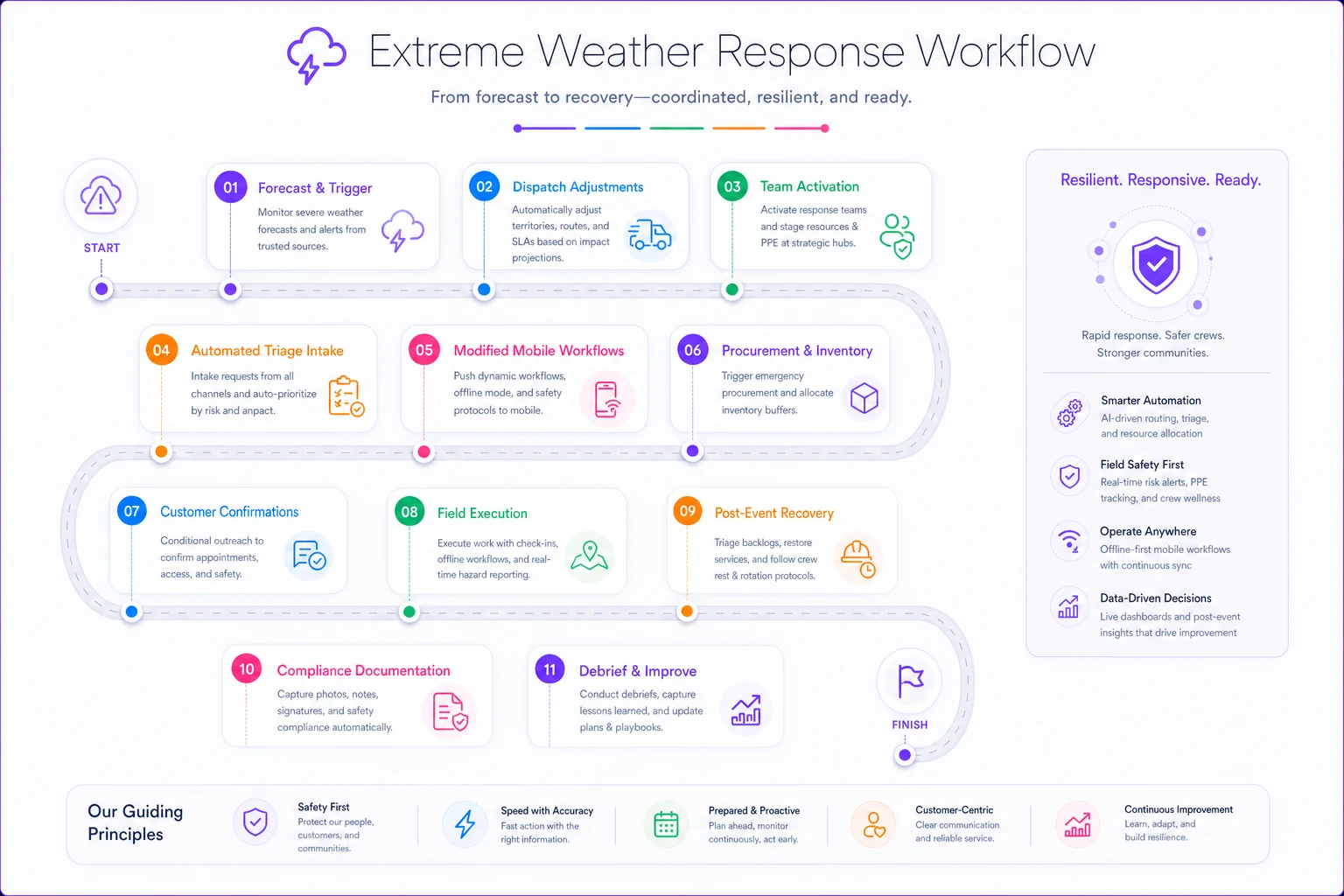
The gap between field service companies that handle extreme weather well and ones that barely survive it comes down to preparation versus reaction. That's not a complicated insight, but most operations don't actually operationalize it until something bad happens.
Operations still treating extreme weather as occasional disruptions face mounting problems: tech turnover from unsafe working conditions, customer churn from unreliable service, workers' comp claims from heat injuries, and compliance violations from poor documentation. They lose their best techs who won't keep risking their health, their best customers who find more reliable alternatives, and their margins to emergency overtime and expedited everything.
The better operators have accepted that extreme weather field service management is a permanent operational requirement, not an edge case. They build the systems, training, and tools before the crisis hits. When the next heat dome arrives or wildfire smoke blankets the region, they execute predetermined plans instead of making desperate calls in real time.
The software and automation infrastructure supporting all of this can't be an afterthought. Manual tracking of weather conditions, paper safety checklists, and verbal customer communications break down at scale. You need systems that automatically adjust capacity, track compliance, manage modified workflows, and coordinate recovery. The upfront investment pays for itself the first time you avoid a serious injury, keep a major customer through a crisis, or sidestep a compliance violation.
Extreme weather field service isn't about heroic efforts from tough crews anymore. It's about intelligent operations that protect your people while still serving customers. The companies building these capabilities now will have a real competitive advantage as extreme weather becomes more frequent—and the ones still hoping to tough it out will lose ground one crisis at a time.
Ready to optimize your field operations?
Join 2,000+ service teams using Romrly to boost productivity, reduce downtime, and enhance customer satisfaction.