



Most rollouts don't fail because the idea was wrong. They fail because the pilot looked great in a conference room and then died the moment it hit a real dispatch board on a Monday during storm season. The gap between "this works in a demo" and "this works across 40 trucks in three regions" is where most field service change management efforts quietly bleed out.
The pattern is almost always the same. A regional manager tests something with two hand-picked techs who happen to be enthusiastic. Metrics look promising. Leadership greenlights the full rollout. Then it gets pushed to everyone at once, the middle-of-the-pack technicians ignore it, dispatchers revert to their old whiteboard habits under pressure, and six weeks later someone quietly stops enforcing it. Nobody officially killed the initiative. It just evaporated.
This article isn't about picking a tool. It's about the human and operational scaffolding around any change — the stakeholder maps, the comms cadence, the small training doses, and most importantly the KPI gates that tell you whether to keep going, pause, or roll back before you've burned trust across the whole organization.
Why pilots lie to you
The core problem with pilots is selection bias, and almost nobody accounts for it.
When you run a pilot with volunteers, you're testing the new process against your most motivated people in your calmest conditions. That's not a test — it's a highlight reel. The technicians who volunteer are usually the ones who'd make almost any process work through sheer effort. Your real risk lives in the middle 60% and the bottom 20%, and those people aren't in your pilot.
A second issue: pilots get babysat. During a pilot, someone from ops is watching the numbers daily, answering questions in real time, and smoothing over friction manually. That hidden support disappears at scale. So the pilot's success was partly the process and partly a person standing behind it who won't be there when you have 200 people using it.
The third thing that breaks: pilots almost never run long enough to hit a bad week. Field service is seasonal and spiky. If your pilot ran during a normal three-week stretch and never encountered a heat wave, a parts shortage, or a two-tech-out-sick Monday, you haven't actually stress-tested anything. You've tested the easy case.
So the mindset shift is this — a pilot's job is not to prove the change works. Its job is to find out where it breaks and whether those break points are survivable at scale.
Map who actually kills your rollout
Before you touch a process, map the people. Not an org chart — an influence-and-friction map. In field service, the person with the title rarely has the power to sink or save a change. The dispatcher who's been there 11 years and trains all the new hires? That person decides.
Eliminate field service chaos with Romrly.
Romrly helps you assign, track, and complete service jobs efficiently and on time.
- Unified job scheduling
- Technician dispatch & tracking
- Customer notifications & updates
No credit card required
Here's the stakeholder map that actually predicts adoption outcomes, broken into what each group can do to you:
| Stakeholder | What they control | Failure mode if ignored | What they need from you |
|---|---|---|---|
| Senior dispatcher(s) | Daily workflow habits, informal training | Quietly reverts under pressure, others follow | Early input, a real voice in design |
| Field techs (middle 60%) | Actual daily compliance | Passive non-adoption, "forgot" | Clear WIIFM, low friction, fast feedback loop |
| Regional/branch managers | Enforcement, local priorities | Deprioritize when their own KPIs conflict | Alignment on which metric wins |
| Parts/warehouse leads | Upstream data quality | Feed bad inputs that break the new flow | Coordination before, not after |
| Finance/ops leadership | Budget, patience, the kill switch | Pull the plug at first bad month | Realistic timelines and gates set in advance |
| Customers (large accounts) | SLA expectations | Notice inconsistency during transition | Insulation from your internal churn |
The single most common mistake is treating senior dispatchers as people to inform rather than people to design with. They have a mental model of how the operation really runs — including all the exceptions that never made it into an SOP. If your change conflicts with that model and you didn't ask them first, they won't argue. They'll just work around it, and everyone who learns from them inherits the workaround.
One useful move: name a "reversion risk" for each stakeholder — the specific thing they'll do to bypass your change when they're under pressure. If you can predict the workaround, you can design against it. If you can't predict it, you probably don't understand the workflow well enough to be changing it yet.
The comms rhythm that keeps a rollout alive
Communication in rollouts fails in two opposite directions. Either there's a big launch announcement followed by silence, or there's a constant drip of updates nobody reads. Both train people to tune you out.
What works better is a predictable, boring cadence with a clear reason to open each message. People need to know three things repeatedly: what's changing this week, what it means for their day specifically, and where the change stands overall — still testing, committed, or being adjusted.
A comms structure that holds up:
-
Pre-launch (2 weeks out) One message from someone the field actually respects — ideally a manager who came up as a tech, not corporate. Explain the why in terms of technician pain, not company metrics. "This is so you stop driving back for parts," not "this improves first-time-fix rates."
-
Launch week Short daily check-in, ideally verbal at the morning huddle. Written follow-up only for the specifics people tend to forget.
-
Weeks 2–6 Weekly one-paragraph status. Include one real example of the change working and one honest thing that's still rough. The honesty is what buys credibility.
-
Gate decisions Whenever you hit a KPI gate (more on those below), tell everyone the result plainly — continuing, pausing, or rolling back. People will forgive a rollback. They won't forgive pretending everything's fine when they can feel it isn't.
The template that matters most is the launch message, and the mistake is making it about the company. Field techs have watched initiatives come and go. They assume this one will disappear too. Your job in that first message is to sound like you know that — and to explain why this one is different in terms they actually care about.
Training in small doses, not marathons
The instinct is to run a big training session before launch. Two hours, slides, a Q&A, everyone certified. It almost never sticks, because field people learn by doing the thing on a real job, not by watching a presentation about it three days before they need it.
Micro-sessions work better. Break the change into the smallest teachable units and deliver them right before people need them, ideally attached to something they already do daily. Ten minutes at the morning huddle beats a two-hour classroom session every time — it happens right before the work and it repeats.
A practical micro-session sequence for a workflow change:
-
Session 1 (5–10 min) The single most important new step, demonstrated live on a real job or recording. Nothing else.
-
Session 2 (next day) The most common mistake people made in the first 24 hours, corrected in front of everyone. No blame — just "here's the gotcha."
-
Session 3 (day 3–4) The exception cases. What to do when the normal flow doesn't fit.
-
Session 4 (end of week 1) Q&A driven entirely by what actually came up, not a pre-written FAQ.
This structure also gives you a natural feedback channel. The questions people ask in sessions 2 and 3 are your early warning system for where the process is confusing or broken. If the same question comes up from five different techs, that's not a training problem — it's a design problem. Fix the process rather than keep re-explaining it.
Ten minutes at the morning huddle beats a two-hour classroom session every time — it happens right before the work and it repeats.
If you're building this alongside a broader operational overhaul, it pairs well with the structured approach in the modular field service operations playbook, which covers how the underlying SOPs and RACI charts should be shaped before you start training people on them. And for new hires who arrive mid-rollout, folding the change into your 90-day technician onboarding checklist keeps you from having two competing versions of "how we do things" floating around at the same time.
KPI gates: deciding to continue, pause, or roll back
This is the part almost everyone skips, and it's the part that separates a disciplined rollout from a hopeful one. Before the pilot starts, you define the numbers that will make you continue, pause, or kill the change — in writing, agreed by finance and ops leadership.
The reason to set gates before is that once you've invested effort and political capital, you'll rationalize bad results. Everyone does. "It's trending in the right direction" is what people say when the number is bad but nobody wants to admit the initiative failed. Pre-committed gates take that judgment out of the emotional moment.
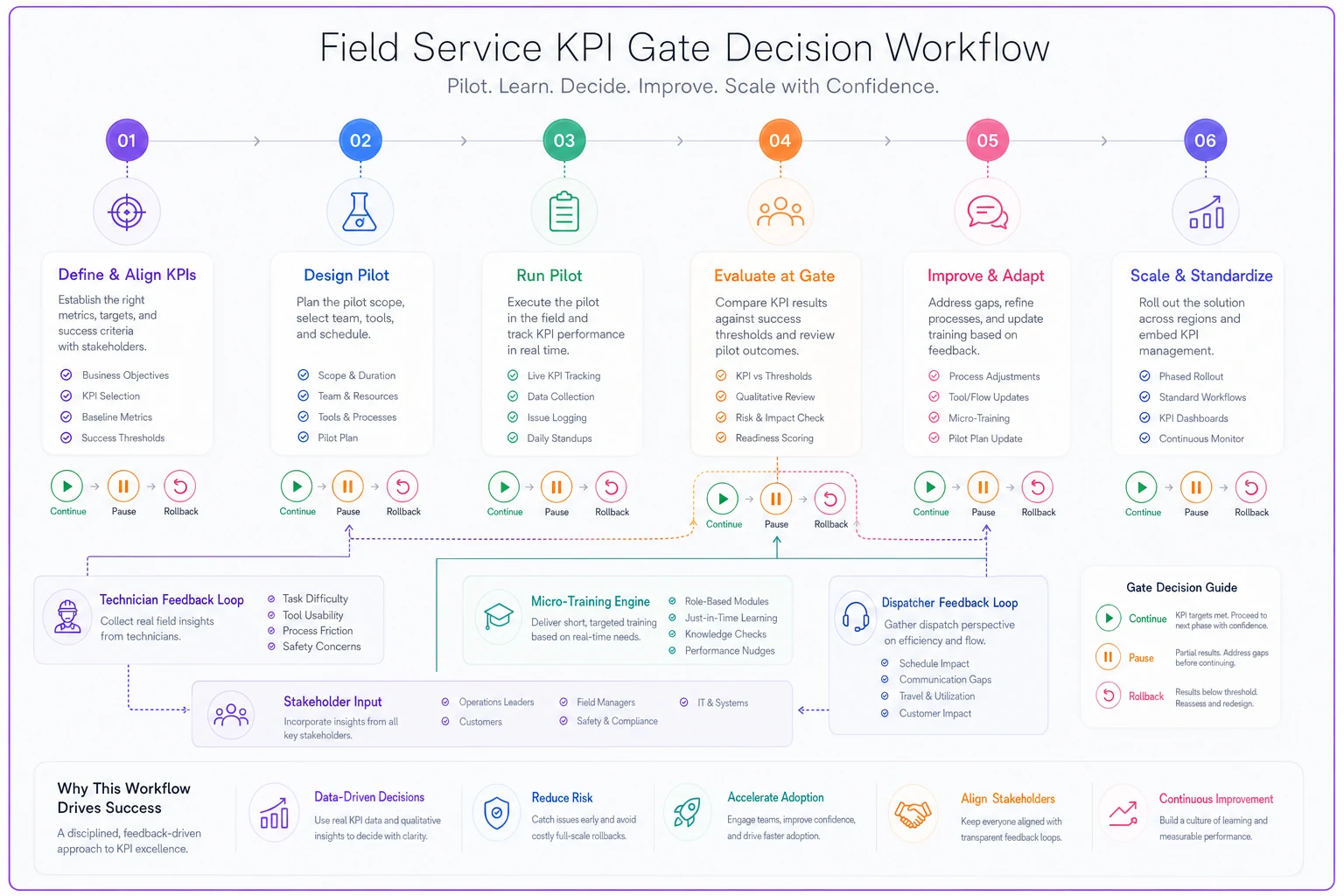
A gate has three parts: the metric, the threshold, and the timing. Vague gates ("adoption should be good by month two") are useless. Specific gates look like this:
-
Continue gate First-time-fix rate holds within 3 points of baseline and dispatcher adoption is above roughly 70% by end of week 4. No major operational damage and real usage.
-
Pause gate Adoption stalls between 40–60% with no upward trend for two consecutive weeks. This isn't a kill — it's a signal that something in the process or comms is broken. Diagnose before deciding.
-
Rollback gate Any core operational metric degrades sharply — SLA compliance drops, callback rate spikes, or a customer-facing failure traces back to the new process. Roll back immediately, no debate.
The rollback gate is the one people resist writing, because it feels like planning for failure. It's the opposite. A pre-defined rollback plan is what lets you take the risk in the first place. When your dispatchers know there's a real, safe way to revert if things go sideways, they experiment more openly instead of hedging and half-adopting.
Visualizing the gate decision workflow helps get everyone aligned.
One nuance on thresholds worth calling out: don't measure only the outcome metric. Measure adoption separately. A rollout can show flat outcome numbers because nobody's actually using the new process — in which case the process might be fine and your adoption effort is the problem. If you only track outcomes, you'll draw exactly the wrong conclusion and scrap a perfectly good change.
A real scenario: rolling out a new job-close workflow
A mid-sized HVAC and refrigeration company, around 55 technicians across three branches, wanted to change how techs closed out jobs — capturing more structured data at the site instead of filling it in later from memory. The goal was cleaner records for warranty claims and fewer disputes with big commercial accounts.
Their first attempt was a full rollout after a two-tech pilot. It fell apart. Both pilot techs were detail-obsessed veterans. Everyone else found the new close-out slower on a busy day and just... didn't do it thoroughly. Within a month, data quality was actually worse than before, because now there were two half-populated systems instead of one messy-but-consistent one.
The second attempt used gates and a stakeholder map. They pulled in the two senior dispatchers early and found a design flaw the veterans had quietly worked around: the new close-out required a field that techs often couldn't fill until they got back to the shop. That single field was tanking adoption. They made it optional at the site and required at the shop.
They set a continue gate at roughly 70% adoption and no drop in daily job throughput by week four. One branch hit it. Two didn't — adoption stalled around 50%. Instead of forcing it, they hit the pause gate, ran a few micro-sessions built entirely around the specific complaints, and simplified two more fields. Adoption climbed to around 75–80% over the following three weeks.
The outcome wasn't dramatic on paper. Job throughput stayed flat, which was the point, and warranty dispute resolution time dropped by somewhere around a third over the next quarter because the records finally held up. But the real win was that nobody's trust got burned. When the same company rolled out their next change, people didn't assume it would disappear.
When this playbook is overkill
Not every change needs stakeholder maps and formal gates. If you're changing something small, reversible, and low-risk — swapping a form field, adjusting a naming convention — running a full gated pilot is bureaucratic theater. Just make the change, watch it for a week, and move on.
This heavier approach earns its keep when the change touches daily workflow for a lot of people, when it affects customer-facing metrics, or when a failed rollout would burn credibility you'll need for future changes. Anything that alters how techs or dispatchers do their core job on every shift qualifies.
It falls apart when leadership won't actually honor the gates. If finance says "sure, we'll roll back if the numbers are bad" but everyone knows they'll never allow it once money's been spent, don't pretend. Fake gates are worse than no gates, because people learn the whole exercise is for show.
And the group that probably shouldn't run a formal rollout at all: very small operations, say under ten people, where everyone's in the same conversation daily anyway. At that size, the informal feedback loop is faster than any structured cadence you'd design. Your "stakeholder map" is a five-minute conversation. Save the formality for when coordination overhead actually starts costing you.
What actually changes as you scale
The uncomfortable truth is that the same rollout method breaks differently at different sizes. At 15 techs, a change spreads by word of mouth and a good senior tech can carry it. At 60, word of mouth fragments across branches and you get inconsistent adoption you can't see. At 150-plus, you're no longer rolling out to people — you're rolling out to local cultures, each with its own dispatcher, its own workarounds, and its own reasons the corporate version won't fit.
That's why centralizing feedback and metrics matters more the bigger you get. When adoption data and the questions from micro-sessions all flow into one place, you can spot the branch that's silently reverting before it becomes the norm. When that information lives in scattered spreadsheets and hallway conversations, you find out three months too late — usually when a customer complains.
The playbook — stakeholder maps, staged comms, micro-sessions, and pre-committed KPI gates — isn't about controlling people. It's about making the operation's real behavior visible early enough to do something about it. Get that visibility right, and rollouts stop being coin flips. They become something you can run repeatedly without spending down the trust you'll need for the next change, and the one after that.
Ready to optimize your field operations?
Join 2,000+ service teams using Romrly to boost productivity, reduce downtime, and enhance customer satisfaction.