



If you buy compressors, HVAC coils, appliance parts, steel fittings, or anything with lumber or metal in it, your parts cost is about to move. Canada rolled out retaliatory tariffs on roughly $20 billion of U.S. goods — duties ranging from 15% to 50% across close to 700 product categories — with measures taking effect September 8. The CNBC coverage laid out the scope, and Reuters broke down the timing and the categories getting hit hardest: metals, lumber, appliances, and a long tail of manufactured inputs.
What most field-service operators miss when a headline like this drops — the tariff itself isn't the biggest problem. The bigger problem is what it exposes about how loosely most service businesses actually track the true cost of the parts they put on a truck. When costs are stable, sloppy purchasing hides in the margin. When costs jump 20% overnight on a handful of your highest-volume SKUs, that sloppiness turns into losses you can't see until the P&L closes.
So skip the trade-war commentary. Here are the operational moves that actually matter over the next few weeks.
First, understand where the damage actually lands
Tariff-driven parts cost doesn't hit your business evenly. It concentrates in a few places, and if you don't know which SKUs and which suppliers are exposed, you'll overreact on cheap stuff and underreact on the parts that quietly eat your margin.
In most mixed field-service operations, roughly 15–20% of your SKUs drive 70%+ of your parts spend. Those are the ones that matter here. A $4 grommet going up 30% is noise. A $380 control board that you install 40 times a month going up 22% is a real number — something like $3,300 a month in new cost that has to come from somewhere.
The mistake operators make is reacting to the tariff percentage instead of the dollar exposure. A 50% duty on a part you buy twice a year is a rounding error. A 15% duty on your bread-and-butter SKU is a margin event.
Before you touch pricing or reorder points, build a simple exposure map. A spreadsheet works fine for the first pass:
| SKU / Part | Monthly volume | Current unit cost | Est. tariff impact | Monthly $ exposure | Sole-source? |
|---|---|---|---|---|---|
| Control board X | ~40 | $380 | +22% | ~$3,340 | Yes |
| Condenser coil | ~25 | $210 | +18% | ~$945 | No |
| Steel fittings kit | ~120 | $46 | +15% | ~$828 | No |
| Compressor A | ~8 | $640 | +30% | ~$1,536 | Yes |
Sort by monthly dollar exposure, not tariff percentage. The parts at the top of that list are where every other move in this article should focus. Everything below the top 10–15 rows can wait.
The 8 moves, roughly in the order you should make them
1. Lock in pre-tariff pricing on your top exposure SKUs — now
Eliminate field service chaos with Romrly.
Romrly helps you assign, track, and complete service jobs efficiently and on time.
- Unified job scheduling
- Technician dispatch & tracking
- Customer notifications & updates
No credit card required
The window between an announcement and the effective date is where disciplined shops separate from reactive ones. You have until September 8. For high-exposure, sole-source parts at the top of your map, get on the phone with your distributor and ask two things: what's already landed in their warehouse at pre-tariff cost, and will they hold current pricing on a forward buy.
A typical scenario: a regional HVAC contractor identifies four SKUs carrying around $9k/month in combined exposure. They place a forward buy covering roughly 8–10 weeks of expected usage at pre-tariff pricing. That's not hoarding — it's buying time to renegotiate and re-source without bleeding margin on every job in the meantime.
The trap is buying deep on the wrong parts. Forward-buying a slow mover ties up cash and warehouse space for a part that turns twice a year. Only pre-buy where high volume and high per-unit impact and sole-source all overlap.
2. Recalculate reorder points for SKUs where lead times will move
Tariffs don't just raise cost — they scramble supply. Distributors re-route sourcing, some substitute to non-tariffed origins, and lead times stretch while everyone adjusts. A part that reliably showed up in three days can quietly drift to 9–12 days for a month or two.
If your reorder points assume the old lead time, you'll stock out right when replacement cost is highest — meaning forced panic buys or emergency freight on top of the tariff. That's a double hit.
This is exactly the kind of situation a tiered forecasting approach is built for. If you haven't already tightened your reorder logic, the framework in our guide on ending stockouts and excess inventory with a tiered parts-forecasting model walks through ROP calculators for mixed-usage SKUs — which is the muscle you want warmed up before lead times start drifting.
3. Introduce a short-term parts surcharge — and make it defensible
Most service businesses are terrified to raise prices, so they eat the cost and wonder why margins slipped a quarter later. A cleaner approach for volatile-cost periods is a transparent parts surcharge tied to specific categories, not a blanket price hike.
Something like: "Due to supplier cost increases on metal and appliance components, a temporary X% materials adjustment applies to affected parts." Customers accept this far more readily than a silent price bump because it's specific and clearly temporary. Commercial clients especially — they're seeing the same headlines you are.
When it makes sense: high-parts-content jobs where materials are 40%+ of the invoice. When it's a bad idea: labor-heavy service calls where parts are a small fraction of the ticket — the surcharge annoys the customer and recovers almost nothing.
4. Requote your open estimates before they burn you
A quiet margin leak nobody flags: estimates written last month at old parts pricing, still sitting in the pipeline, that customers approve after September 8. You quoted a $2,900 job assuming a $640 compressor. Now that compressor lands at $830, and you're stuck at the old number.
Pull every open, unapproved estimate that includes high-exposure parts. For anything going out now, add a shorter validity window — "pricing valid 10 days" is reasonable. For anything already sent, decide whether to proactively requote or absorb it. The point is making the decision deliberately instead of discovering it at invoicing.
5. Qualify a second source for every sole-source SKU on your exposure map
The "Sole-source?" column on your map is the scariest one. A single-supplier part with high volume and a fresh tariff is a margin liability and a continuity risk. If that distributor re-routes or runs short, you're exposed on both price and availability.
You won't fully re-source in three weeks, and you shouldn't try. But you can start qualification now — get pricing from an alternate distributor, order a few units to validate fit and quality, and get the vendor set up in your system so you can flip quickly if needed. The businesses that struggle most in a supply shock are the ones who start looking for a backup supplier after the primary one fails them.
6. Push more localized stocking toward high-exposure, high-volume parts
When replacement cost is climbing and lead times are uncertain, the value of having the right part already on the shelf goes up. This isn't about stocking more of everything — that just converts a margin problem into a cash-flow problem.
It's a targeted shift. For your top exposure SKUs, tighten kit contents and truck stock so techs aren't triggering emergency reorders at inflated prices. A part you already own at pre-tariff cost is worth more today than it was last month. Prioritizing where you hold inventory around the exposure map — rather than spreading stock evenly across the board — is the move.
7. Track parts cost at the job level, not just the P&L level
This is the underlying discipline the whole tariff situation exposes. Most field-service operations know their blended margin but can't tell you the margin on a specific job type after a cost change. So when parts cost jumps, they feel the squeeze but can't pinpoint which work is now unprofitable.
The shops that come through cost shocks cleanly are the ones capturing actual parts cost per work order — what went on the truck, what it cost that week, and what the job billed. When you have that, a 20% tariff on a control board immediately shows up as a specific job type dropping below your margin floor, and you can reprice or reroute that work deliberately.
This is where operational software earns its keep — not through anything flashy, but by tying part cost, work order, and invoice together so cost changes surface at the job level instead of hiding in a quarterly average. AI-assisted forecasting and reorder-point tools help here too, flagging when a SKU's cost or lead time drifts enough to warrant a review, so you're adjusting on signal instead of gut feel. But the value is the visibility, not the automation for its own sake.
8. Set a weekly review cadence until costs stabilize
Cost shocks aren't a one-time adjustment. They play out over weeks as suppliers pass through duties unevenly. A standing 20-minute weekly review through the fall keeps you ahead of it:
-
Which top-exposure SKUs changed cost this week?
-
Did any lead times stretch enough to move a reorder point?
-
Are any open estimates or contracts now underwater?
-
Is the surcharge recovering what we expected, or is it too broad/too narrow?
-
Any sole-source part that needs its backup accelerated?
Five questions, twenty minutes — it's not a big ask. The businesses that skip this cadence make one round of adjustments in September and then drift, absorbing creeping costs they never re-checked.
Keep the review focused on the top 10 SKUs by dollar exposure.
Here's a simple workflow to run that weekly 20-minute review:
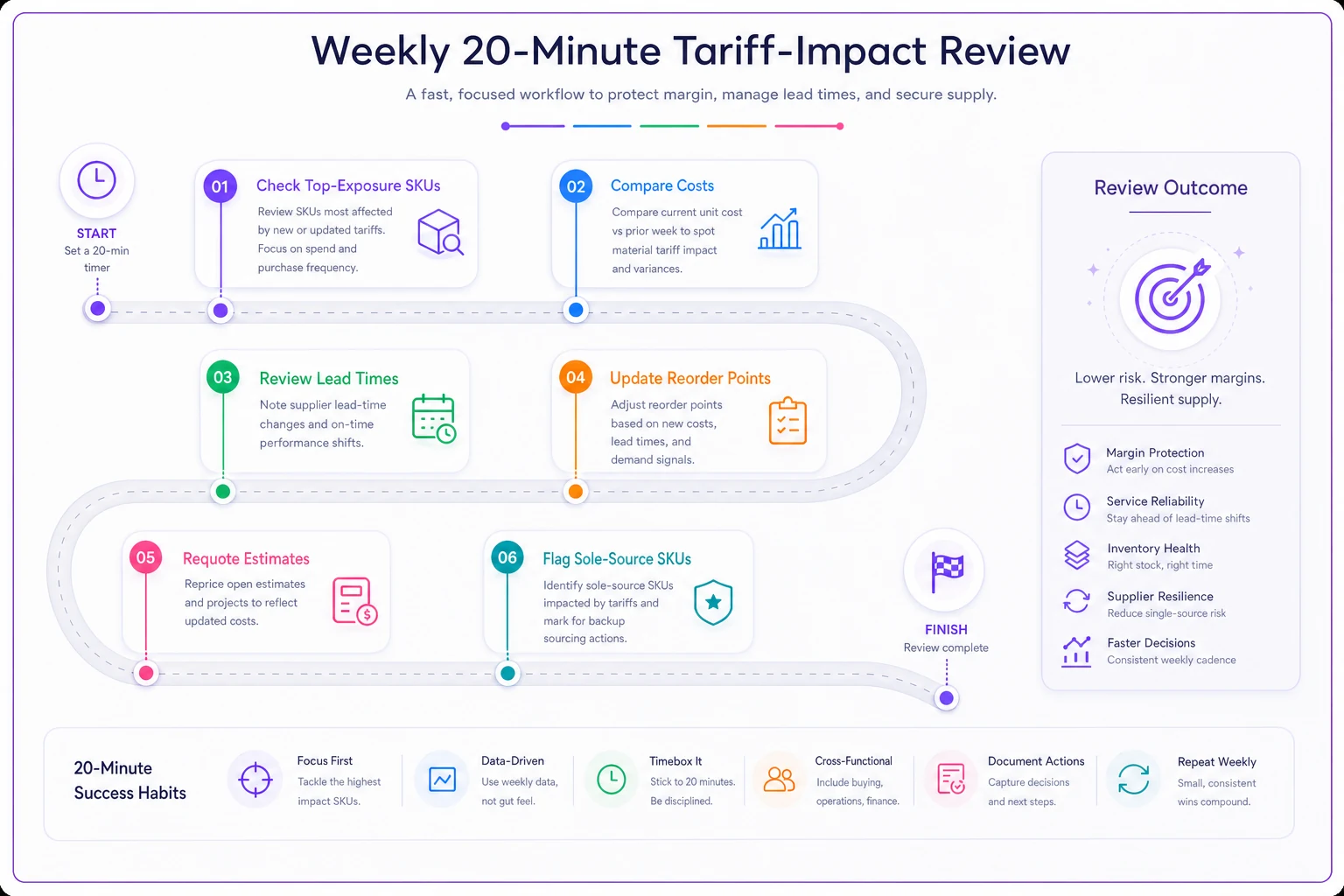
Keep the meeting short and focused on the top-exposure SKUs and the five questions above.
A quick real-world scenario
Take a mid-size appliance repair and install company — around 14 techs, maybe 900–1,000 jobs a month, with parts running close to 45% of revenue. When a cost shock like this hits, their exposure concentrates in appliance control boards and compressors, both largely sole-sourced through one distributor.
Before doing the exposure mapping, their instinct was a blanket 5% price increase across all work. The problem: that approach overcharged labor-heavy service calls, annoying loyal customers, and undercharged parts-heavy installs where the real damage lived. They'd have recovered maybe half the added cost while irritating their best repeat clients.
After mapping exposure, they did the opposite — forward-bought about 8 weeks of their four worst SKUs at pre-tariff pricing, added a targeted 8% materials adjustment on install jobs only, and started qualifying a second board supplier. Net effect over the following two months: they recovered the large majority of the added parts cost, held service-call pricing steady, and avoided a single tariff-driven stockout.
Not a perfect outcome, but a controlled one instead of a slow, invisible bleed. The difference wasn't a clever tool. It was refusing to react to the tariff percentage and reacting to the dollar exposure instead.
Who should NOT overreact here
If parts are a small slice of your revenue — say you're mostly a labor and inspection business — most of this is a footnote. Don't tie up cash forward-buying parts you barely stock. Skim the exposure exercise, flag your two or three biggest-dollar parts, and move on.
Same if your work is dominated by warranty and manufacturer-supplied parts where you don't bear the material cost directly. Your risk there is lead time and availability, not price — so focus on moves 2, 5, and 6, and skip the surcharge conversation entirely.
The operators who need to act hardest are the parts-heavy, sole-source-dependent shops running thin per-job margins. For them, a 20% jump on a handful of core SKUs is the difference between a healthy month and a break-even one.
The takeaway
A tariff deadline is really just a stress test on how well you understand your parts economics. The businesses that get hurt are the ones that discover their exposure in the quarterly numbers, three months late. The ones that come through it treat the next few weeks as a forcing function: map the dollar exposure, protect the top SKUs, tighten reorder points and pricing, and build a simple review rhythm that outlasts this particular headline.
Do that, and September 8 becomes a manageable operational event instead of a margin surprise — and you'll be running tighter parts discipline long after the news cycle moves on.
Ready to optimize your field operations?
Join 2,000+ service teams using Romrly to boost productivity, reduce downtime, and enhance customer satisfaction.