

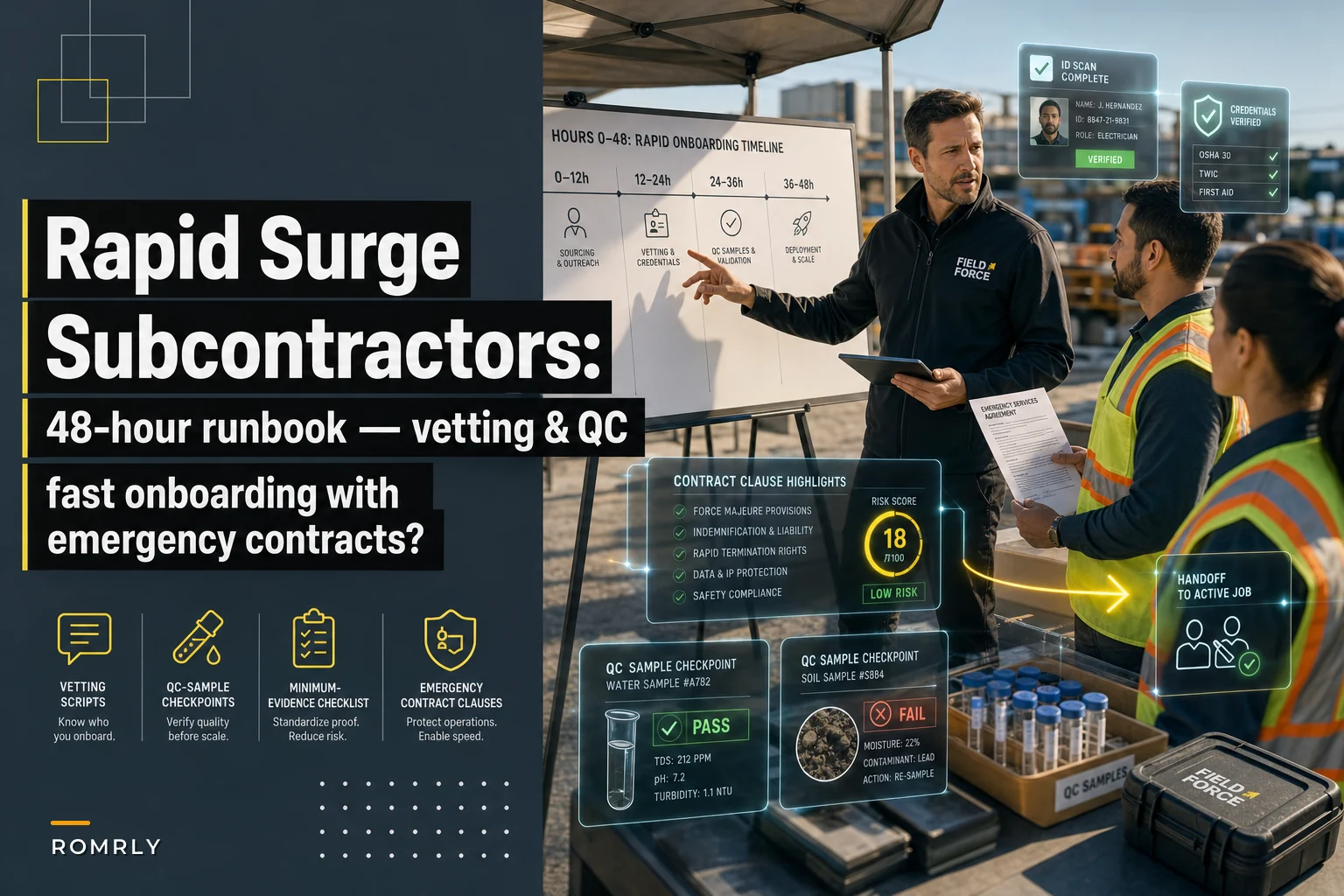

The surge hits on a Tuesday. A regional account signs, a storm knocks out a service region, or three techs quit in the same week. Suddenly you need 8–12 extra bodies in the field by Thursday and your usual sub bench is maxed out. This is the moment where field service managers either hold the line on quality or quietly accept that the next 60 days are going to generate callbacks, chargebacks, and a few angry client emails.
Most advice out there treats subcontractor sourcing like a calm, deliberate procurement exercise. It isn't — not when you're scaling fast. Fast sourcing is a risk management problem. You're trading time you don't have against exposure you can't fully see. The whole game is limiting downside while you move quickly.
This runbook is built for that exact window: the first 48 hours after you realize you need temporary subs, and the two weeks after, when the real quality picture starts showing up in the data. If you want the steady-state version — the full onboarding and spot-audit discipline — that's covered separately in subcontractor governance for field service. This piece is about the emergency path.
The 48-hour timeline (because everything else follows from it)
Surge sourcing fails when people try to run a normal 3-week vetting process in a 3-day window. They either skip steps entirely and get burned by a sub who no-shows or does garbage work, or they refuse to compress and lose the account to a competitor who moved faster.
Staged timeline visualization.
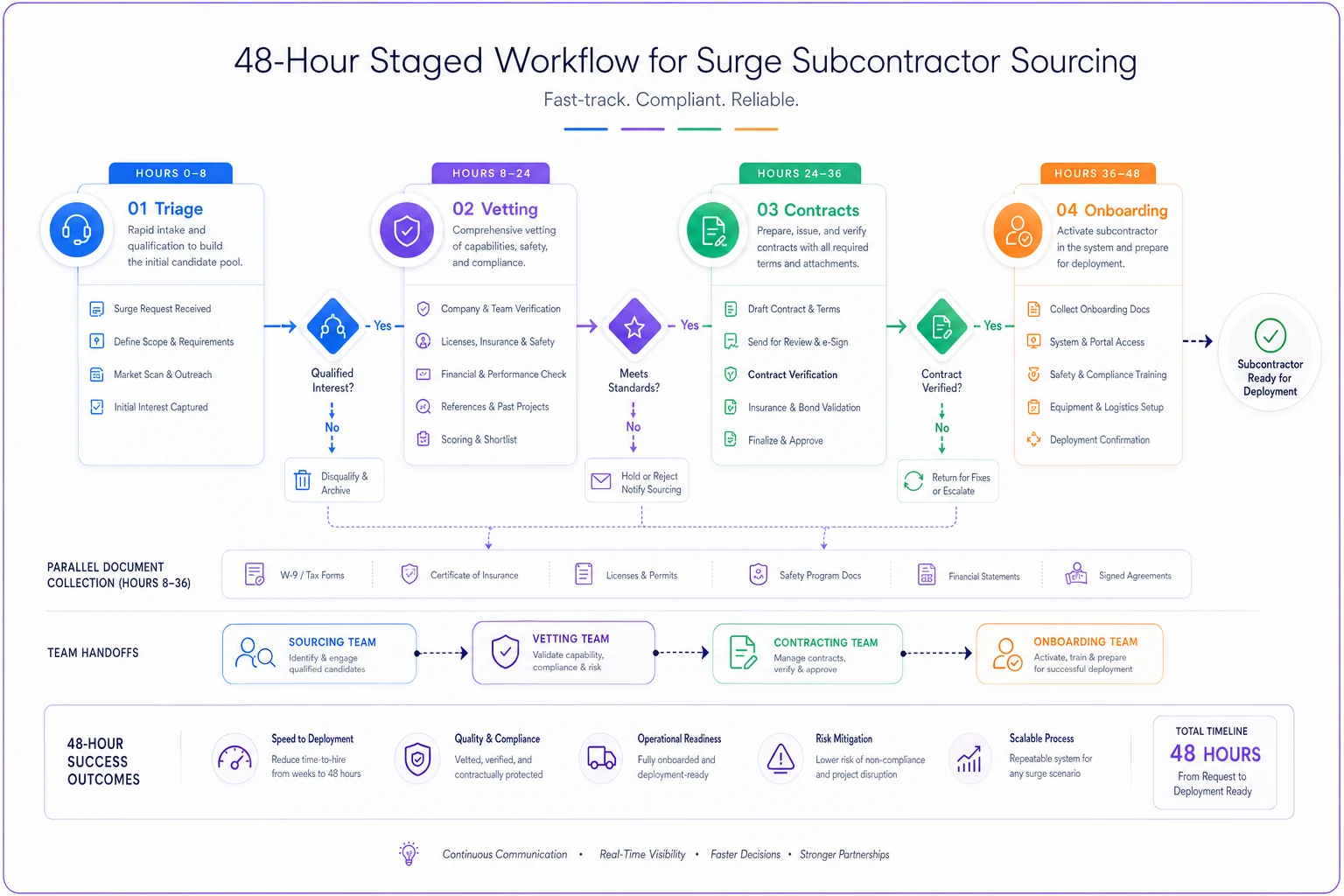
Hours 0–8: Triage and shortlist. Pull your list of pre-vetted subs first. If you've done any prior governance work, you should have a warm bench. Call them before you touch a new source. For net-new subs, post to the two or three channels that actually produce qualified people in your trade — a regional trade group, a staffing partner you've used before, direct referrals from your current crews. Referrals from working techs are, in practice, your highest-conversion source. Cast wide but tag the source of every lead so you can measure it later.
Hours 8–24: Fast vetting calls and document collection. Run the structured vetting script (below) on every candidate. This is a 12–15 minute call, not a coffee chat. In parallel, collect the minimum evidence pack. No evidence, no job. Non-negotiable even under time pressure.
Hours 24–36: Emergency contracts and insurance verification. Send the surge contract with pay and penalty terms spelled out. Verify certificates of insurance directly with the issuer or broker — not just the PDF the sub emailed you. A surprising number of "current" COIs are expired or have carve-outs that leave you exposed.
Hours 36–48: Micro-onboarding and first job assignment. Short, focused onboarding on your workflow, safety expectations, evidence capture, and escalation path. Then assign first jobs — but only low-complexity, high-visibility work for the first wave, so your QC sampling has something to catch.
The point of locking this timeline is that it forces you to decide what you're willing to skip. You're not skipping insurance or the vetting call. You might skip the reference deep-dive until after the first paid jobs. That's a conscious trade, not an accident.
The vetting script that catches 80% of your risk in 15 minutes
What comes up repeatedly in surge-hiring situations is managers winging the phone screen, getting a good feeling about someone, then discovering on day three that the "licensed HVAC tech" mostly does residential installs and has never touched the commercial equipment your account runs.
Eliminate field service chaos with Romrly.
Romrly helps you assign, track, and complete service jobs efficiently and on time.
- Unified job scheduling
- Technician dispatch & tracking
- Customer notifications & updates
No credit card required
A tight script fixes this. The goal isn't to interview for culture fit. It's to surface disqualifiers fast.
Surge vetting call script — run every question, note every answer:
-
Exact scope experience. "Walk me through the last three jobs you did on [specific equipment/system]. What was the fault, what did you do?" Vague answers here are the single best predictor of callbacks.
-
Licensing and certification specifics. Ask for license numbers on the call. "What's your license number and the issuing state?" People who have them answer instantly. People who don't start explaining.
-
Availability reality check. "What else are you committed to over the next three weeks?" Subs who overcommit during surges are a top cause of no-shows. Get the real picture.
-
Tools and truck. "What do you carry on your truck right now? What would you need from us?" A sub showing up without a meter or ladder on day one is lost revenue.
-
Evidence habits. "How do you normally document completed work — photos, forms, sign-offs?" Someone who already photographs their work will adapt to your capture requirements fast.
-
Rate and penalty acknowledgment. "Our surge rate is X, with these completion and quality terms. Does that work?" Get the yes on the call before you send paper.
-
The deal-breaker question. "Is there any job type on this list you'd rather not take?" Honesty here is a green flag. The subs who say "I'll do anything" are often the ones who do nothing well.
Score each call 1–3 on scope match, evidence habits, and availability. Anyone scoring a 1 on scope match gets deferred regardless of how friendly they were. During a surge, likeability is not a qualification.
Minimum evidence pack — the non-negotiable floor
Under time pressure, the temptation is to let documentation slide "just this once." That one exception is how you end up with an uninsured sub on a commercial roof and a claim you can't offload.
-
Certificate of insurance, verified with the issuer, with your company listed or at least the correct coverage limits and effective dates
-
License/certification numbers, checked against the state registry where applicable (takes 2 minutes online for most trades)
-
W-9 or equivalent tax documentation
-
Signed surge contract with pay and penalty terms
-
One form of ID matched to the name on the license
-
Emergency contact and a working mobile number you've actually tested with a text
That's it for the first wave. References, portfolio samples, and deeper background checks can run in parallel after they've started on supervised, low-risk work. The sequencing matters: catastrophic-risk items — insurance, licensing — come before the first job. Quality-refinement items can lag by a few days.
The insurance verification step is where most teams cut corners and where the real exposure lives. A COI PDF is trivially easy to alter or expire. The 10-minute call to the broker is cheap insurance against a six-figure liability gap.
Emergency contract clauses that limit your exposure
Standard subcontractor agreements are written for steady-state relationships. Surge contracts need teeth, because you're onboarding people you barely know and handing them your client relationships.
| Clause | What it does | Typical surge structure |
|---|---|---|
| Completion bonus | Rewards finishing the surge window | Small per-job or weekly bonus for zero no-shows |
| Callback penalty | Shifts rework cost back to the sub | Sub eats the cost of returning for defects within X days |
| No-show penalty | Protects your dispatch schedule | Flat deduction + removal from the bench after two |
| Evidence requirement | Ties payment to documentation | No photos/sign-off = no payment until supplied |
| Quality holdback | Keeps leverage until work is verified | 10–15% held until QC sampling clears the batch |
| Early termination | Lets you cut a bad sub fast | 24-hour termination for cause, no penalty to you |
The holdback clause is the one people underuse. Releasing 100% of payment immediately removes all your leverage the moment the work turns out to be sloppy. A modest holdback — released after your QC sample passes — keeps everyone honest without starving the sub of cash flow.
Keep the contract short. A 3-page surge agreement that people actually read and sign in an hour beats a 15-page document that stalls your timeline. Spell out the pay rate, the penalties, the evidence requirements, and the termination terms in plain language.
When aggressive penalty terms backfire
If you're sourcing from a thin regional labor pool where every sub knows every other sub, heavy-handed penalties will burn your reputation and dry up your bench fast. In tight markets, lean on the holdback and completion bonus instead of punitive no-show fines. The carrot scales better than the stick when subs can simply choose not to work for you.
QC sampling: catching bad work before the client does
You cannot inspect every job a temporary crew does during a surge. You don't have the supervisor hours. So you sample — deliberately and statistically, not randomly based on whoever complains loudest.
The logic is straightforward: new subs carry more unknown risk, so they get sampled harder early, then earn lighter sampling as they build a track record.
A workable QC sampling plan:
-
First 5 jobs per new sub
100% inspection.
Every job gets a QC review, ideally within 24 hours of completion. This is your highest-value window — it catches systemic problems before they multiply across dozens of sites. -
Jobs 6–20
50% inspection.
Once a sub clears the first five clean, drop to sampling half. Mix scheduled and surprise reviews. -
Jobs 21+
20% inspection
for subs with a clean record, bumped back up immediately if a defect appears. -
Any callback or client complaint
automatic return to 100%
for the next 5 jobs.
QC review doesn't always mean a physical site visit. For a lot of trades, a solid evidence pack — before/after photos, meter readings, completion checklist — lets a supervisor review remotely in a few minutes. That's what makes 100% early inspection feasible without a dedicated QC team. The mobile evidence patterns in subcontractor governance for field service carry over directly here.
The mistake teams make is sampling evenly across all subs. If you've got two new subs and ten veterans, your sampling hours should be overwhelmingly aimed at the two new ones. Evenly distributed QC wastes supervisor time on people who've already proven themselves.
A real surge scenario, with numbers
A mid-sized commercial HVAC service company picked up a regional retail account mid-summer — roughly 140 locations needing PM visits inside a six-week window, on top of their normal load. Their in-house crew could cover maybe 60% of it. They needed around 9 temporary subs fast.
The first instinct was to grab anyone available. Instead they ran the staged runbook. Over the first 48 hours they screened about 22 candidates through the vetting script, disqualified 7 on scope mismatch during the calls, and lost 3 more at insurance verification — two had expired COIs, one had a residential-only policy. That left 12 to onboard. They took 9 and kept 3 as backup.
First-wave QC at 100% inspection caught two subs doing incomplete filter changes and skipping the refrigerant check on the checklist. Because it surfaced in the first five jobs, they corrected it with a quick call and a re-review rather than discovering it across 40 completed sites. One sub didn't improve and got cut under the 24-hour termination clause — backup sub slotted in the next day.
Over the six weeks, callback rate on sub-completed work landed in the 6–8% range, roughly in line with their in-house crews, instead of the 20%+ they'd seen on a prior unmanaged surge. The quality holdback meant the one problem sub never got paid for the defective jobs he didn't fix. Rough estimate on avoided rework and preserved account standing: somewhere in the low five figures, plus they kept the account.
What made it work wasn't any single clever tactic. It was refusing to skip the floor — insurance, vetting call, evidence pack — even when the clock was screaming.
Where software actually earns its keep here
None of this requires fancy tooling to start. A spreadsheet and a disciplined manager can run the first surge. But the version that scales — where you're running surges quarterly and managing a bench of 30+ subs with different sampling tiers — gets hard to hold in a spreadsheet fast.
Auto-flag expired COIs and missing evidence so jobs can't be marked billable until the floor is met.
The practical value of a workflow platform in surge sourcing is mostly about not dropping things when you're moving fast. Tracking which subs have verified insurance versus pending. Auto-flagging a sub back to 100% QC the moment a callback is logged. Making sure the evidence pack is actually complete before a job gets marked billable. These are exactly the kinds of checks that fall through the cracks at 11pm on day two of a surge, and exactly what AI-assisted operational workflows handle quietly in the background — surfacing the expired COI, the missed holdback release, the sub who's quietly drifted past his inspection threshold without anyone noticing.
When this runbook makes sense — and when it doesn't
Use the full surge runbook when:
-
you need 5+ temporary subs inside a week
-
the work touches client sites directly
-
there's meaningful liability exposure — commercial, regulated trades, high-value equipment
Skip the heavy version when:
-
you need one or two subs you already know well
-
the work is low-stakes and easily re-done
Who should not do this at all:
anyone trying to use surge sourcing to permanently replace headcount. Temporary subs are a surge tool, not a staffing strategy. If you find yourself running the surge runbook every month, the real problem is capacity planning, and no vetting script fixes a structural shortage.
Fast subcontractor sourcing isn't about moving recklessly. It's about knowing precisely which corners you're allowed to cut and which ones will end you. Keep the floor — insurance, a real vetting call, a complete evidence pack, a contract with teeth — and sample the new people hard early. Everything else can flex to fit the 48 hours you actually have.
Ready to optimize your field operations?
Join 2,000+ service teams using Romrly to boost productivity, reduce downtime, and enhance customer satisfaction.