
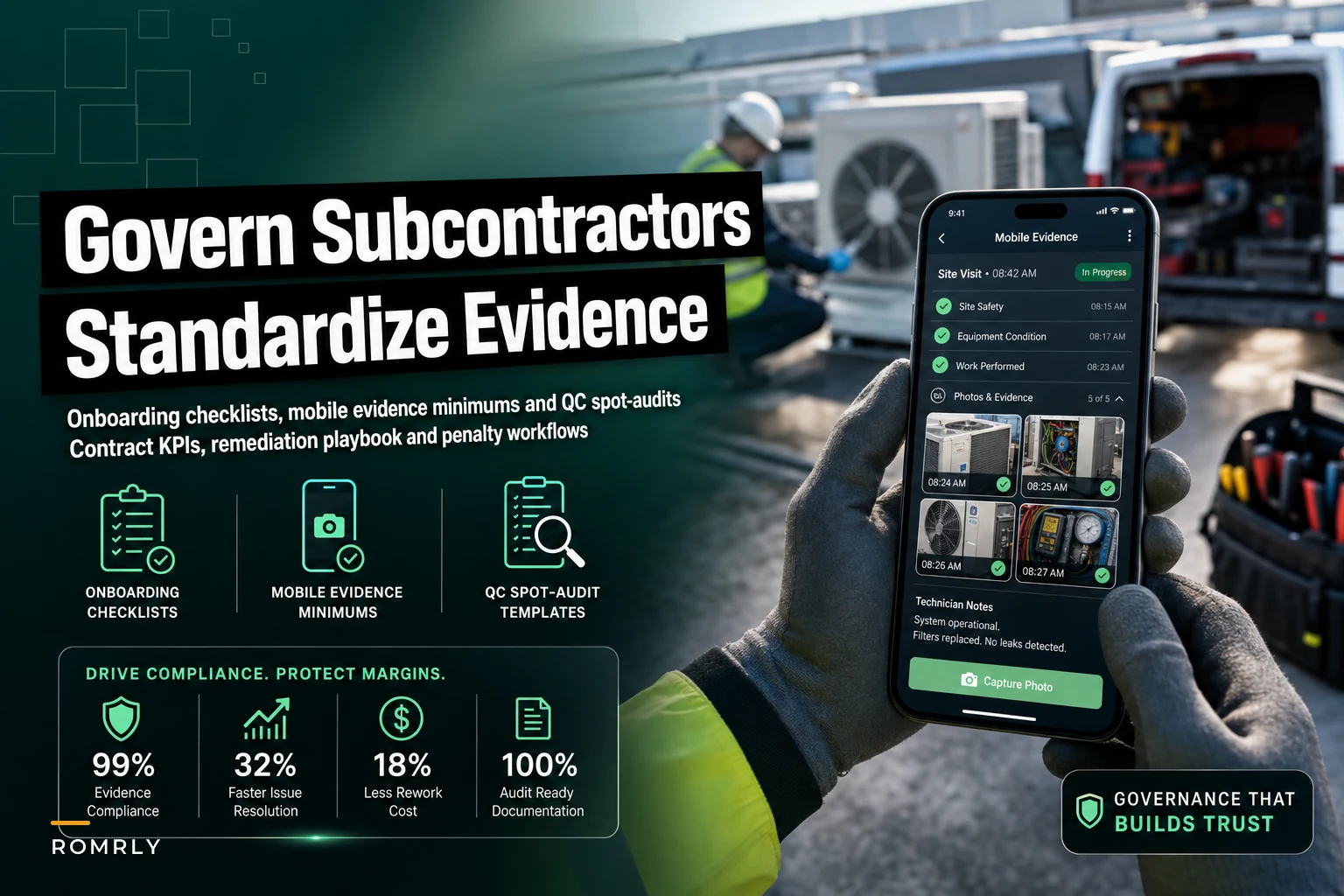

Managing subcontractors in field service is genuinely uncomfortable. You need their coverage and flexibility, but every time a third-party tech shows up at a customer site wearing your company's name, your reputation is riding on someone you don't fully control.
Managing a mixed workforce where half your techs aren't actually yours
It gets harder as you scale. A commercial HVAC company I worked with grew from 12 internal techs to a network of 45 total — including 28 subcontractors — across three states. Customer complaints jumped noticeably in about six months. Not because the subs were bad. They just had no consistent way to verify work quality, track mobile evidence, or enforce standards across a mixed workforce.
Most field service companies stumble into this gradually. You call a trusted contractor when you're swamped. Add a few more during peak season. Before long, third-party techs are handling 30–50% of your service calls and you're still managing them through text messages, hoping for the best.
Why quality control breaks down at scale
The core problem isn't finding good subcontractors. It's maintaining visibility and standards once they're in the field. Your internal techs follow your processes, use your tools, and went through your training. Subcontractors show up with their own habits, their own paperwork, their own definition of "done."
Eliminate field service chaos with Romrly.
Romrly helps you assign, track, and complete service jobs efficiently and on time.
- Unified job scheduling
- Technician dispatch & tracking
- Customer notifications & updates
No credit card required
What typically happens: you onboard a new sub with a handshake agreement and maybe a basic contract. They start taking jobs. Customer feedback trickles in weeks later — sometimes fine, often inconsistent. By the time you spot quality issues, they've already knocked out dozens of calls under your company name.
The gap widens because subcontractors naturally push back on operational overhead. They're independent for a reason. Ask them to fill out extensive paperwork or follow complex protocols and they'll just find another company to work with. But give them too much freedom and your service quality becomes a coin flip.
Across roughly 80 field service operations I've looked at — from appliance repair to commercial electrical — the ones that manage this well don't try to turn subcontractors into employees. They build lightweight governance systems that capture just enough information to maintain quality without creating unnecessary friction.
Building your subcontractor onboarding checklist
Onboarding sets the foundation for everything that follows. Skip steps here and you'll be chasing problems for months.
Essential onboarding components:
Documentation & Compliance (Day 1, ~30 minutes)
-
Insurance certificates (general liability minimum $1M)
-
Workers comp verification
-
Business license and trade certifications
-
W-9 or equivalent tax forms
-
Background check authorization
-
Non-compete/confidentiality agreements
Operational Standards (Day 1, ~60 minutes)
-
Service level agreements (response times, completion windows)
-
Photo evidence requirements for each job type
-
Customer communication protocols
-
Escalation procedures for complex issues
-
Warranty and callback policies
-
Invoice submission process
Technology Setup (Day 1, ~30 minutes)
-
Mobile app installation and login credentials
-
Photo upload training
-
Job acceptance/rejection workflow
-
Time tracking requirements
-
Parts ordering permissions (if applicable)
Field Shadowing (Day 2–3, 4–8 hours)
-
Ride along with a senior tech on 2–3 typical jobs
-
Review photo evidence standards in real scenarios
-
Practice customer interaction
-
Demonstrate close-out procedures
This is different from your 90-day technician onboarding checklist for internal hires. Subcontractors need a compressed version — get them productive fast while making the boundaries crystal clear.
Verification gates before they go solo:
-
Complete one supervised job with a passing score
-
Submit proper photo evidence for the practice job
-
Demonstrate basic app proficiency
-
Sign off on all policies and procedures
Keep everything in a shared folder they can reference later. Most subs work with multiple companies and won't memorize your specific requirements — that's just reality.
Defining minimum mobile evidence requirements
Photo evidence is your remote quality control system. But asking for "photos of completed work" gets you blurry shots of random equipment that tell you nothing useful.
You need specific evidence requirements for each job type, communicated clearly and enforced consistently.
Universal requirements (every job):
-
Arrival photo
wide shot showing address or building number
-
Before photo
close-up of the specific issue or equipment
-
During photo
work in progress (proves they didn't just reset a breaker and leave)
-
After photo
same angle as the before shot showing resolution
-
Completion photo
wide shot of the work area cleaned up
-
Customer signature or digital confirmation
Service-specific additions:
For HVAC work:
-
Thermostat reading before and after
-
Filter condition if replaced
-
Refrigerant gauge readings
-
Model/serial number plate
For plumbing:
-
Water meter reading before work
-
Pipe material and size
-
Water flow demonstration video for drain clearing
-
Shut-off valve locations
For electrical:
-
Panel schedule/breaker identification
-
Voltage readings
-
Wire gauge verification
-
GFCI test button demonstration
A pest control company I worked with cut callbacks by around 60% just by requiring techs to photograph specific evidence points — entry points sealed, bait station placements, treated areas. Before that, customers would claim work wasn't done and there was no way to verify either way.
The key is making evidence collection part of the natural workflow, not an afterthought. If techs have to remember a checklist after finishing a job, compliance drops fast. Build it into the flow: arrive, photo, diagnose, photo, fix, photo, verify, photo, close out.
Here's a simple workflow showing the photo trigger points in sequence.
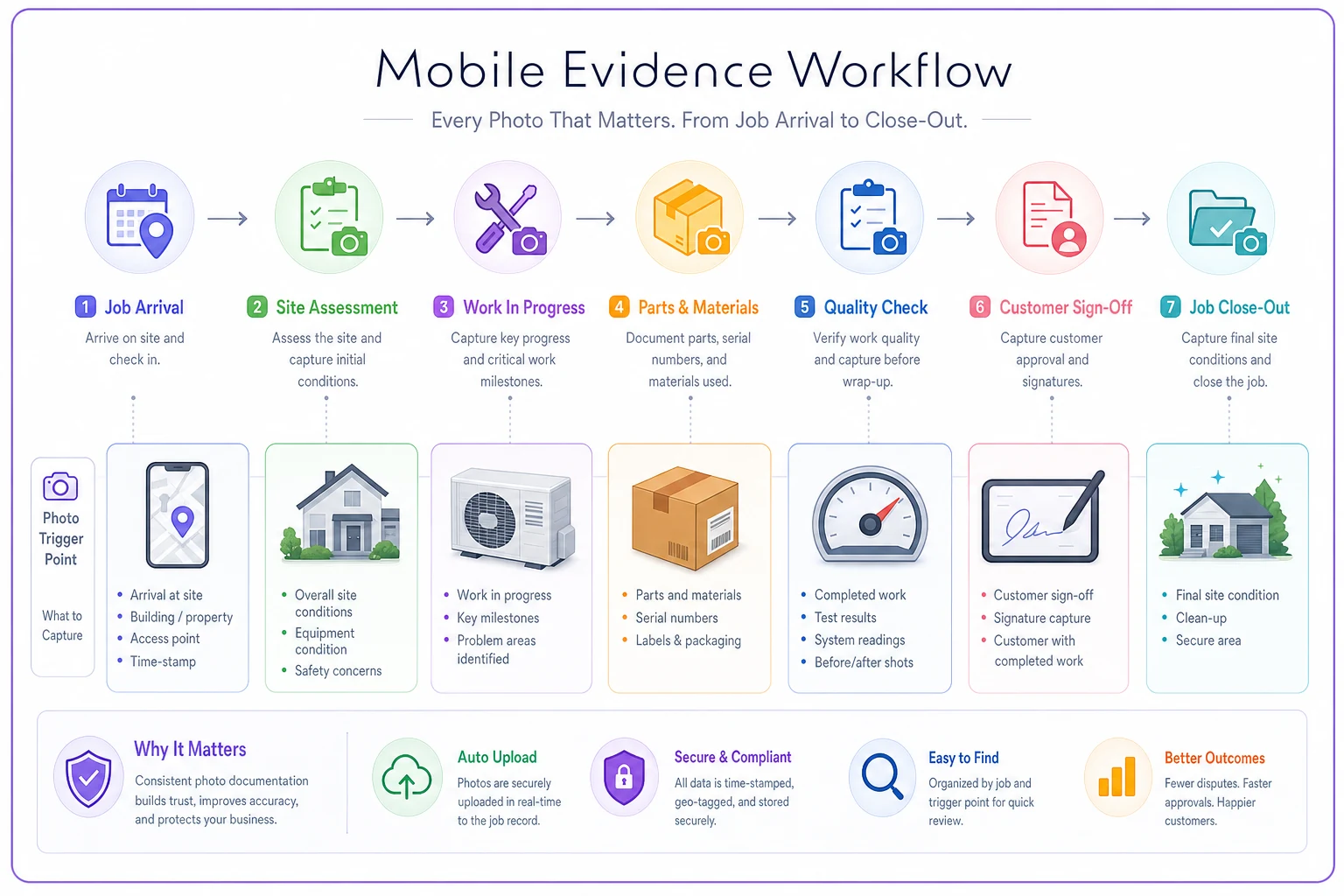
The graphic maps each photo point to the job stage so teams can enforce consistency.
Quality control spot-audit framework
Random audits keep everyone honest. Subcontractors who know they might get checked perform differently than those who think nobody's looking.
Auditing every job isn't realistic. You need a smart sampling approach that catches problems without burning out your QC team.
Audit triggers and frequency:
| Trigger Type | Audit Rate | Priority Level |
|---|---|---|
| New subcontractor (first 30 days) | 100% of jobs | Critical |
| New subcontractor (days 31–90) | 50% of jobs | High |
| Established sub – standard performance | 10% random sample | Normal |
| Customer complaint | 100% for next 5 jobs | High |
| High-value job (>$2,000) | 100% review | High |
| Warranty claim | Previous 10 jobs reviewed | Critical |
| Random monthly selection | 5% of all sub jobs | Normal |
Don't frame audits like an investigation. Call it "job review" or "quality verification." Subcontractors who feel targeted will find other work.
Audit checklist components:
Photo Evidence Review (~5 minutes)
-
All required photos present?
-
Photos show actual work, not something generic?
-
Timestamps align with reported schedule?
-
Location metadata matches job site?
Customer Contact (~5 minutes)
-
Call or text customer within 48 hours
-
Verify arrival/departure times
-
Confirm work scope completed
-
Check satisfaction (1–10)
-
Note any concerns
Technical Review (~10 minutes)
-
Work matches industry standards?
-
Parts used align with the invoice?
-
Warranty terms properly explained?
-
Follow-up requirements documented?
Compliance Check (~5 minutes)
-
Proper PPE visible in photos?
-
Safety protocols followed?
-
Customer property protected?
-
Clean-up completed?
Track everything and look for patterns. A sub who passes individual audits might still show a concerning trend when you zoom out — and that trend won't show up if you're only looking job by job.
Setting measurable contract KPIs
Vague contracts create disputes. "Provide quality service" means nothing when a customer complains. You need specific, measurable performance indicators that both parties understand going in.
Your KPIs should reflect what actually matters for your business. A residential service company might prioritize first-time fix rates. A commercial contractor might care more about response times.
Core KPIs for subcontractor agreements:
Response and Completion
-
Emergency response
on-site within 2–4 hours
-
Standard response
on-site within 24–48 hours
-
Job completion
90%+ completed within quoted timeframe
-
Schedule adherence
85%+ arrival within a 30-minute window
Quality
-
First-time fix rate
75–85% minimum depending on service type
-
Callback rate
below 5% within 30 days
-
Customer satisfaction
8.0+ average
-
Photo evidence compliance
95%+ of jobs fully documented
Administrative
-
Invoice accuracy
95%+ error-free submissions
-
Response to office
within 2 hours during business hours
-
Training compliance
required updates completed within 7 days
Keep the numbers realistic. Setting impossible targets just encourages people to game the system. Companies that require 100% on-time arrival then wonder why subs mark every job as "emergency traffic delay."
Sample KPI tracking table:
| Subcontractor | Jobs (Month) | On-Time % | Fix Rate % | Satisfaction | Callbacks | Status |
|---|---|---|---|---|---|---|
| ABC Plumbing | 47 | 89% | 81% | 8.7 | 2 | Good |
| XYZ Electric | 31 | 76% | 78% | 8.2 | 3 | Warning |
| 123 HVAC | 52 | 92% | 84% | 9.1 | 1 | Excellent |
Review these monthly with each subcontractor. Don't sit on problems until a quarterly review — by then you've already absorbed the damage.
The remediation and penalty playbook
When standards slip, you need a consistent response. Arbitrary punishment breeds resentment. A clear escalation process helps good subcontractors improve while filtering out the ones who won't.
Most companies jump straight to termination threats. That burns relationships you didn't need to burn. A tiered approach works better.
Tier 1: Coaching (First Instance)
-
Phone call within 24 hours to walk through the issue
-
Review specific examples together
-
Identify root cause — training gap, tools, unclear expectations?
-
Document the conversation and improvement plan
-
No financial penalty
Timeline: Resolve within 7 days.
Tier 2: Formal Warning (Second Instance or Pattern)
-
Written warning via email
-
Mandatory retraining on the specific issue
-
Increased audit rate (25% of jobs) for 30 days
-
Suspension from high-value jobs
-
5% invoice reduction for the period
Timeline: 30-day improvement window.
Tier 3: Probation (Serious or Continued Issues)
-
Formal probation notice
-
Reduced job allocation (roughly 50% of normal volume)
-
100% audit rate
-
10% invoice reduction
-
Weekly check-ins
-
No new job types approved
Timeline: 60-day probation.
Tier 4: Termination
-
Contract termination per agreement terms
-
Final invoice settlement
-
Return of any company property
-
Full documentation for legal protection
Some violations skip straight to termination: safety violations, customer abuse, fraud, or using your customer data to compete directly. Make these red lines explicit from day one, not after they've been crossed.
Common mistakes worth avoiding
Treating subs like employees without employee benefits
The fastest way to lose good subcontractors is to impose employee-level procedures without employee-level pay. They chose contract work for a reason. Respect that while maintaining your standards.
Using delayed payments as leverage
Holding invoices to enforce compliance backfires. Reliable subs won't tolerate payment games. Pay on time, every time, then handle performance issues separately.
Surprise requirements
Adding new requirements without notice or rate adjustments breeds resentment. If you need additional documentation or procedures, have the conversation first.
One-size-fits-all standards
A commercial HVAC sub doesn't need the same oversight as a residential handyman. Customize your governance based on service complexity and actual risk.
Ignoring good performers
Don't only manage problems. When subs consistently hit their KPIs, acknowledge it — preferred status, better rates, first pick on profitable jobs. Replacing a reliable subcontractor costs far more than keeping them happy.
Making governance operational
Manual tracking starts breaking down somewhere around 15–20 active subcontractors. Spreadsheets get messy, photos get buried in email chains, and maintaining any kind of audit trail becomes a real headache.
AI-powered operational software changes how subcontractor management actually works at scale. Instead of chasing contractors for photos, the platform prompts them at each stage automatically. Instead of manually calculating KPIs, dashboards stay current in real time. The coordination benefits alone are significant — subcontractors see schedules, accept jobs, and submit evidence in one place, while your team tracks performance, manages audits, and processes payments through the same system.
The automation handles the repetitive parts: tracking evidence submission, flagging missing documentation, calculating performance scores, triggering audit workflows. That frees you up for relationship management and actual decisions rather than administrative cleanup. Some platforms can even review photo evidence automatically, checking that images match job requirements and flagging potential issues before they turn into callbacks.
For context on how this connects to internal team coordination, the shift handover process follows similar principles around documentation and visibility — see dispatcher shift handover.
Planning your rollout
Don't implement everything at once. Subcontractors will push back if you suddenly impose complex new requirements. Phase it over about 90 days.
Days 1–30: Foundation
-
Implement basic onboarding checklist
-
Establish minimum photo evidence requirements
-
Start tracking arrival and completion times
-
Set up simple satisfaction surveys
Days 31–60: Measurement
-
Launch KPI tracking
-
Begin random spot audits (5% of jobs)
-
Share first performance reports with subs
-
Adjust requirements based on feedback
Days 61–90: Enforcement
-
Activate remediation procedures
-
Increase audit frequency for poor performers
-
Recognize top performers
-
Refine based on what the data is actually showing you
Communicate each phase in advance. Subcontractors appreciate knowing what's coming and why — and they're less likely to push back when they don't feel blindsided.
Wrapping up
Strong subcontractor governance isn't about turning contractors into employees or burying them in paperwork. It's about building lightweight systems that protect quality while respecting their independence.
The companies that do this well understand that balance. Clear onboarding, specific evidence requirements, smart audits, meaningful KPIs, and consistent responses to performance issues — that's the whole framework. It doesn't have to be complicated.
Technology makes governance systematic rather than adversarial. When subcontractors can easily submit evidence from their phone and see their performance scores without having to ask, compliance stops feeling like a burden. And when your team has a centralized view of what every sub is doing, you stop managing by instinct and start managing by actual data.
Start with the basics: document your requirements, standardize onboarding, and begin collecting photo evidence. Build from there based on what the data tells you. Within 90 days, you'll have real visibility over a mixed workforce that probably felt impossible to manage when you were running everything through text messages.
The ROI is straightforward — fewer callbacks, better satisfaction scores, reduced liability exposure, and subcontractor relationships that actually hold up over time. Your subcontractors want to do good work. Give them clear expectations, consistent feedback, and fair treatment, and most of them will help you grow.
Strong subcontractor governance isn't about turning contractors into employees or burying them in paperwork. It's about building lightweight systems that protect quality while respecting their independence.
The companies that do this well understand that balance. Clear onboarding, specific evidence requirements, smart audits, meaningful KPIs, and consistent responses to performance issues — that's the whole framework. It doesn't have to be complicated.
Technology makes governance systematic rather than adversarial. When subcontractors can easily submit evidence from their phone and see their performance scores without having to ask, compliance stops feeling like a burden. And when your team has a centralized view of what every sub is doing, you stop managing by instinct and start managing by actual data.
Start with the basics: document your requirements, standardize onboarding, and begin collecting photo evidence. Build from there based on what the data tells you. Within 90 days, you'll have real visibility over a mixed workforce that probably felt impossible to manage when you were running everything through text messages.
The ROI is straightforward — fewer callbacks, better satisfaction scores, reduced liability exposure, and subcontractor relationships that actually hold up over time. Your subcontractors want to do good work. Give them clear expectations, consistent feedback, and fair treatment, and most of them will help you grow.
Ready to optimize your field operations?
Join 2,000+ service teams using Romrly to boost productivity, reduce downtime, and enhance customer satisfaction.