


Consignment sounds like free money on paper. The vendor stocks your parts, you only pay when you consume, and your cash stops sitting on a shelf gathering dust. Then you actually run it for six months and discover you've signed up for a second inventory system with zero controls — one where the vendor's records and your field reality slowly drift apart until the annual true-up lands and someone hands you a bill for $14k in "unaccounted consumption" you can't explain.
That gap is where most consignment programs fall apart. Not at the negotiation table. In the day-to-day mechanics of receipts, returns, and reconciliation nobody bothered to define.
This is a walk through the operational machinery of vendor consignment spare parts field service programs — the triggers that move stock, the receipt and return SOPs, how often you reconcile, what KPIs actually hold vendors accountable, and where finance needs to plug in. With worked examples for the two SKU types that behave completely differently: high-value assemblies and cheap expendables.
Why consignment quietly breaks
The core problem is ownership ambiguity. In a normal purchase, the moment a part hits your dock it's yours, it's on your books, and your inventory system tracks it. Consignment splits that: the vendor owns the part until a consumption trigger fires, at which point ownership flips and you owe money.
If that trigger is fuzzy, everything downstream is fuzzy.
In practice, the breakdown usually looks like this. A tech pulls a consigned compressor off the van, installs it, and closes the job. But the consumption event — the thing that tells both you and the vendor "this part is now sold" — never fires cleanly. Maybe the tech scanned the wrong SKU. Maybe the job got closed as a warranty repair and the part was miscoded. Maybe it was installed but the paperwork sat in a truck for nine days.
Multiply that across a couple hundred consigned SKUs and two dozen techs, and by quarter-end your count says one thing, the vendor's replenishment log says another, and nobody can reconstruct the truth from memory.
The second failure mode is the reverse: consigned stock that walks off the books without ever being consumed. Returns that never get logged. Damaged parts written off informally. A tech pulling a consigned part for something it shouldn't be used for. Every one of those is a phantom consumption event you'll eventually pay for.
The trigger definitions that make or break the program
Before you touch SOPs, you have to nail down exactly what moves a consigned part from "vendor's asset" to "your liability." This is the single most important design decision, and most programs get it wrong by leaving it verbal.
Eliminate field service chaos with Romrly.
Romrly helps you assign, track, and complete service jobs efficiently and on time.
- Unified job scheduling
- Technician dispatch & tracking
- Customer notifications & updates
No credit card required
| State | What it means | Trigger event | Who records it |
|---|---|---|---|
| On hand (consigned) | Vendor owns it, sitting in your locker/van | Physical receipt confirmed | Receiving lead |
| Reserved | Allocated to a job, not yet installed | Work order assignment | Dispatcher / system |
| Consumed | Installed or issued — ownership flips | Job completion + part verified | Technician |
| Returned | Sent back to vendor unused | Return authorization logged | Receiving lead |
A simple visual of the state transitions clarifies who owns each step and what triggers ownership change.
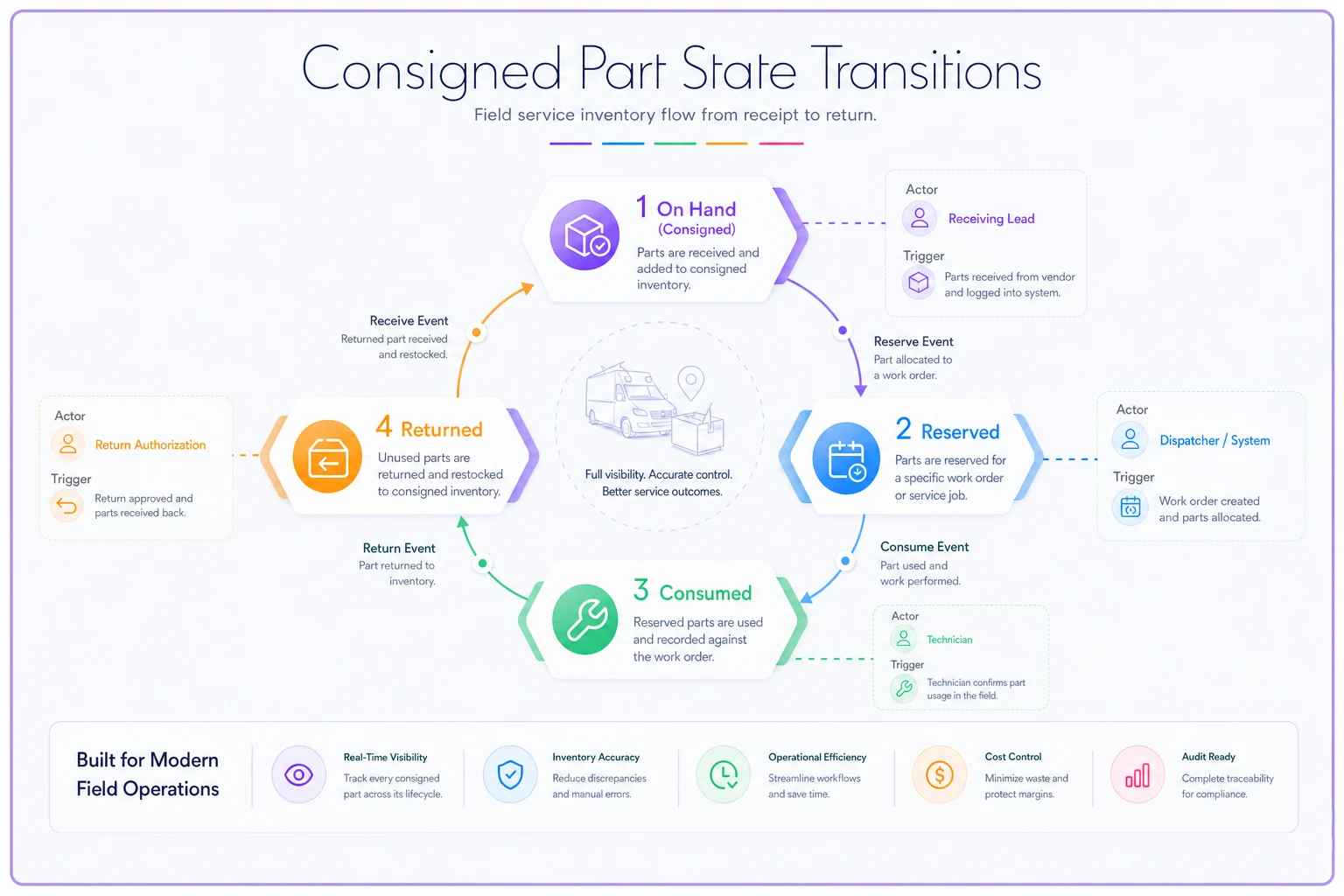
The trap is treating "reserved" and "consumed" as the same thing. They aren't. A part reserved for a job that gets cancelled must roll back to on-hand, not silently become consumed. Programs that skip the reserved state end up billing themselves for parts that never left the shelf.
Worth stating plainly: consumption should trigger on verified installation, not on job close. Those are different moments. A job can close with a consigned part still on the van because the tech swapped in a customer-owned spare instead. If your trigger fires on job close, you just paid for a part you still have.
Receipt SOP: getting parts onto the books correctly
Receipt is where the whole chain starts, and sloppy receiving contaminates everything after it. The goal is simple — every consigned part entering your building gets matched against a vendor delivery document within the same shift.
-
Match the delivery to an expected replenishment. Consigned deliveries should correspond to a min/max replenishment order, not arrive as surprises. Anything unexpected gets quarantined, not shelved.
-
Verify SKU, quantity, and lot/serial against the vendor packing slip. For serialized high-value parts, capture the serial at receipt — this is non-negotiable, and the worked example below shows exactly why.
-
Confirm condition. Consigned parts arriving damaged are the vendor's problem only if you document it at receipt. Miss this window and it becomes your write-off.
-
Assign a bin/van location so the part is findable. Consigned stock that gets absorbed into the general inventory pool is nearly impossible to reconcile.
-
Post the receipt to whatever system holds your consigned ledger — same day.
For serialized high-value items, capture serial numbers at receipt so later reconciliation matches specific units, not just counts.
The recurring mistake is treating consigned receipts more casually than purchased receipts, because "it's not our money yet." That's exactly backwards. You have less margin for error with consigned stock, because you're reconciling against an external party who will absolutely bill you for the difference.
Return SOP: the part everyone forgets
Returns are where consignment programs hemorrhage. Every consigned part you don't consume should eventually either sell or go back — but returns require effort, paperwork, and coordination, so they get skipped. The result is aging consigned stock that the vendor eventually forces you to buy under a "stale stock" clause you didn't read carefully.
-
Excess / slow-moving — vendor takes it back per the agreement's rotation terms. Needs a return authorization (RA) number and usually has a time window.
-
Defective on arrival — vendor credit, documented at receipt, shipped back at vendor cost.
-
Field return (uninstalled) — a reserved part that came back from a job unused. This must roll the state back to on-hand, not vanish.
A tight checklist for any consigned return:
-
[ ] Return reason coded correctly
-
[ ] RA number obtained from vendor before shipping
-
[ ] SKU, quantity, and serial (if applicable) logged against the RA
-
[ ] Consigned ledger updated to reflect the outbound
-
[ ] Proof of shipment retained
-
[ ] Vendor credit or removal confirmation received and matched
That last line is the one people drop. Shipping the part back isn't the end — you need the vendor to confirm they've removed it from your liability. Otherwise you've physically returned a part that's still showing as consumable on their books, and it reappears at true-up.
Reconciliation cadence: match the frequency to the risk
Running one quarterly count across the whole program and hoping for the best is the mistake. High-value and expendable SKUs fail differently and need different rhythms.
| SKU tier | Example | Reconcile | Method |
|---|---|---|---|
| High-value / serialized | Compressors, control boards, pumps | Per-event + monthly full | Serial match, 100% count |
| Mid-value / non-serial | Valves, motors, sensors | Monthly | Full count |
| Expendable / bulk | Fittings, gaskets, fasteners | Quarterly | Cycle count sampling |
For serialized parts, reconciliation is nearly trivial if you captured the serial at receipt and consumption — you're matching a list of serials in against serials consumed and serials still on hand. It either reconciles or a specific serial is missing, and you can chase that one part.
For expendables, chasing individual units is a waste of time. A gasket that costs $0.80 doesn't justify serial tracking. Here you reconcile on aggregate consumption against expected usage rate, and you accept a shrinkage tolerance.
Worked example: high-value SKU
Take a consigned scroll compressor, unit value around $1,900. Twelve units held on consignment across two branches.
At true-up, the vendor's system says 9 consumed, 3 on hand. Your system says 8 consumed, 4 on hand. One unit's worth of disagreement — about $1,900 in dispute.
Because these are serialized, you don't argue in aggregate. You pull the serial ledger:
-
Serials consumed per your records
8 serials, all matched to closed jobs
-
Serials on hand per your count
4 serials, physically verified in the locker
-
Vendor's "consumed" list includes one serial your locker count shows as present
Now it's a concrete question: is serial #A4471 in your locker or installed at a customer site? A physical check settles it in an afternoon. Turns out the vendor logged a replenishment shipment as a consumption. Their error, documented, no charge.
Without serial capture at receipt, that same dispute is unwinnable — you're arguing counts against counts with no way to prove which specific unit is where. You'd probably eat the $1,900 to avoid poisoning the vendor relationship.
Worked example: expendable SKU
Now a consigned brass fitting, value about $1.10, consumed in high volume. You hold roughly 800 on consignment, replenished to min/max.
You will never reconcile these by serial. Instead, you set an expected consumption band. Say historical usage runs 380–440 units a month. At month-end the vendor bills for 465 consumed. That's above band but not wildly — worth a glance, not an investigation.
But if the vendor billed 620 consumed against a physical count showing your on-hand didn't drop enough to support that number, now you have a real gap. For expendables, the reconciliation signal isn't "which unit is missing" — it's "does aggregate consumption plus current on-hand equal what was received."
The practical rule: set a shrinkage tolerance for expendables, maybe 2–4% depending on the part, and only escalate when consumption breaks the band. Chasing every fitting is how you spend $40 of labor policing a $1.10 part.
Vendor KPIs that actually hold them accountable
Most consignment agreements track nothing about vendor performance, which means the vendor has no operational pressure to keep their side clean. A few KPIs change that:
-
Replenishment accuracy — did the delivered quantity/SKU match the order? Target above 98%.
-
Reconciliation dispute rate — disputed line items as a share of total consumption events. A rising dispute rate usually means their records are drifting.
-
RA turnaround — days from return authorization request to credit confirmation. Slow RA turnaround is where returns pile up.
-
Stale stock ratio — share of consigned value that's aged past the rotation window. This is a shared responsibility, but tracking it surfaces whether the vendor is stocking you with slow movers.
-
True-up variance — total dollar gap at reconciliation vs. total consigned throughput. This is your headline number.
The pattern worth watching: a vendor whose dispute rate creeps up quarter over quarter isn't necessarily dishonest. Usually their own inventory system is loose, and they're pushing that looseness onto you at true-up. Surface it early and it becomes a joint fix instead of an annual fight.
The finance handoff
Consignment lives in an awkward spot — it's operational until a consumption event fires, then it's instantly a financial transaction. If ops and finance aren't wired together, consumption events pile up as unbilled liabilities that hit all at once.
-
Consumption events post from the field system into the consigned ledger in near real-time (or at least daily batch).
-
Finance receives a consumption feed — not a monthly surprise, a running total — so accrued liability is visible continuously.
-
Vendor invoices get matched three-way
vendor invoice ↔ your consumption ledger ↔ physical reconciliation.
-
Variances above a dollar threshold get flagged for the ops-side reconciliation owner before payment, not after.
This three-way match is the same discipline that protects you in warranty recovery — the evidence-first chargeback workflow with a finance reconciliation cadence uses nearly identical logic: never pay or claim on a number you can't tie back to a documented event.
The failure that shows up most often here is finance accruing consigned consumption monthly off the vendor's invoice rather than your own ledger. That means you're trusting the vendor's count to book your liability, and you've lost the check. Your consumption ledger has to be the source of truth, and the vendor invoice validates against it — not the other way around.
A real scenario
A regional HVAC service company, about 30 techs, ran consignment on roughly 140 SKUs across three branches. No serial capture, quarterly aggregate reconciliation, finance accruing off vendor invoices.
Their annual true-up landed with a variance of around $11k–$13k they couldn't explain. It had been happening for two years, treated as a cost of doing business.
The fix wasn't complicated. They split the SKU list into serialized high-value (about 25 SKUs) and expendables (the rest). Serial capture at receipt and consumption for the high-value group. Monthly reconciliation on those, quarterly banded checks on expendables. Consumption posting shifted to a daily feed so finance accrued off their own numbers.
The next true-up variance came in under $2k, and most of that was genuine expendable shrinkage they could actually account for. The unexplained gap — the part that had been quietly costing them somewhere around $12k a year — mostly disappeared, because now every high-value dispute pointed at a specific serial someone could go physically find.
When consignment makes sense — and when it doesn't
It's a good fit when:
-
You carry expensive, slow-moving parts you'd rather not own outright
-
Demand is unpredictable enough that pre-buying ties up real cash
-
Your vendor relationship is stable and they have decent inventory discipline
It's a bad idea when:
-
You have no reliable way to capture consumption events in the field
-
Your part-tracking is already loose on owned inventory (consignment amplifies existing chaos)
-
The vendor's stale-stock clause forces you to buy aging inventory you can't move
Who should not do this: a shop that can't reconcile its own inventory shouldn't add a consignment ledger on top. You'll just have two systems disagreeing instead of one. Get owned-inventory counts trustworthy first, then layer consignment onto that discipline.
The takeaway that matters
Consignment doesn't fail because the model is bad. It fails because the mechanics — the triggers, the return confirmations, the serial capture, the ledger that finance actually trusts — get left informal while everyone focuses on the headline savings.
Get the four states defined. Capture serials on anything worth arguing about. Reconcile high-value per-event and expendables in aggregate. Make your consumption ledger the source of truth, not the vendor's invoice. Do that consistently, and the annual true-up stops being a fight and starts being a formality — which is exactly what a well-run program should feel like.
Consignment doesn't fail because the model is bad. It fails because the mechanics — the triggers, the return confirmations, the serial capture, the ledger that finance actually trusts — get left informal while everyone focuses on the headline savings.
Get the four states defined. Capture serials on anything worth arguing about. Reconcile high-value per-event and expendables in aggregate. Make your consumption ledger the source of truth, not the vendor's invoice. Do that consistently, and the annual true-up stops being a fight and starts being a formality — which is exactly what a well-run program should feel like.
Ready to optimize your field operations?
Join 2,000+ service teams using Romrly to boost productivity, reduce downtime, and enhance customer satisfaction.