


Warranty money is the quietest form of leakage in field service. Nobody notices it walk out the door because it never technically showed up on a P&L line. A tech swaps a compressor under warranty, forgets to grab the serial photo, the OEM kicks the claim back three weeks later, and by then the failed part is scrapped and the labor hours are billed to nobody. That's not a bad quarter — that's a permanent hole in your margin that repeats every single week.
This post is narrowly about one thing: building an evidence‑first warranty chargeback workflow so claims get submitted right the first time, get reimbursed faster, and stop getting absorbed into your own cost of service. Not SLA credits, not job pricing — just warranty reimbursement mechanics.
The real reason warranty claims get denied (it's rarely the claim itself)
Denials almost never happen because the failure wasn't covered. They happen because the packet arrived incomplete, late, or contradicting itself.
Here's what a typical OEM warranty adjudicator actually checks:
-
Is the serial number legible and does it match the registered asset?
-
Is the failure date inside the coverage window?
-
Does the failure description match a covered failure mode (not "wear," not "customer abuse")?
-
Is the defective part being returned, or is there photo evidence it was destroyed?
-
Do the labor hours claimed match the OEM's flat-rate labor guide?
Now look at how a field tech actually closes a job. They diagnose, they fix, they move to the next call because dispatch is already texting. The serial photo is blurry or missing. The failure gets written as "unit not cooling" instead of "TXV valve failure — restricted refrigerant flow." Labor gets logged as 3.5 hours when the OEM only pays 1.8 on that repair code.
Every one of those gaps is a denial waiting to happen. And the pattern that keeps showing up: the packet that would've taken 90 extra seconds to complete in the field now takes an admin 40 minutes to rebuild from memory — assuming the evidence still exists at all.
Warranty vs. billable: the decision rule that stops the ambiguity
Half the leakage isn't denials. It's misclassification at the point of repair. The tech isn't sure if the job is covered, so they either bill the customer (angry callback later) or eat it as a goodwill fix (silent margin loss). Neither option gets a warranty claim filed.
Eliminate field service chaos with Romrly.
Romrly helps you assign, track, and complete service jobs efficiently and on time.
- Unified job scheduling
- Technician dispatch & tracking
- Customer notifications & updates
No credit card required
You need a hard decision rule the tech can run in under a minute, on site, before they close the job. Here's a workable version:
| Condition | Classification | Action |
|---|---|---|
| Part failed inside coverage window + covered failure mode + no abuse evidence | Warranty | Build claim packet, tag part for return |
| Part failed inside window but failure caused by misuse/environment | Billable | Document abuse evidence, quote customer |
| Failure mode ambiguous, inside window | Warranty‑pending | Build full packet, flag for office review before invoicing |
| Outside coverage window | Billable | Standard invoice |
| Labor covered but part not (or vice versa) | Split | Warranty for covered portion, billable remainder |
The single most valuable line in that table is warranty‑pending. Most shops don't have this state. Without it, ambiguous jobs get force-classified by a tech who's guessing — and those guesses tend to land on "just bill it" or "just eat it." A pending bucket lets someone with the OEM contract in front of them make the actual call before the invoice goes out and before the part gets scrapped.
The evidence‑first packet: capture it at the truck, not at the desk
The core idea is straightforward: the claim is built at the moment of repair, not reconstructed afterward. Reconstruction is where evidence dies.
A complete warranty packet for most OEM programs contains:
-
Asset identity — serial number photo, model number, install/registration date
-
Failure evidence — photo of the failed component, photo of the failure symptom (frost line, burn mark, leak point)
-
Diagnostic reading — the actual measurement that proves the failure mode (subcooling, amp draw, pressure reading)
-
Repair code + labor — mapped to the OEM's labor guide, not raw clock time
-
Part traceability — old part serial (if applicable), new part serial, return tag number
-
Timestamp + geotag — proves the repair happened when and where claimed
Here's a numbered field process that gets this done consistently, without slowing the tech down much:
-
Scan the serial first, before touching the repair. If the plate is unreadable, the tech knows immediately and can clean it or flag it — not discover the problem three weeks later.
-
Photograph the failure symptom before disassembly. The frost line or scorch mark disappears once you start working.
-
Log the diagnostic reading as a number, not a sentence. "27° subcool" beats "seemed low."
-
Select the repair code from a dropdown, not free text. This forces alignment to the OEM labor guide and eliminates the "3.5 hours logged vs. 1.8 paid" gap.
-
Tag the failed part with a return number before it leaves the site. Untagged parts become unreturnable, and unreturnable parts become denied claims.
-
Trigger the packet to office/pending review at job close — not at end of week.
This flow shows how each evidence-capture step maps to a specific moment in the repair so techs don't need a separate paperwork phase.
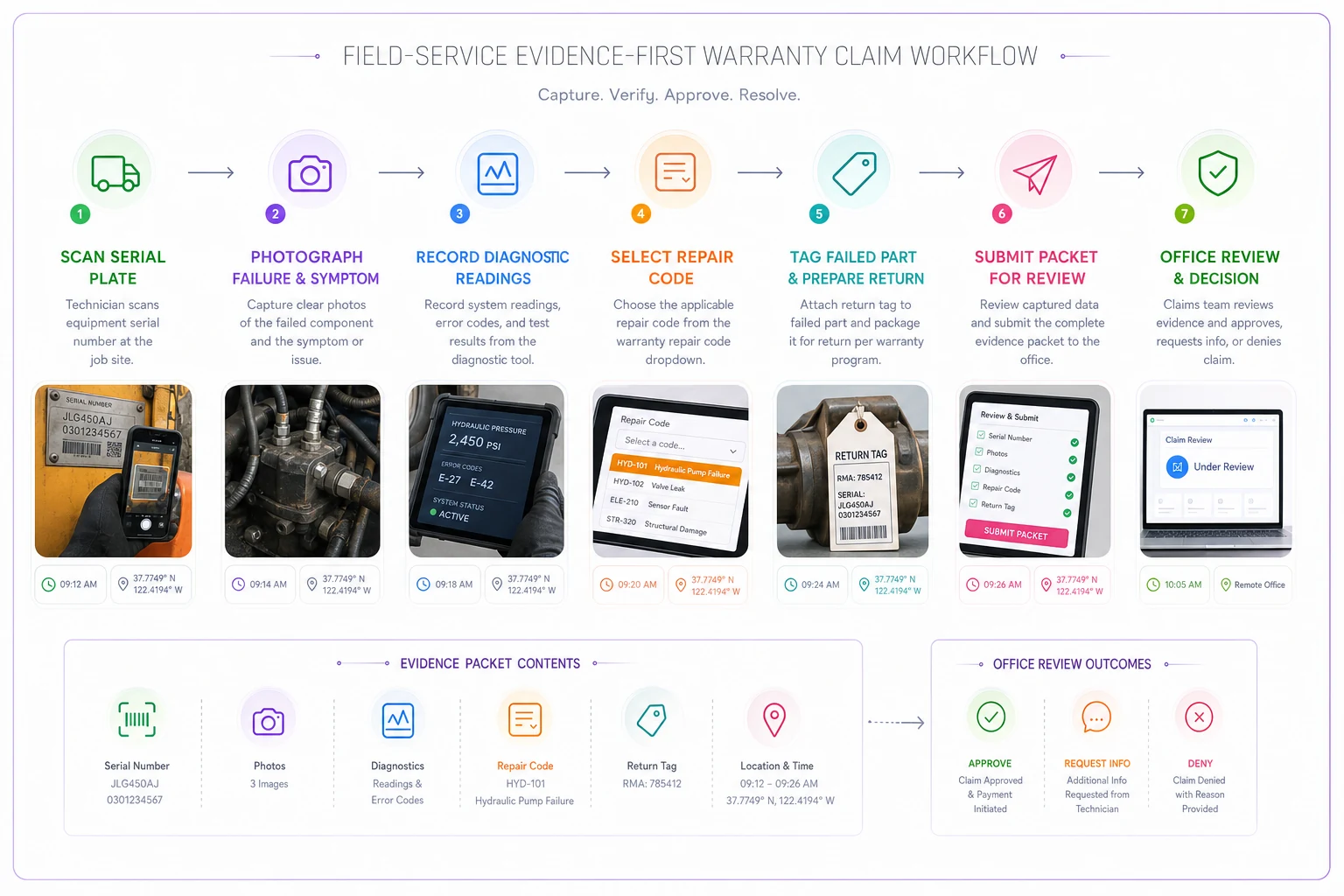
The reason this works isn't the checklist itself. It's that each step is tied to a moment the tech is already at — before the repair, during diagnosis, at part swap. You're not adding a separate paperwork phase. You're attaching evidence capture to work that's already happening.
Where the money actually leaks: five failure points
The leakage tends to cluster in five predictable spots:
-
Scrapped parts. No return tag, part gets tossed, OEM requires it back, claim dies. This is the biggest single category by a wide margin.
-
Labor overclaim → clawback. You claim clock hours, OEM pays flat-rate, you write off the difference. Sometimes they claw back paid claims months later during audit.
-
Blown filing windows. Many OEM programs have a 30–90 day filing deadline. A packet sitting in someone's inbox past that window is a total loss.
-
Misclassified jobs. The billable/warranty confusion above — the claim never gets filed at all.
-
Reconciliation gaps. You filed it, but nobody's tracking whether it actually got paid. Denials go unappealed because nobody's watching.
That last one is the quiet killer. Filing a claim feels like completing the task. But a filed claim that's never checked against an actual payment is just optimistic paperwork.
The finance reconciliation cadence
This is the part most field service shops skip entirely, and it's where an evidence‑first workflow either pays off or doesn't. Filing claims without reconciling them is like sending invoices and never following up on payment.
Set a two-track cadence with finance:
Weekly (operations-side):
-
Review the warranty‑pending bucket. Clear every job to warranty or billable — nothing older than 7 days should stay in limbo.
-
Confirm every failed part flagged for return actually shipped with a tracking number.
-
Check the filing-window aging report. Anything within 10 days of its OEM deadline gets escalated.
Monthly (with finance):
-
Match filed claims to received reimbursements. Any claim filed 45+ days ago with no payment gets flagged.
-
Categorize denials by reason code. If "missing part return" is your top denial, that's a field-capture problem, not a filing problem.
-
Track clawbacks separately. A paid-then-reversed claim points to a labor-code or documentation issue worth fixing upstream.
The value of doing this monthly with finance rather than quarterly is straightforward: OEM filing and appeal windows are short. A quarterly review uncovers denials that are already past their appeal deadline. This same discipline of matching records against expected payments is what protects you elsewhere — the audit-trail approach covered in the SLA credits data governance checklist applies almost directly to warranty adjudication.
Vendor handoff checklist
When the claim leaves your hands and goes to the OEM or distributor, the handoff itself is a leak point. Run a standard check before every submission:
-
[ ] Serial number matches registered asset in OEM portal
-
[ ] Failure mode maps to a covered repair code
-
[ ] Diagnostic reading attached and supports the failure mode
-
[ ] Labor hours match OEM flat-rate guide (not clock time)
-
[ ] Failed part return tracking number recorded
-
[ ] Claim filed with days-to-deadline noted
-
[ ] Claim logged in reconciliation tracker with expected reimbursement amount
That last item is what closes the loop. If you record the expected reimbursement at the time of filing, the monthly finance review has something concrete to match against. A claim without an expected dollar figure is essentially invisible during reconciliation.
A real scenario
A regional HVAC service company running around 14 techs was filing warranty claims off memory at end of week. Their admin rebuilt packets from job notes, and the denial rate on OEM compressor and board claims was sitting close to 30% — mostly missing part returns and labor overclaims that got clawed back months later.
They made three changes: serial-scan-first at the truck, a dropdown of OEM repair codes tied to the flat-rate guide, and a monthly reconciliation review with their bookkeeper matching filed claims to actual reimbursements.
Within about four months, the denial rate dropped to somewhere in the 8–10% range. Average time-to-reimbursement moved from roughly 70 days to just under 40, mostly because packets stopped bouncing back for missing evidence. The number that surprised them most wasn't the denial rate — it was discovering roughly $9k in claims from the prior two quarters that had been filed and simply never followed up on. That money was just sitting there, uncollected, because nobody had been watching the payment side.
When this level of rigor makes sense — and when it doesn't
It makes sense when warranty-eligible repairs are a meaningful slice of your volume — OEM-covered equipment, newer installs still in coverage, or programs with real reimbursement value. If you're running 40+ potentially-covered repairs a month, the leakage adds up fast enough to justify the workflow overhead.
It's overkill when almost all your work is out-of-warranty service on aging equipment, or when reimbursement values are tiny relative to the admin cost of chasing them. Some shops file $60 warranty claims that cost more than $60 in labor to prepare and reconcile. If that's you, set a minimum claim threshold and stop filing below it.
Who should not build this yet: if your field data capture is still unreliable — if techs can't consistently get a photo uploaded from site because of connectivity or app friction — fix capture first. An evidence-first packet built on shaky capture just moves the failure point downstream. The same goes if you haven't nailed down your per-job cost picture yet; knowing what a covered repair actually costs you is what tells you whether a claim is worth filing at all, which is why it's worth getting your per-job unit-cost worksheet sorted before you scale the warranty side.
The one thing to fix first
If you only change one thing this week, make it the return tag. Missing part returns are the most common single denial reason, and they're also the easiest to eliminate: no failed part leaves the site without a return number attached, full stop.
Make return-tagging a non‑negotiable step in your techs' closeout routine to stop the single biggest denial cause.
That one rule alone tends to recover the largest chunk of leaked warranty dollars, because a covered failure with a returned part is the claim OEMs approve without much of a fight. Everything else — the decision table, the reconciliation cadence, the labor-code alignment — makes the workflow tighter over time. But the evidence has to exist first, and evidence dies at the truck, not at the desk. Build the capture there, and reimbursements start showing up on time instead of arriving six months late, or not at all.
That one rule alone tends to recover the largest chunk of leaked warranty dollars, because a covered failure with a returned part is the claim OEMs approve without much of a fight. Everything else — the decision table, the reconciliation cadence, the labor-code alignment — makes the workflow tighter over time. But the evidence has to exist first, and evidence dies at the truck, not at the desk. Build the capture there, and reimbursements start showing up on time instead of arriving six months late, or not at all.
Ready to optimize your field operations?
Join 2,000+ service teams using Romrly to boost productivity, reduce downtime, and enhance customer satisfaction.