

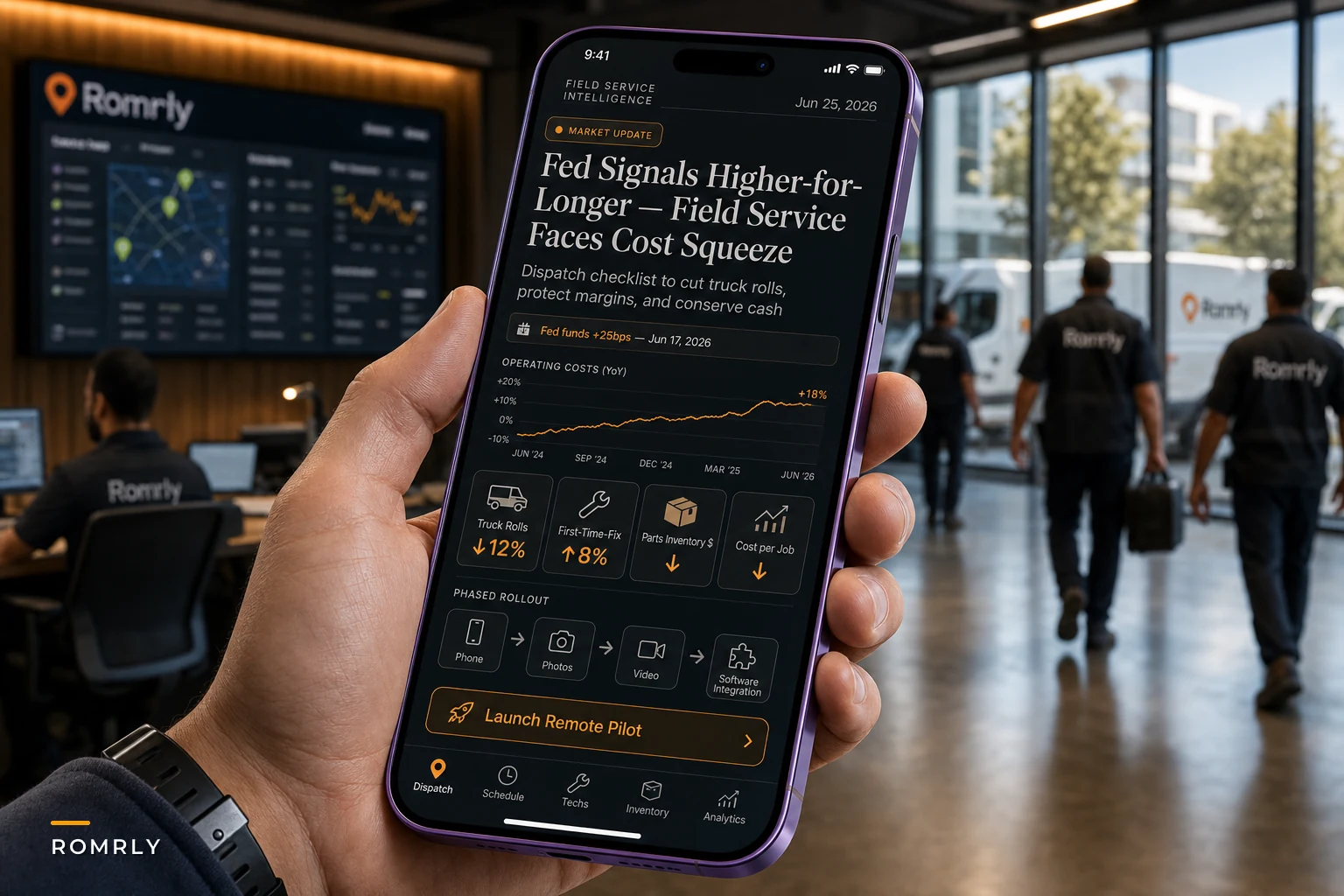

Yesterday's Fed decision basically confirmed what most field service managers have been feeling for months: money's going to stay expensive. The Federal Reserve held rates steady and — more importantly — dropped language about potential cuts. Translation: those equipment loans, working capital lines, and fleet financing rates aren't moving anytime soon.
For field service operations, this hits different than most businesses. You're not just absorbing higher borrowing costs — you're managing fleets burning $4.50/gallon diesel, techs demanding $35–45/hour to stay competitive, and parts inventory that ties up more cash every quarter. Every unnecessary truck roll now costs more than it did two years ago, and that's before factoring in the opportunity cost of a tech driving 40 minutes to reset a breaker.
The math is getting brutal. A single truck roll runs anywhere from $150 to $400 depending on your market and service type. When financing a new service vehicle costs 8.5% instead of 4%, and your fuel budget is up 30% year-over-year, every wasted trip hits the bottom line directly. Field service businesses that don't adapt are going to find themselves choosing between cutting service quality or watching margins evaporate.
The compounding cost problem
Most field service managers track the obvious costs — hourly wages, fuel, parts markup. But higher interest rates create a cascading effect that touches everything. Your parts distributors are dealing with the same financing pressures, so they're tightening payment terms. Instead of net-60, you're getting net-30. That $80k in rotating inventory now needs to turn faster, or you need a bigger credit line at worse rates.
Then there's the vehicle replacement trap. Three years ago, you could finance a new Transit or Sprinter at 3.9% over 60 months. Today you're looking at 7.8% with excellent credit, higher if not. On a $55,000 service vehicle, that's an extra $4,800 in interest alone. So you keep older vehicles running longer — more breakdowns, more rental costs when trucks are in the shop, techs sitting idle waiting on a loaner.
The labor market doesn't help either. With rates staying high, construction and development slow down, which theoretically should free up more available techs. What actually tends to happen is that the experienced ones stay put at stable companies, and you're fighting over the same shrinking pool. To attract anyone decent, you're offering $2–3/hour more than last year plus signing bonuses that would have seemed insane in 2019.
The real margin killer is the combination effect. Higher wages mean each truck roll costs more. Higher fuel costs mean each mile costs more. Higher financing costs mean you can't easily add vehicles to optimize routes. Every inefficiency gets magnified.
Why standard dispatch optimization isn't enough anymore
In most field service operations, Monday morning looks like this: dispatcher pulls up the schedule, looks at a map, and groups jobs by general area. North side techs handle north side calls. Seems logical. Except this approach wastes enormous amounts of windshield time.
Eliminate field service chaos with Romrly.
Romrly helps you assign, track, and complete service jobs efficiently and on time.
- Unified job scheduling
- Technician dispatch & tracking
- Customer notifications & updates
No credit card required
Dispatchers regularly send techs on 25-minute drives past other techs who are 8 minutes from the same job. Why? Because Tech A "knows that customer" or Tech B "doesn't like doing compressor replacements." These informal rules made sense when diesel was $2.80 and experienced techs started at $28/hour. Now every preference-based routing decision costs real money.
Geographic batching also falls apart when you factor in actual traffic patterns, job complexity, and parts availability. Your north side tech might be closest to five jobs, but if three of them need parts he doesn't have on the truck, you've just created three future truck rolls. Meanwhile your south side tech is carrying exactly those parts, driving past those locations to reach his assigned territory.
Callbacks from incomplete repairs are the worst of it. Nothing destroys profitability faster than sending a tech back to finish a job. You eat the full cost of another truck roll and can't bill for it. At current cost structures, three callbacks can wipe out the profit from an entire day of standard service calls.
Dynamic scheduling based on real-time factors — parts on hand, skill match, current location, traffic — can cut unnecessary truck rolls by 20–30%. But most dispatchers are still using the same whiteboard-and-gut-feel system they learned fifteen years ago.
The hidden profit in reducing truck rolls
Every field service manager knows truck rolls cost money, but few actually calculate the full impact. Take a typical 8-tech operation running around 420 service calls monthly. At current cost levels, you're probably looking at something like:
-
Average truck roll cost
$275 (wages, fuel, vehicle wear, overhead allocation)
-
Average revenue per call
$385
-
Net margin per successful call
$110
Of those 420 calls, probably 60–70 are callbacks, follow-ups, or "quick stops" that generate little or no revenue. Another 30–40 are diagnostic visits that could have been handled remotely. That's roughly 100 wasted truck rolls monthly, burning $27,500 in direct costs while generating maybe $8,000 in billable work.
| Description | Amount |
|---|---|
| Typical operation | 8-tech operation running around 420 service calls monthly |
| Wasted truck rolls | Roughly 100 wasted truck rolls monthly |
| Direct costs of wasted rolls | Burning $27,500 in direct costs |
| Billable work from wasted rolls | Generating maybe $8,000 in billable work |
Cutting those unnecessary truck rolls in half — just 50 fewer wasted trips — saves $13,750 monthly in direct costs. The bigger gain comes from redeployment. Those 50 freed-up slots can handle actual revenue-generating work. At your average ticket value, that's potentially another $19,000+ in monthly revenue. Combined, you're looking at a meaningful swing to your bottom line.
The compound effect builds over time too. Fewer truck rolls means less vehicle wear, which extends replacement cycles. Less windshield time means less tech fatigue. Fewer callbacks means better online reviews, which drives more high-margin work your way.
Some operations that seriously commit to reducing truck rolls see profit margins jump from 12–15% up to 22–25% within six months — not from raising prices or cutting staff, just from eliminating dispatch and diagnostic waste.
Remote diagnostics that actually work in practice
The phrase "remote diagnostics" makes a lot of field service managers roll their eyes. They've seen vendors pitch expensive webcam setups that customers never use properly. But practical remote diagnostics isn't really about technology — it's about systematic triage before rolling a truck.
Start with commercial accounts where you already have equipment history. HVAC companies have figured this out better than most. Before dispatching for a "no cooling" call, they'll have someone walk the customer through thermostat settings, circuit breakers, and filter status. Sounds basic, but roughly 15% of emergency calls resolve over the phone once someone asks the right questions in the right order.
Our remote diagnostics pilot plan covers the technical setup in detail, but the operational side matters more. You need clear escalation triggers — when to keep troubleshooting versus when to dispatch immediately. A grocery store freezer alarm gets immediate response. An office building AC issue might get 10 minutes of remote diagnosis first.
Having customers send smartphone videos of equipment panels, error codes, and unusual sounds works surprisingly well. Nothing fancy, but effective. A 30-second video showing a flashing error code can tell an experienced tech exactly what parts to bring, eliminating the diagnostic visit entirely. Some operations have cut their two-visit repairs by 40% just by requiring video submission for non-emergency calls.
The key is making remote diagnostics systematic, not optional. Every non-emergency call follows the same triage process. Dispatchers need scripts, not suggestions. "Is the unit making any unusual sounds? Can you hold your phone near it for 10 seconds?" These structured questions catch issues customers wouldn't think to mention.
Building this into your operational software means dispatchers can't skip it — the system won't allow a work order to be created without completing remote triage for applicable call types. That forced consistency is what separates operations that actually reduce truck rolls from those that try for a month and revert to old habits.
Parts management when carrying costs spike
With working capital costing 8–9% annually, that $120k in van stock and warehouse inventory stings more than it used to. But cutting inventory creates multiple trips for parts — exactly what you're trying to avoid. The balance point has shifted, and most operations haven't caught up.
The traditional approach says stock trucks with commonly needed parts plus specialty items based on tech preference. Except carrying $3,000 in miscellaneous capacitors "just in case" costs around $270/year per van in carrying costs alone. Across 8 trucks, that's over $2,000 annually on parts that might get used twice.
A smarter approach: centralize slow-moving inventory and use actual data to optimize truck stock. Track every part pull for 90 days. Patterns will emerge — Tech A uses certain refrigeration parts weekly, Tech B barely touches them. So why is Tech B carrying $400 in refrigeration components? Because that's what the "standard truck setup" says.
Track every part pull for 90 days to identify slow movers and reconfigure truck stock accordingly.
Create role-specific truck configurations. Commercial HVAC techs carry different parts than residential service techs. Installation crews need different inventory than repair techs. This seems obvious but most operations still use generic setups designed back when parts were cheaper to carry.
Dynamic restocking based on next-day schedules also helps reduce both carrying costs and truck rolls. If Tech A has three commercial calls tomorrow, stock tonight for those specific customer types. Pull historical data — what parts did you need on the last five visits to each site? Load those tonight instead of hoping generic inventory covers it.
Some operations have started using "parts runners" during peak season — lower-wage employees who deliver parts to job sites. Sending an $18/hour runner to deliver parts beats pulling a $40/hour tech off another billable job. One runner can typically support four or five techs, preventing dozens of parts-related return trips monthly.
Tight dispatch protocols that eliminate waste
Loose dispatch protocols drain money faster than almost anything else. The problem usually isn't the dispatchers — it's the absence of systematic decision frameworks. When every dispatch decision relies on individual judgment, you get expensive inconsistency.
Start with arrival windows. Most operations still quote 4-hour windows because that's what they've always done. CNBC's analysis of the Fed decision highlighted how service businesses need operational efficiency to offset higher costs. Tighter windows seem harder to manage but actually reduce waste. A 2-hour window forces better route planning. Customers are more likely to be ready. Techs spend less time waiting around.
Put hard stops on courtesy calls. "While you're there" requests are a quiet profitability killer. A tech spending "just 15 minutes" checking a neighbor's unit sounds like good customer service. But that 15 minutes plus documentation plus schedule adjustment means the next appointment runs late, and it cascades through the rest of the day. Set a firm policy: any add-on work requires dispatcher approval and a schedule adjustment.
Batch by capability, not just geography. If Tech A is certified on a specific equipment brand, route all those calls through them — even if it means crossing territories. The extra drive time costs less than sending an uncertified tech who needs two visits or risks warranty issues.
Drop the "favorite tech" policy for standard service calls. Customer preference makes sense for installations or complex repairs, but allowing customers to demand specific techs for routine maintenance creates routing nightmares. One operation I looked at was running 30% more miles monthly because they honored every customer preference. Switching to "preferred tech when available" cut windshield time by roughly two hours per tech per day.
Real-time schedule adjustment prevents cascade failures. When a job runs over, most dispatchers just push everything back. A smarter protocol means reassessing the remaining route immediately. Can another tech absorb a quick job? Should you reschedule the complex afternoon call rather than rush it? These decisions need to happen in real time, not at 4 PM when options are gone.
Tech training that reduces return visits
The link between training gaps and truck rolls isn't obvious until you dig into callback data. Poorly trained techs don't just work slower — they generate future truck rolls through incomplete repairs, missed issues, and customers who don't trust the work.
Most operations treat training as front-loaded. New tech gets two weeks of ride-alongs, some manufacturer videos, then they're "trained." Six months later they're generating twice the callbacks of senior techs, but nobody connects it to specific knowledge gaps.
Callback analysis by tech reveals exactly where to focus. Tech B has four callbacks monthly on control board issues. Tech C never completes combustion analysis correctly the first time. These patterns show you where to spend training time. Most operations never run this analysis — they just see callbacks as a general problem and throw generic refresher training at it.
Targeted micro-training beats broad refreshers every time. Instead of sending everyone to manufacturer training, identify specific weakness patterns. Tech B gets 30 minutes with a senior tech focused specifically on control board diagnostics. Tech C gets a two-hour session on combustion analysis. Focused sessions fix specific problems that are generating truck rolls.
The diagnostic process matters more than component knowledge alone. Experienced techs rarely miss problems because they follow systematic diagnostic approaches. Newer techs skip steps, make assumptions, miss secondary issues. Teaching diagnostic methodology prevents more callbacks than teaching component repair ever will.
Video review of completed repairs works incredibly well, even if it feels a little awkward at first. Techs record short 2-minute videos explaining what they found, what they fixed, and what they checked. Reviewing these weekly catches bad habits before they become callback generators. One operation reduced callbacks by 35% over four months through video review and targeted coaching — no new equipment, no big training budget.
Building a reduce truck rolls culture without killing morale
Pushing efficiency in field service has a real risk: techs can interpret "reduce truck rolls" as "work harder for the same pay" if you frame it wrong. The pushback is real, especially from senior techs who've built their routines over years.
Frame it around professional pride, not cost cutting. No tech wants to be the one generating callbacks. No tech enjoys driving back to fix something they missed. Position truck roll reduction as "getting it right the first time" rather than "saving company money."
Share specific wins. "Tom's remote diagnosis yesterday saved a 40-minute round trip" lands differently than "we need to reduce truck rolls by 15%." Make heroes of techs who prevent unnecessary visits. One operation posts a "saved truck roll" board — not punishing the bottom, but celebrating the top. It works.
Give techs some skin in the game. Some operations share fuel savings with techs who reduce mileage. Others bonus based on first-call completion rates. The key is making efficiency gains benefit the people creating them. A tech who prevents five truck rolls monthly through better diagnosis should see something more than a pat on the back.
Address the overtime concern directly. Techs sometimes resist efficiency initiatives because unnecessary calls mean overtime hours. If reducing truck rolls threatens their income, they'll quietly sabotage every initiative. Smart operations guarantee hour minimums or redistribute saved time into profitable work that maintains tech income while improving margins.
Technology needs careful introduction too. Techs assume new software means surveillance and micromanagement. Positioned correctly — "this helps you avoid callbacks" or "this makes sure you have the right parts before you leave" — those same tools get embraced. Let techs help shape the workflows instead of having systems imposed on them.
When reducing truck rolls becomes counterproductive
Not every truck roll reduction makes sense. Push too hard and you create bigger problems than you solve.
Emergency calls need immediate response. Trying to remotely diagnose a gas leak or electrical burning smell wastes critical time and creates liability. Set clear categories where remote diagnosis never applies. The risk of delayed emergency response outweighs any possible savings.
Some customers pay for premium service specifically to skip the remote troubleshooting step. They want a tech on-site fast, and they're paying for that. Forcing these high-value accounts through cost-saving triage protocols will cost you more in relationship value than you save in truck rolls.
Geographic extremes change the math too. If a customer is 90 minutes from your shop, sending a tech back for parts might actually cost more than holding them on-site while parts are delivered. Don't apply urban efficiency metrics to rural routes.
New techs also need real field exposure, including diagnostic visits. Preventing all "learning opportunity" truck rolls stunts technician development. Budget for some inefficiency during training — it's an investment, not waste.
And ultimately, customer satisfaction scores matter more than efficiency metrics. If your truck roll reduction drops first-call resolution from 85% to 70%, you're creating future problems. Angry customers leave reviews, demand discounts, and switch providers. The lifetime value loss from poor service will exceed whatever you saved on truck rolls.
Practical rollout for systematic truck roll reduction
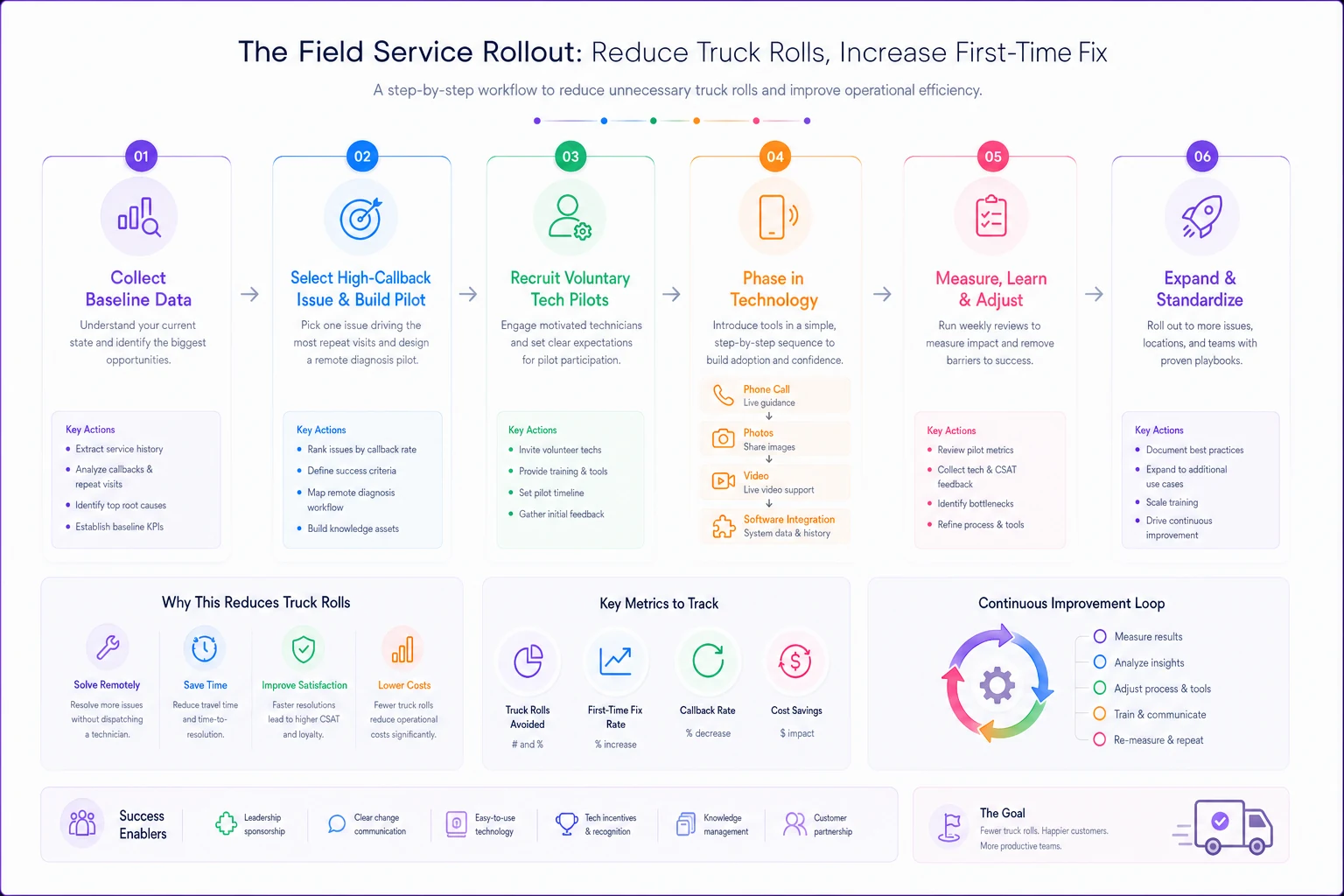
Changing dispatch and diagnostic processes requires careful sequencing. Change everything at once and your operation falls apart. Here's what tends to actually work when operations make this transition.
Month 1 — collect data, don't change anything yet. Log every callback with specific reasons. Track parts runs separately from service calls. Note every instance where remote diagnosis could have applied. This baseline shows you where to focus and gives you something to measure against later.
Pick one high-callback issue type and fix that process first. Maybe it's "no cooling" calls in summer. Develop remote diagnosis protocol just for that issue. Train dispatchers on the questions. Create customer communication scripts. Get this single process running smoothly before expanding.
Build tech buy-in through voluntary pilots. Ask for volunteers to test remote diagnosis protocols instead of mandating them. The techs who opt in become champions when it works. Their stories convince skeptics better than any management directive.
Phase in technology gradually.
-
Weeks 1–4
Phone-based remote diagnosis only
-
Weeks 5–8
Add texted photo requirements for specific issue types
-
Weeks 9–12
Introduce video diagnosis for complex problems
-
Week 13+
Integrate diagnostic data into dispatch software
This gradual build prevents overwhelming staff with too many new systems at once.
Measure the right things from day one:
-
Callbacks by type and technician
-
Miles driven per completed job
-
Parts-related return visits
-
First-call completion rate
-
Customer satisfaction scores
Watch these weekly, not monthly. Fast feedback lets you adjust before bad patterns become habits.
Set realistic targets based on your actual operation. A residential HVAC company might cut truck rolls by 25%. A commercial equipment service operation might see 15%. Your geography, customer base, and service mix determine what's possible. Don't chase arbitrary benchmarks that don't fit your reality.
Here's a simple workflow visualization.
Watch these weekly, not monthly. Fast feedback lets you adjust before bad patterns become habits.
The new economics of field service
The Fed's decision to hold rates high isn't a temporary inconvenience — it's the operating environment field service businesses need to plan around. Every unnecessary truck roll now carries a higher cost that compounds through financing expenses, wage pressure, and fuel prices. Operations that don't systematically reduce waste will face a slow squeeze between service quality and profitability.
The tools and processes to cut truck rolls already exist though. You don't need revolutionary technology or heavy capital investment. Systematic remote diagnosis, tighter dispatch protocols, targeted training, and operational discipline can realistically cut unnecessary visits by 20–30% within six months.
At current cost structures, reducing truck rolls from 520 to 420 monthly saves roughly $27,500 in direct costs while freeing capacity for additional revenue-generating work. That kind of monthly impact goes a long way toward offsetting the pressure from higher interest rates and wages.
The operations doing well despite this rate environment aren't the ones with the newest trucks or the most sophisticated software. They're the ones that eliminated waste, systematized their processes, and built cultures where efficiency and service quality reinforce each other. They turned higher costs into operational discipline that will serve them regardless of where rates go next.
Your techs are driving past opportunities to save money every single day. In an environment where borrowing costs stay elevated and margins stay compressed, operational efficiency isn't just smart — it's necessary.
Ready to optimize your field operations?
Join 2,000+ service teams using Romrly to boost productivity, reduce downtime, and enhance customer satisfaction.