

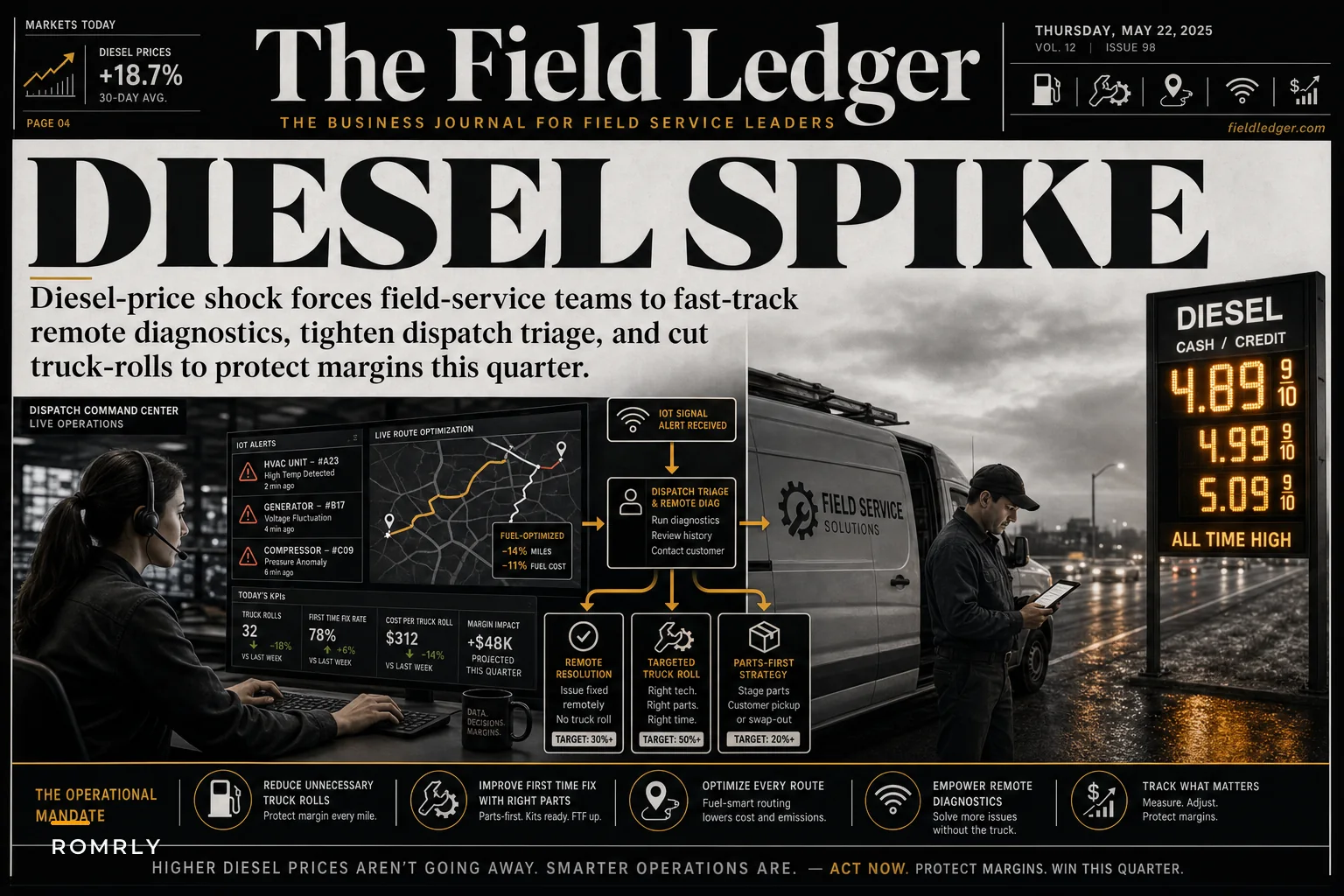

Last week changed things fast for field service operations. Russia's sudden diesel export ban sent U.S. diesel futures jumping by their largest single-day margin in four years, according to Reuters. For service managers running fleets, this wasn't just a market headline—it was an immediate hit to operating costs that landed right in the middle of peak summer season.
The math is rough. A commercial service van averaging 14 MPG just saw its per-mile cost climb from around $0.28 to potentially $0.35 or higher. Multiply that across 40 trucks running 80 miles daily and you're looking at an extra $8,000–$9,000 monthly just in fuel. That's before idle time, unnecessary callbacks, or those diagnostic runs where a tech drives 45 minutes to reset a breaker.
What this spike really exposed, though, is that most field service operations were already bleeding money on unnecessary truck rolls before diesel hit these levels. The fuel crisis just made those inefficiencies impossible to keep ignoring.
The Hidden Multiplication Effect
When diesel spikes, the damage goes beyond simple fuel costs. Every unnecessary truck roll now carries a compounding penalty that most managers miss.
Take a typical HVAC operation running 25 trucks. Pre-spike, sending a tech to diagnose a commercial rooftop unit might cost around $47 in direct expenses—fuel, hourly wage, vehicle wear. Post-spike, that same visit hits $58. But the real damage is the cascade.
That tech spending 90 minutes on a diagnostic visit can't take the emergency call that came in 20 minutes away. Dispatch sends someone else from across town—adding another 35 miles of windshield time. The first customer needs a part that's not on the truck, so now there's a return visit tomorrow. One service need has turned into three truck rolls, each carrying that inflated fuel penalty.
It gets worse in spread-out territories. A plumbing company covering three counties might watch their average cost per resolved ticket jump from $165 to $210, not because the work changed, but because their dispatch patterns never accounted for fuel swings.
Why Traditional Dispatch Rules Break Under Pressure
Most dispatch systems use proximity-based routing—closest tech gets the call. That worked fine when fuel was stable. When diesel costs swing 20% in a week, those same algorithms start killing margins.
Eliminate field service chaos with Romrly.
Romrly helps you assign, track, and complete service jobs efficiently and on time.
- Unified job scheduling
- Technician dispatch & tracking
- Customer notifications & updates
No credit card required
Standard dispatch software treats all service calls the same. The commercial freezer alarm gets the same priority weighting as a residential AC tune-up. The experienced tech with diagnostic equipment gets sent to reset a circuit breaker while the junior tech struggles with a complex variable-speed motor issue five miles away.
What really breaks these systems is they can't factor in resolution probability. They can't tell the difference between a call that needs hands-on repair and one that could be handled over the phone. They don't know which tech carries the right parts for specific equipment models. They can't predict which issues are likely to turn into callbacks.
During fuel spikes, these blind spots stack up. Every misrouted truck, every tech dispatched without the right parts, every diagnostic visit that could've been a call—they all cost more when diesel is pushing $4.50.
Remote Diagnostics: The Immediate Pressure Valve
The fastest way to reduce truck rolls isn't better routing—it's eliminating the trip entirely. Remote diagnostics technology has come a long way, but adoption is still surprisingly low. Most operations still dispatch first and diagnose second.
A facilities management company in Phoenix restructured their diagnostic workflow last year, well before this current situation. They installed IoT sensors on critical equipment at their top 40 commercial properties—their highest-value contracts—and fed that data to their dispatch center, where coordinators can spot problems before customers even notice them.
Their process: when equipment shows anomalies, the coordinator pulls historical data, cross-references recent service records, and starts a remote diagnostic session. About 35% of issues get resolved through remote power cycling, setting adjustments, or walking the customer through something basic. Another 25% get properly diagnosed before anyone gets in a truck, so the right tech arrives with the right parts.
About 40% still need truck rolls—but they're targeted. The tech knows exactly what's wrong, carries the correct components, and finishes the job on the first visit. Their first-time fix rate jumped from around 67% to 84%, purely through better pre-dispatch intelligence. If you want a structured way to build this capability, the remote diagnostics pilot plan breaks down the technical requirements and ROI milestones in detail.
Here's a simple workflow visualization:
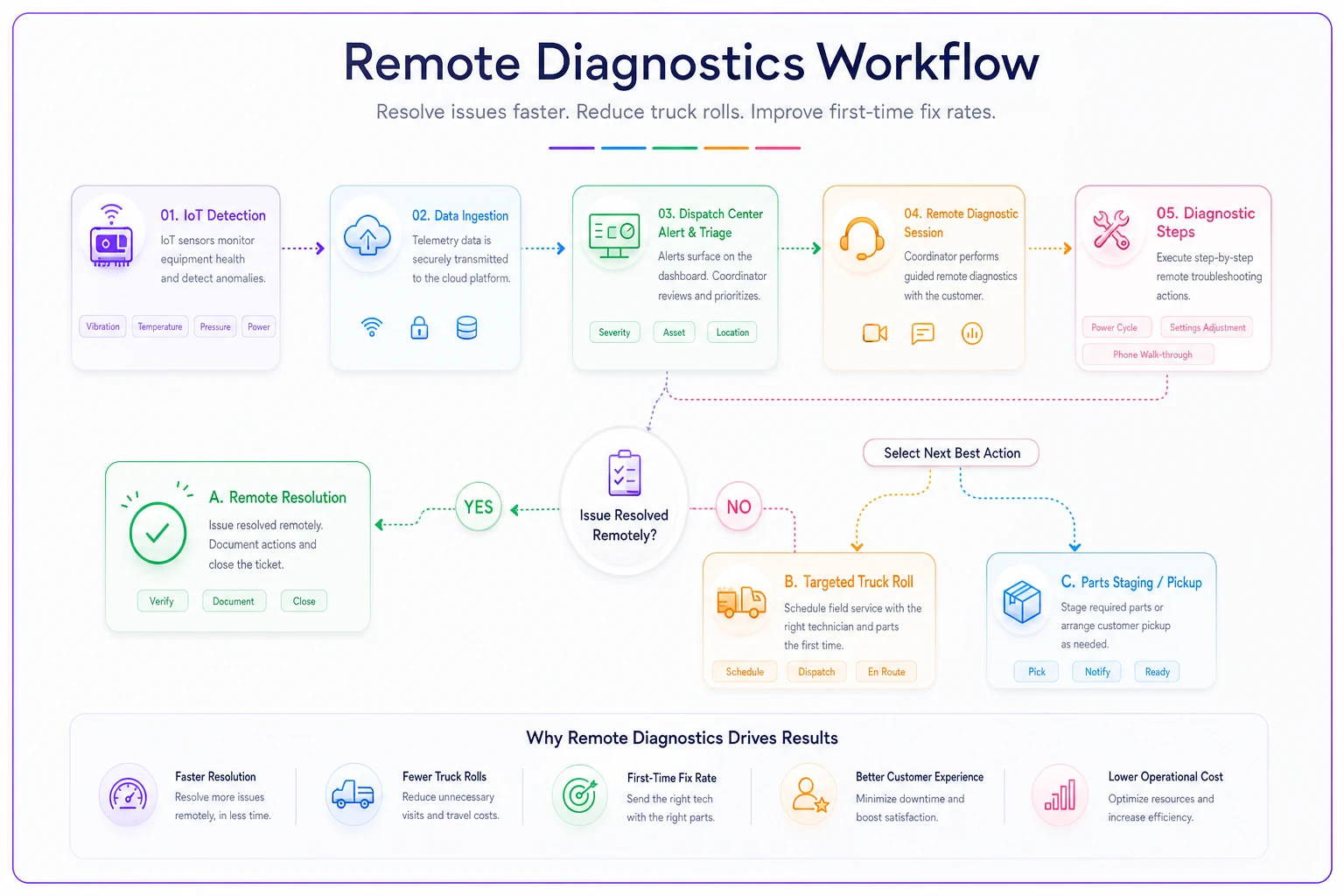
The diagram shows how many issues resolve before a truck rolls and how targeted truck rolls reduce wasted miles.
The Parts Problem Everyone Ignores Until It's Too Late
Remote diagnostics only work if techs arrive prepared. Most field service operations still run with generic truck stock—a handful of common parts that might cover 60% of issues. The other 40% triggers callbacks, return trips to the warehouse, or customer wait times while parts get ordered.
During fuel volatility, that parts gambling gets expensive fast. An elevator service company tracked their callback patterns and found that 18% of their truck rolls were technicians returning to sites with parts they hadn't carried initially. Each callback averaged 42 miles round-trip from their central warehouse.
Map parts usage by customer site and adjust truck stock daily to the day's routes.
Their fix wasn't complicated, but it took discipline. They pulled three months of service data and mapped which parts were used at which customer sites. Patterns emerged—certain building ages needed specific relay models, certain elevator brands had predictable wear points, certain areas had water quality issues affecting hydraulic systems.
They restructured truck inventory based on daily routes instead of generic lists. Techs servicing downtown high-rises carried different stock than those hitting suburban office parks. They also set up forward inventory points—locked storage at major accounts where they could stage commonly-needed components.
Callback rates for parts dropped to around 7%, saving roughly 1,400 truck miles monthly. At current diesel prices, that's close to $5,000 in direct fuel savings, plus the labor hours and customer satisfaction on top of that.
Triage Scoring That Actually Reduces Movement
Not every service call needs an immediate truck roll. Without clear triage criteria, though, dispatchers make gut-feel decisions—sending trucks to whoever complains loudest or has the biggest contract.
A commercial refrigeration company built a scoring matrix that changed how they dispatch entirely. They weighted factors like:
-
Equipment criticality (blood bank freezer vs. break room refrigerator)
-
Failure impact (complete outage vs. degraded performance)
-
Customer self-help capability (tech-savvy facility manager vs. elderly property owner)
-
Historical resolution patterns (customers whose issues tend to be user error)
-
Current equipment age and service history
The scoring runs automatically through their dispatch platform, but the real work was training coordinators to trust it. High-score issues get immediate truck rolls. Medium scores trigger a remote diagnostic attempt first. Low scores get scheduled into efficient route clusters or pushed to the next regular maintenance visit.
The scoring surfaced some surprises. About 22% of their "emergency" calls turned out to be maintenance issues that customers had panicked about. Another 15% were user errors—thermostats set wrong, breakers needing a reset, filters needing basic cleaning. Catching those through phone triage eliminated roughly 450 unnecessary truck rolls per year.
Dynamic Routing vs. Static Territory Management
Traditional field service runs on static territories—Tech A covers zip codes 1–5, Tech B handles 6–10. It made sense when customer density was predictable and fuel was stable. Now it's a liability.
Dynamic routing means rebuilding the schedule daily based on real conditions. A pool service company in Houston dropped territories entirely during last summer's heat wave. Instead, they cluster jobs daily based on:
-
Current tech locations and remaining capacity
-
Equipment and parts on each truck
-
Traffic patterns and time-of-day constraints
-
Customer flexibility—who can wait vs. who needs service now
-
Skill matching for specific equipment types
Every morning, their dispatch platform builds optimized routes that minimize total fleet mileage while keeping service windows intact. Techs might hit different areas each day, but the system tries to match techs to customers they've serviced before when it can.
The transition wasn't smooth. Experienced techs pushed back on losing "their" customers. Some customers noticed different faces. But the numbers made the case—fuel costs dropped 18% while completion rates improved. What helped was giving techs visibility into the routing logic so they understood the reasoning, not just the outcome.
Building Fuel Triggers Into Operating Procedures
Most companies treat fuel spikes as something to ride out. Smarter operators build fuel volatility triggers directly into their SOPs so the response is automatic, not reactive.
| Diesel Price | Policies |
|---|---|
| $3.75/gallon diesel | - Remote diagnostic attempts required before dispatch - Non-critical maintenance batched into weekly route clusters - Part pickup trips require a minimum of three orders |
| $4.25/gallon diesel | - Territory boundaries become flexible for route optimization - Customers get offered self-service options with phone support - Forward parts staging activates at major accounts |
| $5.00/gallon diesel | - Emergency-only dispatch for residential accounts - Commercial accounts move to scheduled cluster service - Fuel surcharges activate automatically |
Nobody's scrambling when prices move because everyone already knows the playbook. Dispatchers know when policies shift. Techs understand why routes look different. Customers get transparent communication instead of surprises.
The Technology Stack That Actually Matters
Every software vendor promises to reduce truck rolls. Most field service platforms just digitize existing inefficiencies. The tools that actually cut unnecessary movement share a few specific traits.
-
Real-time visibility comes first. If dispatchers can't see where every tech is, what they're carrying, and what they've completed, they're routing blind. GPS tracking matters, but live job status updates—ones techs can actually input quickly from the field—matter more.
-
Historical intelligence drives better decisions over time. The system needs to remember that Customer A's equipment always needs Part X, that Tech B specializes in Brand Y, that Location C has parking restrictions after 2 PM. That institutional knowledge can't live in someone's head—it needs to be built into routing logic.
-
Integration depth determines whether any of this actually works. Routing needs to talk to inventory management, customer history, equipment databases, and accounting. When those systems run in silos, dispatchers make decisions with incomplete information.
AI-powered operational software can tie these pieces together—learning from patterns to predict which calls need truck rolls versus remote resolution, analyzing service history to recommend better parts stocking, flagging customers with high callback rates before dispatch happens. The platform becomes a force multiplier for good operations, not a substitute for them. The best routing algorithm can't fix a warehouse chronically out of stock, and the smartest diagnostic system fails if techs don't document what they find.
Measuring What Actually Drives Profit
Traditional field service metrics focus on activity—calls completed, response times, utilization rates. During a fuel crisis, those numbers become distractions.
The metrics that matter right now:
-
Miles per resolved ticket (not per visit)
-
First-visit resolution rate by issue type
-
Remote resolution percentage
-
Callback rate within 7 days
-
Parts availability at point of service
-
Revenue per gallon of fuel consumed
A fire suppression company rebuilt their entire dashboard around fuel efficiency metrics and discovered something uncomfortable. Their top performer by traditional measures—most calls completed daily—was actually their least profitable tech. He was cherry-picking easy jobs, which meant other techs had to cover the complex issues he avoided.
Their "slowest" tech had the highest profit contribution. She spent more time on proper diagnosis, carried comprehensive parts inventory, and had near-zero callbacks. Her lower daily ticket count masked how much better her fuel efficiency and customer satisfaction scores were. That kind of thing doesn't show up until you measure the right things.
The Psychological Shift Nobody Prepares For
Reducing truck rolls means fighting human instinct. Dispatchers want to help customers immediately. Techs are used to windshield time. Customers expect someone to show up.
A pest control company ran straight into this when they launched their reduced truck roll initiative. Dispatchers felt guilty making customers wait. Techs worried fewer visits meant fewer hours. Customers pushed back on phone troubleshooting instead of in-person service.
The shift came from reframing the conversation. They stopped talking about "reducing service" and started talking about "solving problems faster." Phone diagnostics became "express support." Clustered routing became "comprehensive area service days."
They also shared the math directly. When customers understood that unnecessary truck rolls eventually mean higher prices, most got on board. When techs saw that better-planned routes meant less unpaid drive time and more actual repair work, resistance faded.
The Competitive Reality of Fuel-Efficient Operations
Companies that get fuel efficiency right during price spikes don't just survive—they take market share. While competitors raise prices or quietly cut service quality, efficient operators hold margins without degrading the customer experience.
An appliance repair company used the 2022 fuel spike to overhaul their service model. While competitors added fuel surcharges, they invested in diagnostic technology and route optimization. Their costs actually went down while others struggled.
They marketed it hard. "No fuel surcharges" became their headline. They guaranteed first-visit resolution or the second visit was free. They offered video diagnostic sessions for customers willing to try basic troubleshooting first.
When fuel prices normalized, they'd gained real market share from companies that had just passed costs along. More importantly, the operational improvements stayed, giving them structural advantages that don't go away when diesel drops back down.
Making the Shift Sustainable
Fuel prices will stabilize eventually. But the operational improvements built during volatility should stick—and most of them won't unless someone actively makes sure they do.
Document what's working. That remote diagnostic process that saved 200 truck rolls last month? Write it down. The parts staging system that improved first-visit completion? Make it an SOP. The routing changes that cut fleet mileage by 15%? Make them standard.
Also worth noting: getting budget approval for diagnostic equipment or routing software is easier when fuel is $4.50 a gallon. Use the pressure to push through improvements you've wanted for years.
And when diesel drops back to $3.00, don't abandon the remote diagnostics. When customers stop asking about fuel surcharges, don't drift back to inefficient routing. The habits built during a crisis are the ones that actually create durable competitive advantages.
The diesel spike that hit field service operations last week isn't just a temporary cost problem—it's a pressure test that's revealing inefficiencies operators have been tolerating for years. Every unnecessary mile, every callback for missing parts, every diagnostic visit that could've been a phone call—these aren't new problems. Volatile fuel markets just made them impossible to rationalize away.
The managers who use this moment to restructure operations won't just get through the current spike. They'll build something that holds up long after prices normalize.
Ready to optimize your field operations?
Join 2,000+ service teams using Romrly to boost productivity, reduce downtime, and enhance customer satisfaction.