

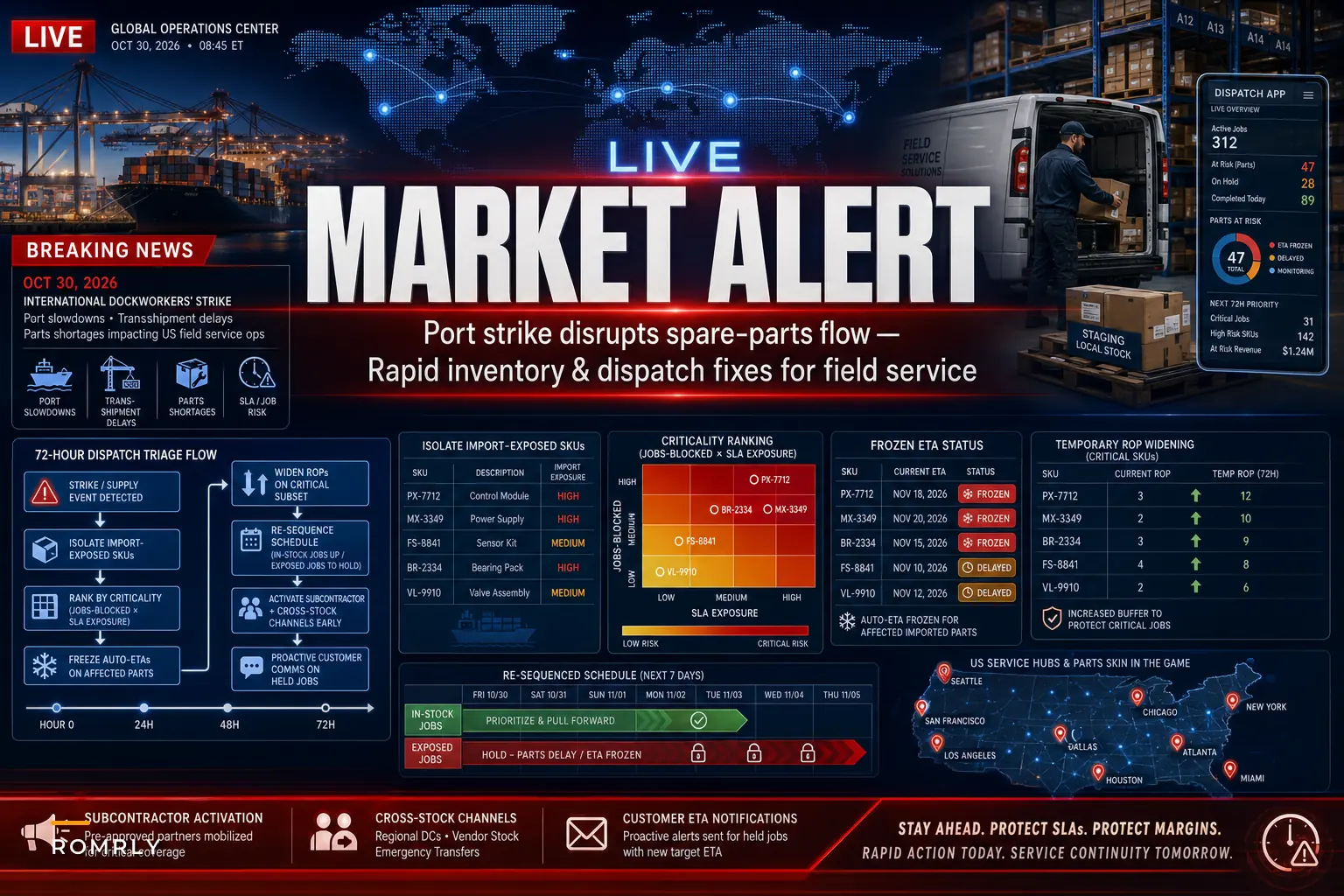

On October 30, 2026, dock and port workers staged coordinated walkouts across more than 100 ports in 22 countries. Reuters reported that the action hit container handling and transshipment activity at major shipping hubs, and Al Jazeera covered the broader scope of the day of action. Whatever the backdrop, the operational reality for a field-service manager is narrow and immediate: containers sitting idle at transshipment points mean your imported compressors, control boards, and sensor modules just got slower and less predictable.
A single-day coordinated strike rarely empties your shelves on its own. The damage comes from the wake — the backlog, the vessel bunching, the reshuffled sailing schedules, and the expedited-freight scramble that follows for two to six weeks. If your parts come through Asian or Mediterranean hubs feeding the US West Coast, that wake is what you plan around starting the morning you hear about it.
This isn't about predicting shipping markets. It's about the handful of moves you make in the first 72 hours that decide whether you absorb the disruption quietly or bleed SLA credits and margin for the next month.
What actually breaks first (and it's not your shelf)
The instinct is to check inventory levels. That's the wrong first look. Shelf counts tell you where you are today, not where your lead-time variance is about to go.
What breaks first is your reorder logic. Most field-service operations run reorder points calibrated to normal lead times — say, a control board that reliably lands in 12 days. When that same board quietly stretches to 19–26 days with a wide error band, your ROP math is now wrong for every imported SKU at once. You don't stock out today. You stock out in three weeks, on the exact high-demand parts, because the system kept ordering as if nothing changed.
The second thing to break is ETA credibility with customers. A dispatcher promises a Thursday fix based on a part showing "in transit." The part is in transit — onto a vessel anchored outside a congested port. The promise was made against stale data, and the SLA clock doesn't care about your supplier's problems.
The operations that suffer most during supply shocks aren't usually the ones with the thinnest inventory. They're the ones with the slowest information loop between supplier delays, reorder triggers, and the customer-facing promise. Parts availability is a data problem before it's a stock problem.
The first 72 hours: a triage sequence
Don't try to fix everything at once. Work in order. The sequence below keeps you from chasing noise.
Eliminate field service chaos with Romrly.
Romrly helps you assign, track, and complete service jobs efficiently and on time.
- Unified job scheduling
- Technician dispatch & tracking
- Customer notifications & updates
No credit card required
-
Isolate your import-exposed SKUs. Pull every part that originates overseas or depends on an imported sub-component. For most mixed fleets this ends up being a surprisingly short list — often 40–80 SKUs that actually matter, not your whole catalog. These are the only parts the strike touches.
-
Rank those SKUs by criticality, not by cost. A $40 sensor that's blocking 15 open work orders is more urgent than a $900 assembly you touch twice a quarter. Criticality = jobs-blocked × SLA exposure, not unit price.
-
Freeze automatic ETAs on affected parts. Stop your system from promising customer dates based on supplier "in transit" status for the exposed SKUs. Switch those to a manual-confirm state until you've re-verified each lead time.
-
Temporarily widen reorder points on the critical subset. You're buying a safety buffer against lead-time variance, not panic-stocking. Bump ROP only on the ranked top tier.
-
Pull forward the repairs you can do with what's on the shelf. Re-sequence the schedule so jobs that need in-stock parts move up, and jobs needing exposed parts move to a holding queue with proactive customer comms attached.
-
Open your subcontractor and cross-stock channels before you need them. The expedited-freight and subcontractor markets get expensive fast when everyone reacts at once. Early inquiries cost nothing and lock in options.
The point of this sequence is discipline. In real operations, the failure mode is a manager who tries to re-plan the entire parts catalog on day one, burns two days on it, and still misses the five SKUs that actually blow up the SLA.
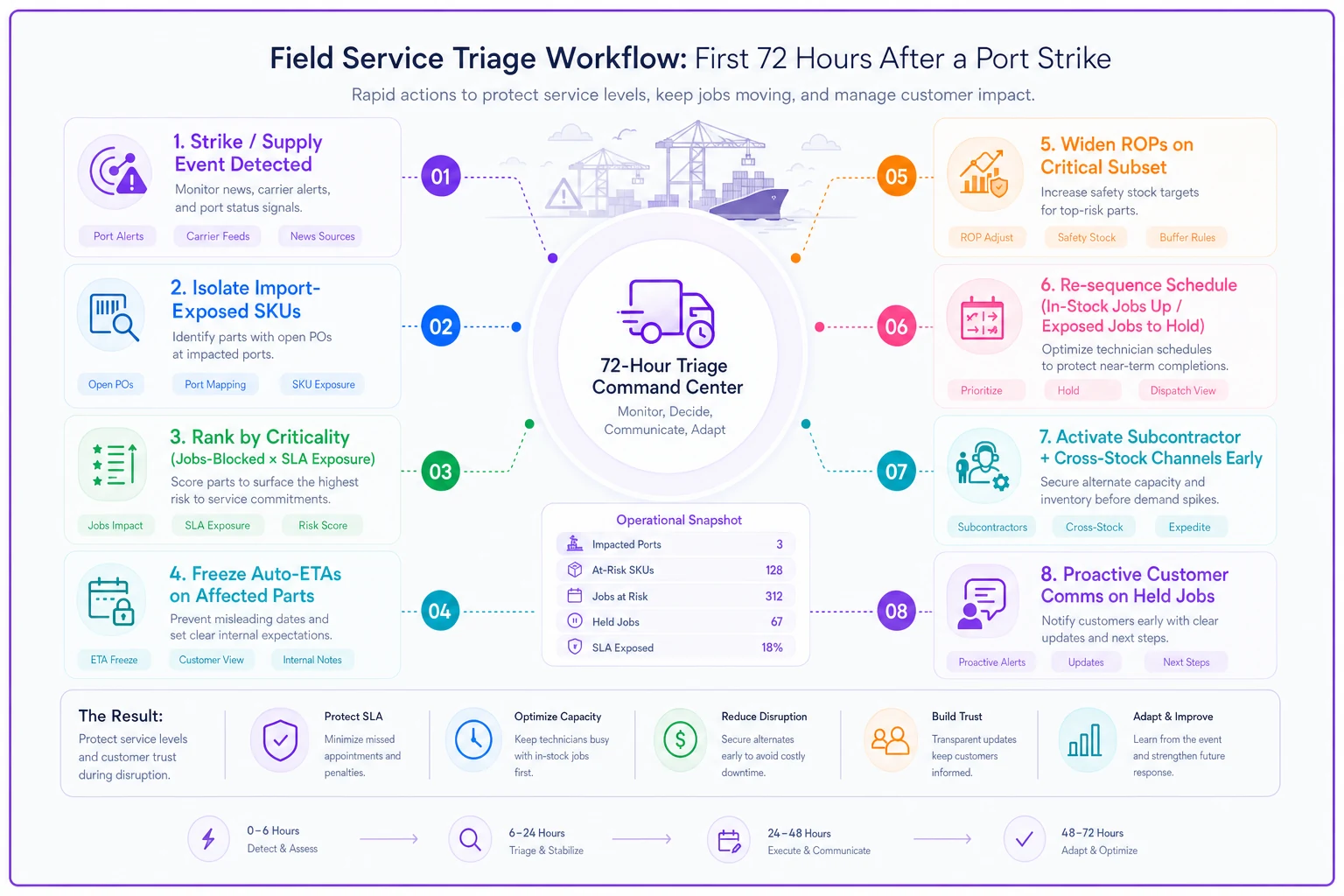
Here's a quick visual of that triage sequence.
Localize parts staging before freight gets expensive
When inbound lead times stretch, the cheapest lever is often moving parts you already own closer to where the demand is — not buying more.
A typical example: a commercial HVAC-R operator running four regional depots keeps most imported control boards centralized at one hub for inventory efficiency. Under normal lead times that's fine. During a supply shock, that centralization becomes a liability — the depot near a high-failure customer cluster runs dry while another sits on idle stock three states away.
The move is temporary redistribution. Pull your blocked and at-risk work orders, map them to depots, and shift critical imported SKUs toward the demand, even if it breaks your normal stocking rules for a few weeks. You're trading inventory efficiency for first-time-fix protection during a window where a missed fix costs far more than a slightly unbalanced shelf.
Pre-map depot demand clusters monthly so you can act on redistribution on day zero.
This is where remote parts staging and van-stock discipline pay off. Operations that ride out supply shocks well tend to have already thought through forward-staging as part of a broader field-service resilience and continuity program — so the redistribution playbook already exists and doesn't have to be invented under pressure.
Protect first-time-fix with substitution and repair‑vs‑wait calls
Every blocked imported part forces a decision most dispatch boards don't capture well: do you wait for the exact part, substitute an equivalent, repair the existing component, or defer the job?
A simple decision frame for that call under supply stress:
| Situation | Preferred move | Why |
|---|---|---|
| Equivalent domestic/alt-supplier part exists | Substitute | Avoids the delayed import entirely; verify spec fit first |
| Part is repairable, failure is non-safety | Temporary repair | Keeps asset running; schedule permanent fix when part lands |
| Critical asset, no substitute, high SLA exposure | Expedite freight | Freight premium is cheaper than SLA credit + churn risk |
| Low-criticality, flexible customer | Deferred + proactive comms | Preserves scarce parts for high-exposure jobs |
The mistake worth flagging: teams default to "wait for the right part" because it's the path of least resistance. That default quietly destroys first-time-fix rates and stacks up truck rolls. During a supply shock, the default should flip toward substitution and interim repair wherever safety and spec allow — with the exact-part fix scheduled rather than endlessly pending.
Capturing these decisions matters too. If you don't log why a job used a substitute or got deferred, you lose the audit trail you'll need when a customer disputes an SLA credit six weeks later.
Customer comms: the part most managers under-invest in
A delayed part you communicated clearly is a managed exception. The same delay discovered by the customer when nobody shows up is an SLA breach and a trust hit. The parts situation is often identical — the outcome diverges entirely on communication.
Operations that hold customer relationships during supply shocks tend to do three unglamorous things:
-
Proactive early warning. The moment a job moves to the holding queue, the customer hears a specific, honest ETA — not silence followed by a last-minute scramble.
-
Realistic ranges, not false precision. "Your part is now landing in the 18–24 day window and we'll confirm once it clears the port" beats a confident date you'll miss.
-
A visible interim plan. For critical assets, the message isn't just "it's delayed" — it's "here's the temporary fix we're applying now, and here's when the permanent one happens."
Customers forgive delays far more readily than they forgive surprises. The SLA credit disputes that get ugly almost always trace back to a promise made on stale data, not to the delay itself.
A short real scenario
A mid-sized commercial refrigeration company — roughly 22 techs, two depots — imports a specific electronic controller used across a chain-restaurant contract. After a port slowdown, their normal 11-day lead time on that controller drifted past 20 days with no reliable confirmation window.
In the first two days they did four things: flagged the controller as import-exposed, bumped its reorder point, redistributed the handful of units they had toward the depot covering the restaurant cluster, and switched roughly a dozen affected work orders to interim-repair-plus-proactive-ETA. Instead of letting those jobs silently slip into breach, they converted most to managed exceptions with clear comms. SLA credit exposure that quarter stayed in the low hundreds instead of the low thousands they'd have absorbed by staying passive, and first-time-fix on the affected contract held up better than in the prior disruption.
Nothing exotic happened there. They just moved on day zero instead of day ten.
Where the right system quietly earns its keep
None of these moves require fancy tooling in theory. In practice, doing them fast across dozens of SKUs and open work orders by hand is where it falls apart.
Operations that respond cleanly tend to run on a platform where lead-time changes, reorder points, parts location, and customer ETAs live in one connected view — so flagging import-exposed SKUs, widening reorder points on a subset, and freezing auto-ETAs are a few configuration changes, not a week of spreadsheet surgery. AI-assisted reorder logic that catches lead-time variance before it causes a stockout, and dispatch that surfaces which open jobs are blocked by which delayed part, turns a chaotic scramble into a ranked work list.
The value isn't automation for its own sake. It's that the information loop — supplier delay → reorder trigger → dispatch decision → customer promise — closes in hours instead of weeks. That loop speed is the whole game during a supply shock.
When aggressive moves make sense — and when they don't
Not every operation should react hard to every headline.
Widening reorder points and expediting freight makes sense when: you have real import exposure on critical SKUs, tight SLAs with credit penalties, and high-failure assets where a stockout directly causes breaches. The cost of over-preparing is modest inventory carry; the cost of under-preparing is churn.
It's a bad idea when: your parts are domestically sourced or dual-supplied, your SLAs are loose, or you'd be panic-buying slow-moving stock that becomes an obsolescence problem later. A short-horizon strike doesn't justify months of excess inventory on the shelf.
Who should mostly sit tight: operators with low import exposure, deep local supplier relationships, or flexible customers who tolerate ranges. Over-reacting burns cash and dispatcher attention on a problem you don't really have.
The judgment call is exposure, not fear. Figure out how many of your critical SKUs actually touch the disrupted import channels before you spend a dollar on expedited freight.
The underlying lesson
Port strikes, weather events, tariff shocks — the specific trigger changes, the operational exposure doesn't. Every one of these events tests the same thing: how fast your operation can detect a lead-time shift, re-rank its parts and jobs, and reset customer expectations before promises break.
The teams that keep their SLAs and margins intact aren't the ones with perfect forecasting. They're the ones who treat supply variance as a standing operational discipline — a known playbook they run on day zero — rather than a fire drill they improvise each time a new headline lands. Build the triage sequence once, keep your import-exposed SKU list current, and the next disruption becomes a managed window instead of a bad month.
Port strikes, weather events, tariff shocks — the specific trigger changes, the operational exposure doesn't. Every one of these events tests the same thing: how fast your operation can detect a lead-time shift, re-rank its parts and jobs, and reset customer expectations before promises break.
The teams that keep their SLAs and margins intact aren't the ones with perfect forecasting. They're the ones who treat supply variance as a standing operational discipline — a known playbook they run on day zero — rather than a fire drill they improvise each time a new headline lands. Build the triage sequence once, keep your import-exposed SKU list current, and the next disruption becomes a managed window instead of a bad month.
Ready to optimize your field operations?
Join 2,000+ service teams using Romrly to boost productivity, reduce downtime, and enhance customer satisfaction.