

Most continuity plans in field service are written to survive an audit, not an actual disruption. They sit in a shared drive, 40 pages long, approved by someone who left two years ago, and nobody opens them when a regional supplier files for bankruptcy on a Thursday afternoon and your Friday jobs suddenly have no parts.
The gap isn't awareness. Everyone knows disruptions happen — weather, supplier failures, labor shortages, a highway shut for three days. The gap is that the plan doesn't convert into action fast enough. By the time someone decides "yes, this is bad enough to do something different," you've already burned two days of normal dispatch logic on an abnormal week.
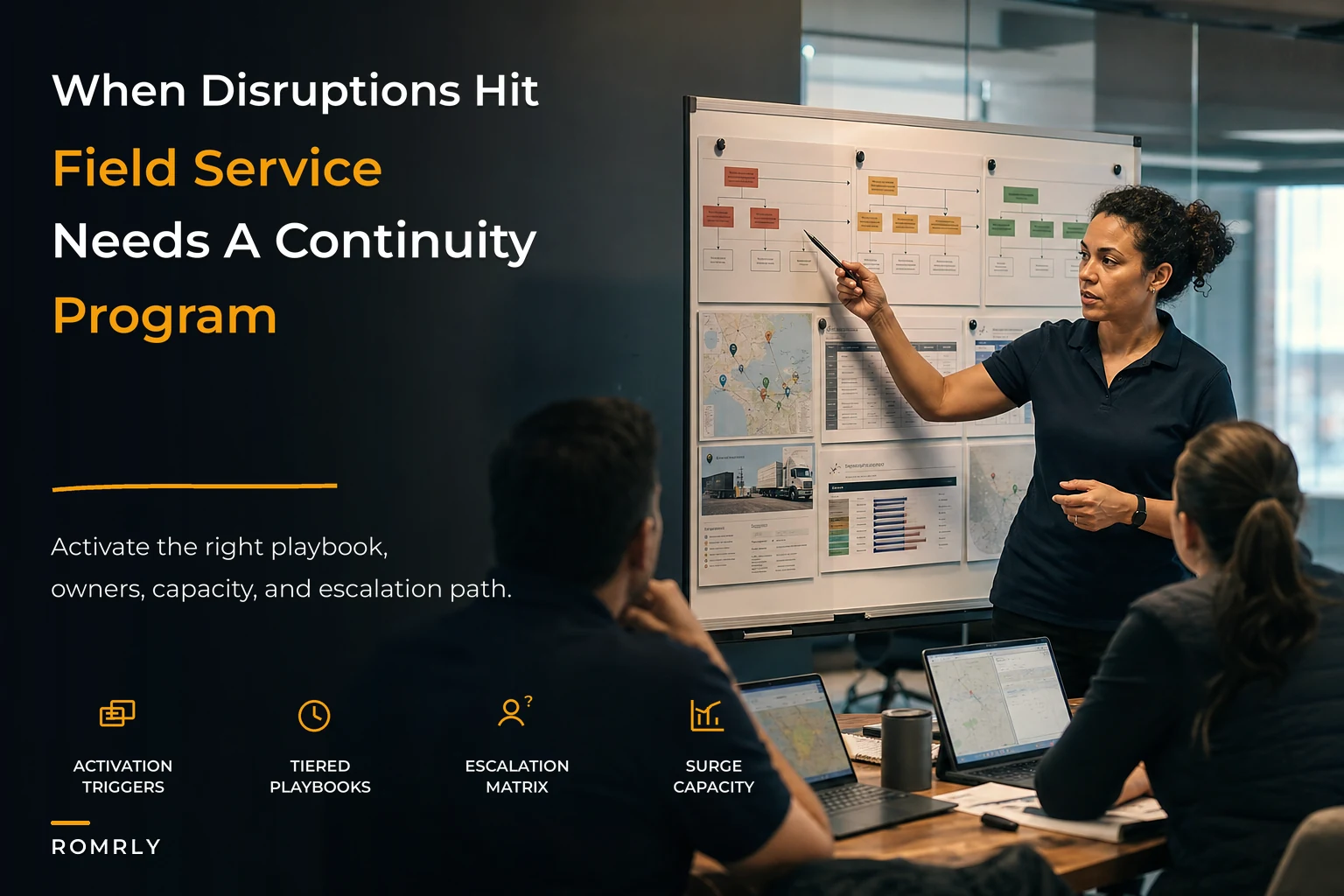
A real field service resilience continuity plan isn't a document. It's a tiered system with clear activation triggers, pre-wired customer priorities, pre-written comms, and an escalation matrix that tells people exactly who decides what, when. The whole point is to remove the hesitation. This post walks through how that system fits together, where it breaks at scale, and what the governance rituals look like to keep it from rotting.
Why most continuity plans fail the moment they're needed
The failure pattern is almost always the same — and it's not a planning failure, it's an activation failure.
Something goes wrong. A dispatcher notices parts aren't arriving. A regional manager hears a rumor about a supplier. Customers start calling. For the first several hours, everyone treats it like a normal bad day. They work harder, make more phone calls, shuffle a few jobs. The assumption is it'll sort itself out by tomorrow.
It doesn't. By day two, the workarounds are stacking. Technicians are returning to the depot for parts that aren't there. Dispatch is manually rerouting without any framework. Nobody's told priority customers anything, so they're calling in angry, pulling your best people off the actual problem to handle inbound complaints.
What you see across field operations is that the plan existed the whole time — it just never got invoked, because there was no clear trigger and no one empowered to pull it. Continuity plans die in the ambiguity between "this is a rough day" and "this is an incident."
The second failure is that the plan is one monolithic thing. It treats a two-hour power outage the same as a three-week supply shock. People hesitate to activate it for smaller events because spinning up the whole apparatus feels like overkill — and honestly, they're right. The fix is tiering.
Tiered disruption playbooks: the core of the system
Tiers matter because of proportionality. You need a response that scales with actual severity, so nobody hesitates to invoke the small version and nobody under-responds to the big one.
Eliminate field service chaos with Romrly.
Romrly helps you assign, track, and complete service jobs efficiently and on time.
- Unified job scheduling
- Technician dispatch & tracking
- Customer notifications & updates
No credit card required
A workable structure uses three tiers. Keep it to three — four is too many to reason about under stress, and two isn't enough granularity.
| Tier | What it looks like | Scope | Who activates | Response posture |
|---|---|---|---|---|
| Tier 1 – Localized | Single-day disruption, one territory, limited parts or access impact | Hours to 1 day | Shift lead or dispatcher | Reprioritize existing jobs, tap local reserve, no customer comms unless SLA at risk |
| Tier 2 – Regional | Multi-day, multiple territories or a key supplier wobble | 2–7 days | Regional ops manager | Activate cross-dock, surge capacity, priority-customer comms, daily standups |
| Tier 3 – Program-level | Structural disruption — supplier failure, extended outage, major weather event across the network | 1+ weeks | Exec sponsor + continuity lead | Full playbook, executive escalation matrix, external comms, customer prioritization enforced |
The value of the table isn't the labels. It's that each tier has a named owner who can activate without asking permission. That single detail — removing the approval bottleneck for the lower tiers — is what makes the difference between a plan that activates in 30 minutes versus one that activates a day and a half later when the damage is already done.
Each tier should have its own one-page playbook. Not 40 pages. One page per tier, because under pressure nobody reads more than that. The page covers: the trigger, the owner, the first five actions, who gets notified, and what success looks like at 24 hours.
It's worth being direct about something: most operations skip the one-pager because it feels too simple. That's backwards. The simplicity is the point. A complex document that nobody can navigate under stress is useless. A single page that someone can scan in 90 seconds and act on is what actually runs the incident.
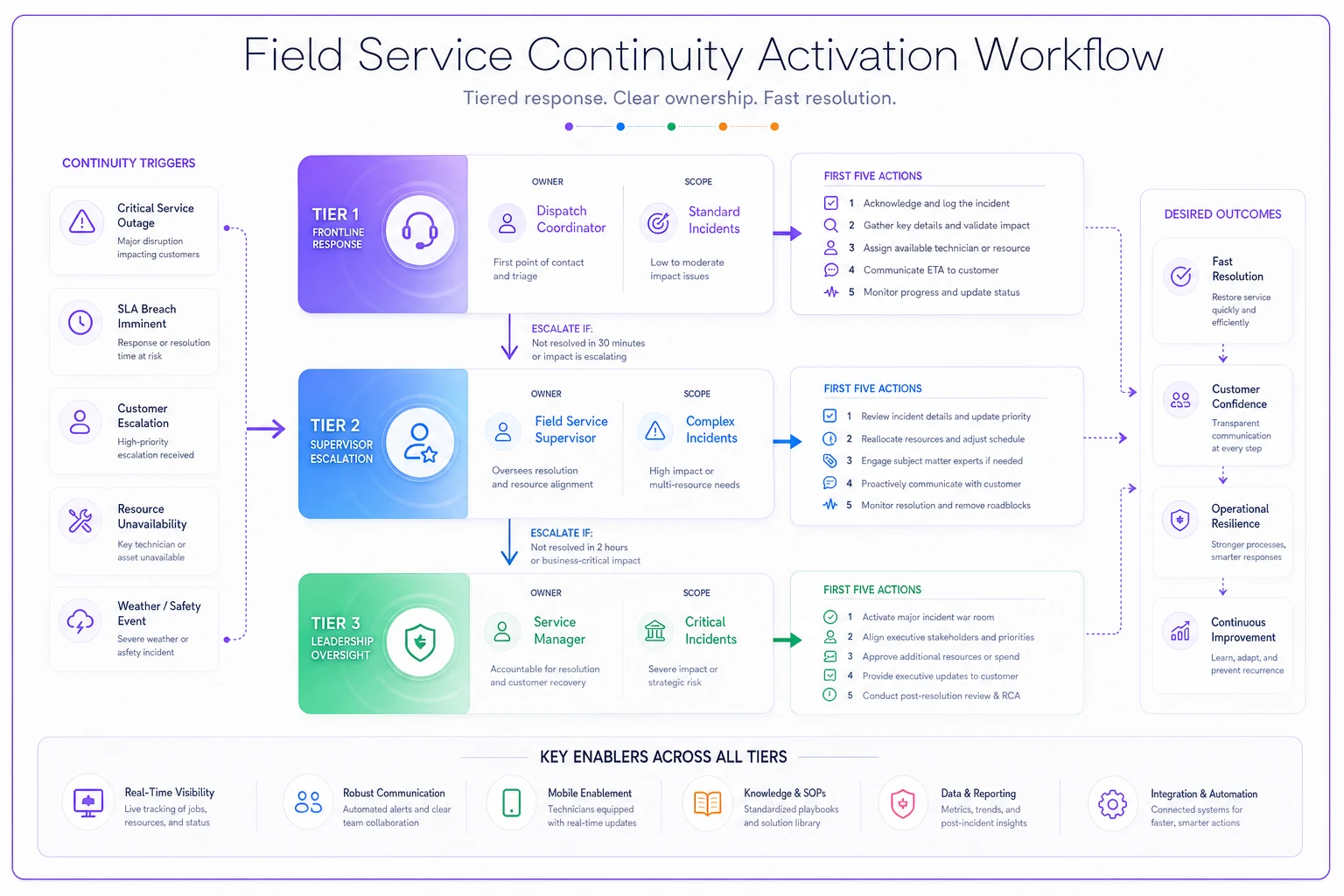
A quick visual of the tiered activation helps teams see the escalation flow at a glance.
Activation triggers: making the decision for people in advance
The whole system hinges on triggers that are objective enough that nobody has to debate them in the moment.
Vague triggers ("significant disruption") don't work because "significant" is a judgment call, and judgment calls stall. Concrete triggers work because they're nearly automatic.
-
Parts availability More than X% of today's scheduled jobs are blocked on parts not expected within 24 hours → Tier 2.
-
Supplier signal A primary supplier misses a confirmed delivery window by more than a day with no reschedule, or any credible insolvency/force-majeure notice → Tier 2, review for Tier 3.
-
Access/geography A territory loses road access or power affecting more than a quarter of planned jobs → Tier 1, escalate if it persists past end of day.
-
Capacity Available technician-hours drop below committed SLA hours for the next 48 hours → Tier 2.
The supplier trigger is the one operations get wrong most often. They wait for official confirmation that a vendor has failed. By then the window to activate alternate sourcing is already closed. The trigger should fire on the credible signal, not the confirmation. A contingency that turns out unnecessary is a far better outcome than waiting for certainty you only get after it's too late to act.
This is also where your sourcing structure matters enormously. Operations running a vendor consignment model for spare-parts governance have far more room to absorb a supplier shock, because inventory is already positioned and the relationship is structured for flexibility. Continuity planning and parts governance aren't separate disciplines — the strength of your sourcing model determines how hard Tier 2 and Tier 3 actually bite.
A note on where the trigger data comes from
Triggers only fire if someone — or something — is watching the signals. In a small operation, that's a dispatcher checking parts status every morning. As you scale, no human reliably watches all the signals across every territory. Operations running workflow platforms with automated thresholds tend to catch disruptions earlier — the system flags that 22% of tomorrow's jobs are parts-blocked before anyone would have noticed manually. The automation isn't making the decision. It's surfacing the trigger condition so the right person can act on it fast. That's the difference between finding out at 7am versus finding out when complaints start rolling in at noon.
Cross-dock and surge capacity: the two levers you pull at Tier 2
When a tier activates, you need levers that are already wired — not ones you're improvising under pressure.
Cross-dock activation means pre-agreed arrangements to move parts laterally — from an unaffected region, a distributor, or an alternate depot — into the disruption zone without routing everything back through central inventory. The reason to pre-wire it: cross-docking requires agreements, receiving procedures, and someone authorized to approve the transfer cost. If you're negotiating all that during the disruption, you've already lost two days.
What a pre-wired cross-dock actually looks like:
-
Pre-identified source nodes — which depots or partners can ship parts, and their typical turnaround.
-
Pre-approved spend authority — the Tier 2 owner can approve expedited transfers up to a set dollar amount without a sign-off chain.
-
A receiving SOP — how parts coming in through an abnormal channel get logged so inventory counts don't fall apart (disruptions are where inventory accuracy quietly dies).
-
A reconciliation step — scheduled after the event, so the cost and stock movements get properly accounted for.
Pre-validate and document source-node lead times quarterly so cross-dock decisions don't rely on memory during an event.
Surge capacity is the people side. It's the pre-defined set of levers for getting more technician-hours fast: overtime rules, on-call escalation, cross-territory borrowing, and pre-vetted subcontractor relationships. The mistake is treating surge as "call around and ask who can work." Surge should be a sequence with a known order — internal overtime first, then cross-territory, then subs — with cost and approval level attached to each step.
One thing worth noting: operations that surge well have already decided which jobs they'll defer. You can't add capacity to everything, so surge only works if it's paired with deliberate deprioritization of non-urgent planned work. That decision is much easier when you've already mapped job criticality — which leads directly into customer prioritization.
Priority-customer wiring: deciding who matters before the crisis
In a disruption, you cannot serve everyone on the normal timeline. The operations that come through intact are the ones that decided in advance who gets protected.
Priority-customer wiring means every customer and every job carries a pre-assigned criticality level that your systems and your people can see instantly when a tier activates. Not a gut call from whoever's on shift.
-
P1 – Protected Contractual SLA with real penalties, safety-critical sites, or customers whose downtime creates cascading harm (healthcare, food cold-chain, critical infrastructure). These get served no matter what.
-
P2 – Important Significant accounts, SLA-bound but with more tolerance, or jobs where delay creates meaningful but recoverable cost.
-
P3 – Standard Routine work that can be rescheduled without contractual or safety consequence.
The wiring matters more than the framework. When Tier 2 activates, your dispatch view should immediately sort by criticality. If someone has to manually figure out which of 180 open jobs are P1 during a crisis, the framework is useless. This is exactly where a workflow platform that carries the priority tag on every job record pays off — prioritization is already encoded, so reprioritizing the schedule under a disruption becomes a filter, not a research project.
A common and expensive mistake: letting the loudest customer become the de facto priority. Without pre-wired criticality, whoever calls most aggressively gets served first — and your actual P1, the one who trusts you to just handle it and doesn't call, gets neglected until they're furious. Pre-wiring protects you from being managed by volume instead of importance.
Comms templates: removing the writing from the worst moment to write
During a disruption, communication is both the most important and the most neglected task. People are heads-down fixing the operational problem, so customer and internal comms slip — which turns a service problem into a trust problem.
The fix is pre-written templates that only need variables filled in. Not polished prose written fresh while everything's on fire.
You need templates for at least these situations:
-
Proactive customer notice (we're aware of X, here's what it means for your service, here's our next update time)
-
Rescheduling notice for deferred P2/P3 jobs
-
Internal standup brief for the daily disruption huddle
-
Executive status update — short, structured, same format every time
-
All-clear / resumption notice when you return to normal operations
The single most important element in any customer template is the next update time. "We'll update you by 2pm" does more to preserve trust than any apology. What breaks customer relationships during a disruption isn't the disruption itself — it's the silence. A customer who gets a clear heads-up and a reliable update cadence will tolerate a surprising amount of delay. One who hears nothing for two days assumes you've forgotten them.
Keep the templates boring and consistent. The executive update especially should use the identical structure every time so it can be read in 20 seconds: current tier, what's affected, what we're doing, what we need, next update. Resist the urge to make it narrative — structure is faster to scan and easier to compare across days.
Executive escalation matrix: who decides what, and when
The escalation matrix answers the questions that otherwise stall everything: who has authority to spend, who approves deferring a contractual customer, who talks to the big account, who declares Tier 3.
The matrix should be a simple grid: decision type on one axis, tier on the other, with a named role in each cell. Roles, not names — people leave, roles persist.
Decisions worth pre-assigning:
-
Authority to activate each tier
-
Expedited spend thresholds at each tier (dispatcher up to $X, regional up to $Y, exec above)
-
Authority to defer a P1 or P2 customer (should sit high, deliberately)
-
Authority to engage subcontractors and at what rate
-
Who owns external/public communication at Tier 3
What separates a working matrix from a decorative one: the lower-tier authorities are genuinely delegated. If every meaningful decision rolls up to the exec, you don't have a tiered system — you have a single bottleneck with extra paperwork. The exec's job in Tier 1 and most of Tier 2 is to stay out of the way and let the owners work. They engage seriously at Tier 3.
A worked activation example
Here's how it fits together in a realistic scenario.
A regional HVAC and refrigeration service company — around 40 technicians across four territories — gets hit when their primary compressor supplier misses a confirmed delivery and then issues a vague notice about "fulfillment delays of indeterminate length." It's mid-summer. Demand is already high.
Hour 1: The missed-delivery-plus-no-reschedule trigger fires. The regional ops manager declares Tier 2 — no meeting, no waiting for confirmation of how bad it is. The one-page Tier 2 playbook comes out.
Hours 2–4: Dispatch filters the open board by criticality. About 60 open jobs; roughly 12 are P1 (cold-chain customers losing product if refrigeration fails). Cross-dock activates — two other territories have compressor stock, and the pre-approved transfer authority lets the regional manager move units same-day without a sign-off chain. Surge sequence kicks off: overtime offered first to cover the P1 load.
Hours 4–6: Comms go out. P1 customers get a proactive call using the template — "we're aware, you're prioritized, next update by end of day." P3 customers with routine maintenance get the rescheduling notice, freeing capacity. The exec gets the standard status brief: Tier 2, compressor supply, P1s covered via cross-dock, monitoring for Tier 3 if the supplier situation worsens.
Day 2–3: Daily 15-minute standup using the internal brief template. The team tracks whether cross-docked stock will hold. The supplier confirms a multi-week delay, so the continuity lead reviews for Tier 3 and begins alternate sourcing in earnest.
The outcome isn't magic. Some P3 work slips by a week or two. But every P1 gets served, no cold-chain customer loses product, and the big accounts hear from the company before they have to call in. Compare that to the unplanned version of the same event — where the first full day is lost to confusion, the loudest P3 customer accidentally gets prioritized over a cold-chain P1, and three key accounts only find out about the problem when their units fail.
The difference between those two outcomes is entirely the pre-wiring. Same disruption, same resources — just a system that activated in an hour instead of a day and a half.
Where this connects to the rest of your operation
Continuity isn't a standalone program. It leans on systems you should already be building.
Your ability to avoid truck rolls during a disruption depends on diagnostic capability — if you can resolve issues remotely, a supply or access disruption hurts far less. Operations with a mature remote diagnostics capability to reduce truck rolls have a built-in buffer, because not every problem requires a part and a visit in the first place.
Your asset strategy matters too. Disruptions expose aging equipment — the units most likely to fail during a heat wave or a supply crunch are the ones already on borrowed time. A disciplined approach to failure-mode-based asset replacement reduces the number of surprise failures that collide with a disruption window. Continuity planning and asset planning quietly reinforce each other.
Resilience is emergent. It comes from the sourcing model, the diagnostic depth, the asset health, and the dispatch discipline all being reasonably sound — and then a continuity layer on top that activates them coherently when something breaks.
When a full continuity program makes sense — and when it's overkill
Not every operation needs the full three-tier apparatus with an executive matrix.
When it makes sense:
-
You carry contractual SLAs with real financial penalties
-
You serve any safety-critical or cascading-harm customers
-
You operate across multiple territories where a localized event can be contained or can spread
-
You've already been burned by a supply or weather disruption and felt the cost of improvising
When it's overkill:
-
A single-territory operation with a handful of technicians and no hard SLAs — you don't need a matrix, you need the owner's phone number and a short list of priorities
-
Very early-stage operations still figuring out basic dispatch; build the fundamentals first, continuity later
One category that often gets skipped: operations where the underlying data isn't reliable. If your parts counts aren't accurate on a normal day, a continuity plan won't save you — it'll just activate on bad data. Get inventory and dispatch fundamentals stable before layering crisis machinery on top. A continuity plan amplifies whatever operational discipline you already have, good or bad.
Governance rituals: keeping the plan alive
The hardest part isn't writing the plan. It's keeping it from becoming the dead 40-page document in the shared drive. That takes a few lightweight rituals.
-
Quarterly tabletop exercise. Pick a scenario, walk through the activation in about 45 minutes, find what's stale. You don't need to simulate the whole crisis — just test whether the triggers, owners, and first actions still make sense.
-
Post-incident review after every real Tier 2+ activation. What fired late? What trigger didn't exist? What template was missing? Update the one-pagers within a week, while it's fresh.
-
Ownership refresh when roles change. The matrix uses roles, but someone has to confirm the role is actually staffed. Review whenever there's a reorg or a key departure.
-
Annual supplier and cross-dock sanity check. Are the pre-agreed source nodes still valid? Do the spend authorities still match reality? Supply relationships drift.
The rituals are what separate a continuity program from a continuity plan. The plan is the artifact. The program is the living practice of keeping the artifact true and the muscles trained. Skip the rituals and you're back to the shared drive document nobody opens.
Bringing it together
A field service resilience continuity plan works when it removes hesitation. Tiered playbooks remove the "is this bad enough?" debate. Concrete triggers remove the judgment stall. Pre-wired customer priorities remove the scramble to figure out who matters. Comms templates remove the burden of writing under pressure. The escalation matrix removes the "who decides?" paralysis.
None of that is exotic. It's just decided in advance instead of in the moment — which is the entire game, because the moment is exactly when nobody has bandwidth to decide well.
The operations that survive disruptions intact aren't the ones with the most elaborate plans. They're the ones who did the deciding early, kept the plan short enough to actually use, and practiced activating it before they had to.
A field service resilience continuity plan works when it removes hesitation. Tiered playbooks remove the "is this bad enough?" debate. Concrete triggers remove the judgment stall. Pre-wired customer priorities remove the scramble to figure out who matters. Comms templates remove the burden of writing under pressure. The escalation matrix removes the "who decides?" paralysis.
None of that is exotic. It's just decided in advance instead of in the moment — which is the entire game, because the moment is exactly when nobody has bandwidth to decide well. The operations that survive disruptions intact aren't the ones with the most elaborate plans. They're the ones who did the deciding early, kept the plan short enough to actually use, and practiced activating it before they had to.
Ready to optimize your field operations?
Join 2,000+ service teams using Romrly to boost productivity, reduce downtime, and enhance customer satisfaction.