

Most managers try to fix rework with a training day. Pull the team off the road, run a four-hour session on torque specs or documentation standards, everyone nods, and three weeks later your first-time-fix rate is right back where it started. The problem isn't that your techs don't know the work. It's that the actual mistake—the skipped photo, the untested reconnect, the part that didn't get swapped because it "looked fine"—happens in the field, under time pressure, with nobody watching.
That's the gap micro-rituals close. A micro-ritual is a fixed, repeatable action tied to the specific point in a job where rework tends to enter. Not a checklist buried in the app. Not a 20-minute SOP. A short, scripted habit the tech runs the same way every time, paired with a supervisor cadence that actually checks whether it's happening.
This isn't about adding process for its own sake. Rework hides its real cost: the second truck roll, the SLA credit, the customer who now distrusts you, the tech demoralized because they got pulled off a new job to fix an old one. The goal is to find the two or three moments where mistakes cluster and get a small ritual into each one.
Where rework actually enters the job
Before scripting anything, you need to know where your rework is born. It's almost never spread evenly. In most field operations, repeat visits trace back to a handful of predictable failure points:
-
The pre-work moment — tech arrives, doesn't confirm the actual fault matches the dispatch note, and fixes the wrong thing.
-
The parts moment — wrong part grabbed, right part skipped because "it looked okay," or a needed consumable left on the truck.
-
The verification moment — repair done, but never tested under real load or the exact condition the customer reported.
-
The documentation moment — work completed correctly but photos, readings, or notes missing, so warranty or SLA gets denied and someone goes back out anyway.
Pull your last 30 callbacks and tag each one with which moment it came from. You'll usually find 70–80% cluster into just two. That clustering is the whole point. You don't need five rituals. You need a ritual sitting on your two biggest leak points.
A quick way to find them: pull reopened work orders from the last quarter and for each one write a single sentence—"came back because ___." Sort them. The pattern shows up fast.
The three rituals that cover most rework
Below are the three micro-rituals that cover the majority of field rework. Each runs in about five minutes or less, with a word-for-word script so there's no ambiguity about what "doing it" actually means. The scripts matter. Vague instructions like "verify the repair" get interpreted twelve different ways.
Eliminate field service chaos with Romrly.
Romrly helps you assign, track, and complete service jobs efficiently and on time.
- Unified job scheduling
- Technician dispatch & tracking
- Customer notifications & updates
No credit card required
Ritual 1: The 60-second fault confirmation (pre-work)
Runs the moment the tech is in front of the unit, before touching anything.
Script the tech runs (out loud or into the app voice note):
-
"Dispatch note says the fault is
___."
-
"What I'm actually observing is
___."
-
"These match / don't match."
-
If they don't match
"Stopping. Updating the work order and confirming scope before proceeding."
The power is in step 4. Most "fixed the wrong thing" callbacks happen because the tech trusted the dispatch note and never looked up. An HVAC tech sent for "no cooling" fixes a capacitor, but the real issue was a blocked drain tripping a safety switch. Thirty seconds of comparing the note to what's actually in front of them catches that before the second truck roll.
Ritual 2: The parts-and-consumables pause (mid-work)
Runs right before the tech starts the physical repair, not after.
Script:
-
"Parts I need for this fix
___."
-
"Parts I have on hand right now
___."
-
"Gap
___ — get it now or flag it now, not after I've opened the unit."
-
"Consumables that commonly get skipped on this job type
___ — do I have them?"
The consumables line is the one that saves you. Techs rarely come back for the main part—they come back because they skipped the gasket, the filter, the sealant, the small thing they assumed was fine. Teams that move FTF the fastest are usually the ones who built proper kit SKUs and replenishment rules so this pause has a real answer instead of a guess.
Ritual 3: The load-test verification (close-out)
Runs after the repair, before packing up. This is the single highest-value ritual for most teams.
Script:
-
"The customer's reported symptom was
___."
-
"I am now reproducing the exact condition that caused it."
-
"Result under that condition
___."
-
"Photo or reading captured
yes/no."
-
"If I can't reproduce the original condition, I note why and flag it."
The trap is "it works now" testing—tech powers it on, sees it run, and leaves. But the fault only showed up under load, at temperature, after ten minutes, or during a specific cycle. Verifying under the actual reported condition is what separates a real fix from a callback waiting to happen.
Visual: workflow of the three micro-rituals and supervisor checks.
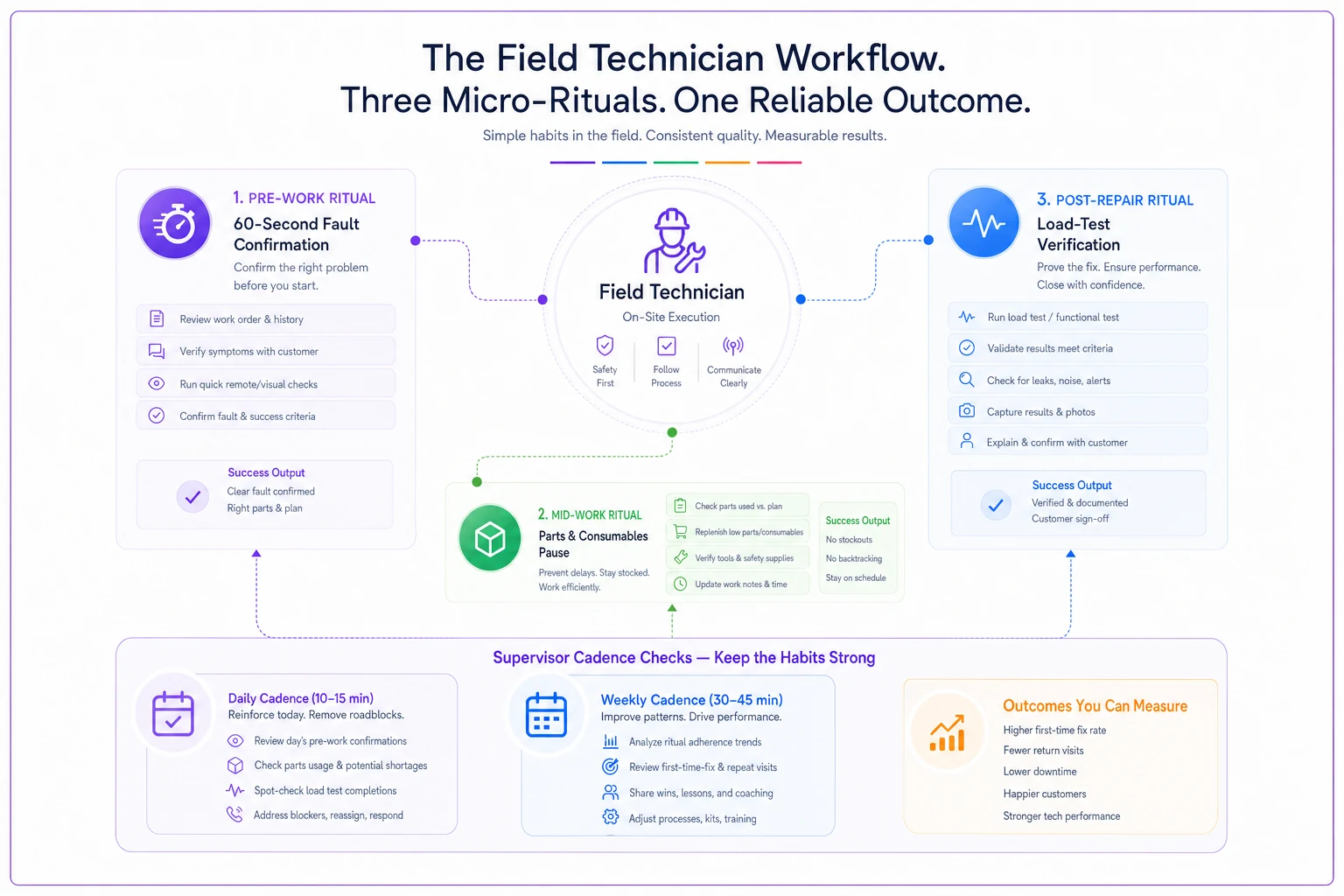
Keep the flow visible in the truck or mobile app.
How the rituals map to your KPIs
Each ritual attacks a specific KPI. Keep this mapping visible so supervisors and techs understand why the ritual exists—habits with a clear purpose survive; habits without one quietly die.
| Ritual | Primary KPI it protects | Rework type it prevents | Time cost |
|---|---|---|---|
| Fault confirmation | First-time-fix (FTF) | Wrong-problem fixes | ~1 min |
| Parts-and-consumables pause | FTF + return-for-parts rate | Missing-part callbacks | ~2 min |
| Load-test verification | Rework / callback rate | "Didn't actually fix it" returns | ~3–5 min |
Total across all three is under 8 minutes, and most jobs only need one or two depending on the job type. That's deliberate. The fastest way to kill a ritual program is to make it feel like overhead. If a tech feels like they're spending more time on ceremony than wrenching, adoption collapses within a month.
The tracking template (keep it stupidly small)
The mistake most managers make is building an elaborate compliance tracker that nobody fills in honestly. The tracking has to be lighter than the ritual itself. Here's the minimum viable version—one row per job, filled by the tech, spot-checked by the supervisor:
-
Job ID
-
Rituals that applied (confirmation / parts / verification)
-
Ran? Y/N for each
-
Verification result captured? Y/N
-
Any scope change flagged? Y/N
Five fields. If your work order app already captures photos and notes, you can often fold the verification evidence into the existing close-out flow rather than adding a separate form. The point of tracking isn't to audit every job—it's to give the supervisor something concrete to coach against.
One pattern worth watching: when "Ran? Y" is checked but there's no verification photo attached, that's your tell that the ritual is being box-checked, not actually performed.
One pattern worth watching: when "Ran? Y" is checked but there's no verification photo attached, that's your tell that the ritual is being box-checked, not actually performed. The gap between claimed and evidenced is where coaching lives.
The coaching cadence that makes it stick
Rituals without a cadence decay. Here's the rhythm that holds adoption without turning a supervisor into a full-time auditor.
-
Daily (2 minutes, async) Supervisor glances at the previous day's jobs, picks one where verification evidence is thin or missing, and sends a single specific message to that tech. Not a group blast. One person, one job, one ask.
-
Weekly (10 minutes, per tech) Supervisor reviews that tech's callback list against ritual compliance. The conversation is always "which ritual would've caught this?"—never "why do you keep messing up."
-
Monthly (team level) Pull FTF and rework trend lines. Show the team the number moving. People sustain habits they can see working; they drop habits that feel like faith.
The weekly one-on-one framing matters most. The second this becomes a disciplinary tool, techs start gaming the tracker and you lose all signal. Supervisors who treat it as "let's figure out together where the job went sideways" get honest data. It's the same coaching muscle that makes structured onboarding work—short, specific, repeated feedback beats occasional big corrections every time.
A real scenario
A regional appliance repair company—about 14 techs, mostly residential—was running a callback rate around 18%, meaning roughly 1 in 5 jobs generated some kind of return trip. FTF sat in the low 70s. The owner had already tried a documentation crackdown that fizzled out within a few weeks.
They tagged their last 40 callbacks and found two clusters: "fixed and left but it failed again under normal use" and "had to come back for a part." So they deployed two rituals—verification and the parts pause—and skipped the fault-confirmation one entirely since their dispatch notes were already solid.
Over about three months, callback rate dropped from roughly 18% to the 11–12% range. FTF climbed into the low 80s. Nothing dramatic happened overnight. The weekly one-on-ones slowly shifted how techs thought about close-out. The owner's rough math put the recovered capacity somewhere around 9–12 truck rolls a week they no longer had to make—real time that went back into billable work instead of apologies.
No new tools, no new hires. Two 5-minute habits jammed into the exact two moments rework was being born, checked every week.
When this works—and when it doesn't
When micro-rituals make sense:
-
Your rework clusters into two or three identifiable moments (most teams do).
-
Your techs are competent but inconsistent—the knowledge exists, the habit doesn't.
-
You have supervisors who can run a light weekly cadence.
When this is the wrong fix:
-
Your rework is a skills problem—techs genuinely don't know the correct procedure. No ritual fixes a knowledge gap; that's a training and career-ladder issue.
-
Your dispatch data is so unreliable that techs can't trust any note. Fix the upstream data first, or the confirmation ritual just surfaces chaos.
-
You have no supervisor bandwidth at all. Rituals without a cadence become theater within six weeks.
Very small teams where the owner is also the lead tech and already eyeballs every job probably don't need this. At that scale the ritual is already happening in their head—formalizing it adds friction without adding much control.
Rolling it out without the eye-rolls
Don't announce a "new program." Announcing programs invites resistance. Pick your single biggest rework moment, introduce one ritual, and run it for three weeks before adding a second. Let the first number move before you ask for more. Techs who see their own callback list shrink become the people who defend the ritual to new hires—far more effective than any mandate from the office.
Keep the scripts somewhere the tech sees them at the job—laminated in the truck, pinned in the mobile app, whatever fits your workflow. The script is the whole thing. "Verify the repair" fails because everyone defines it differently. "Reproduce the exact condition the customer reported and capture a reading" fails for nobody.
Rework rarely comes from bad technicians. It comes from good technicians under time pressure skipping the one small step that would've caught the problem—and nobody noticing until the customer calls back. Find your two leak points, script a five-minute habit for each, and check them every week. That's the entire program.
Ready to optimize your field operations?
Join 2,000+ service teams using Romrly to boost productivity, reduce downtime, and enhance customer satisfaction.