



Most field service businesses don't have a retention problem. They have a structure problem that shows up as a retention problem.
When a solid tech with three years under his belt walks out the door for a $2/hour raise at a competitor, the exit interview says "compensation." But if you rewind the tape, the real story is almost always the same: nobody ever told him what "next" looked like. There was no visible path to earning more without leaving, no signal that the company was investing in him. So when someone offered a clear step up, he took it — and the extra dollars were just the tiebreaker.
That's the thing about technician retention and the field service career ladder. It's not one lever. It's a chain of connected systems — hiring, onboarding, micro‑training, competency checks, promotion rules, and how you wire pay to all of it. Break any single link and the whole chain leaks people.
Why turnover is a systems failure, not a morale failure
Walk into ten field service shops and ask why they lose techs, and nine will say "pay" or "the market." Both are real. But they mask a deeper pattern.
What tends to actually happen: a business hires reactively (someone quit, we need a warm body), onboards inconsistently (whoever's free shows the new guy around), trains informally (you learn by riding along until you don't), and promotes based on gut feel and tenure. Pay increases happen when someone threatens to leave, not on a schedule tied to skill.
Every one of those steps is disconnected from the others. The new hire has no idea how the shadowing period connects to a raise. The three-year tech has no idea what separates him from the lead role that just opened up — and when it goes to the owner's nephew, or to whoever complained loudest, the message lands hard. The competent quiet ones start updating their résumés.
The insight most owners miss: techs don't leave because the ladder is too steep. They leave because there's no ladder at all — just a flat floor with a few people standing on invisible boxes.
When the rungs aren't defined, ambition has nowhere to go but out.
What breaks as you scale
A two-truck operation can run on relationships. The owner knows every tech, adjusts pay by feel, and everyone understands the pecking order because there are only four people. Works fine — until it doesn't.
Eliminate field service chaos with Romrly.
Romrly helps you assign, track, and complete service jobs efficiently and on time.
- Unified job scheduling
- Technician dispatch & tracking
- Customer notifications & updates
No credit card required
Here's roughly where things crack as headcount grows:
-
3–8 techs Informal works, but inconsistency creeps in. Two techs doing the same job get paid differently for reasons nobody can fully explain. Resentment starts.
-
8–20 techs The owner can't personally develop everyone anymore. Onboarding quality now depends entirely on which senior tech got stuck with the new person. First-time-fix rates vary wildly by "who trained who."
-
20+ techs You've got tribes. Skill levels are all over the map, nobody agrees on what "senior" means, and your best people are quietly doing the hardest jobs for the same pay as the guy who cherry-picks easy tickets. The good ones burn out or leave.
The pattern is consistent: informal systems don't fail loudly. They erode. You don't notice until your two strongest techs give notice in the same month and you realize half your institutional knowledge just walked out the door.
The five links in the chain
A working technician career ladder isn't a document you post on the wall. It's a set of connected mechanics. Here's how the pieces fit together.
1. Hiring that maps to the ladder
Most shops hire for "can this person do the job today." Better shops hire for "where can this person land on the ladder, and how fast can they climb."
The practical shift: define your levels before you interview, then hire against them. If your ladder has four rungs — Apprentice → Technician → Senior Technician → Lead — you can slot a candidate honestly and set expectations from day one. A candidate who hears "you're coming in as a Technician, and here's exactly what Senior looks like and what it pays" behaves completely differently than one who hears "we'll see how it goes."
2. Onboarding that connects to competency, not to the calendar
The weak version of onboarding is time-based: "you're off probation after 90 days." The strong version is competency-based — you're off probation when you can demonstrate a defined set of skills, whether that takes 60 days or 110.
A structured 90-day technician onboarding checklist with competency milestones and KPI gates replaces "hang around until you seem ready" with real checkpoints — field shadowing, supervised solo jobs, and measurable gates the new tech has to clear before moving on.
3. Micro-training that runs continuously, not in annual bursts
Nobody gets better from a once-a-year training day. Skill grows in small, frequent doses tied to the actual work.
The most effective version is short, job-specific learning — 2 to 3 minute guides a tech can pull up on-site when they hit an unfamiliar unit. And the best source for that material is your own completed jobs. Turning real repair records into a library of micro-guides generated from job records does two things at once: it gives newer techs a way to level up on demand, and it captures the knowledge your senior people carry in their heads before they leave with it.
Micro-training is what makes the competency gates achievable. You can't ask a tech to demonstrate a skill you never gave them a way to learn. The training and the gate have to be built as a pair.
4. Competency gates and the matrix behind them
This is the backbone of the whole system, and the piece most shops skip because it takes real work to build.
A competency matrix is a grid: skills down one side, proficiency levels across the top. For each skill, you define what each level actually means in observable terms — not "good at diagnostics" but "can diagnose a no-cool call on units A, B, and C without phone support, correct diagnosis 90%+ of the time."
Here's a simplified slice of what one looks like:
| Skill area | Apprentice | Technician | Senior Technician | Lead |
|---|---|---|---|---|
| Diagnostics | Assists, needs sign-off | Solo on common faults | Solo on complex/intermittent faults | Trains others, handles escalations |
| First-time fix rate | N/A (supervised) | ≥ 70% | ≥ 85% | ≥ 85% + mentors low performers |
| Customer handling | Observes | Handles routine | De-escalates conflict | Owns key accounts |
| Documentation | With help | Complete & on time | Clean enough to reuse | Audits others' records |
| Safety/compliance | Supervised only | Independent, zero incidents | Runs toolbox talks | Owns site risk sign-off |
The gate is simple: you don't move up until you can demonstrate every competency at the next level. No exceptions, no favorites. That last part matters more than the matrix itself — the whole thing collapses the first time someone gets promoted who hasn't cleared the gates. Everyone watches that. Everyone learns the real rules.
5. Incentive wiring — where most ladders fall apart
You can build a solid matrix and still lose everyone if pay doesn't move with the rungs. Techs aren't stupid. If clearing a competency gate earns them a certificate and a handshake but no more money, they'll clear the gate somewhere that actually pays for it.
-
Tie some pay to skills, not just tenure. Otherwise you reward showing up over getting better.
-
Don't make the whole raise performance-variable. Techs need stability; a base bump plus a smaller incentive component beats an all-bonus scheme.
-
Reward the things you actually want. If you bonus purely on job volume, you'll get cherry-picking and rushed work. Blend in first-time-fix and rework rates.
Wiring incentives means every rung has a defined pay band, and clearing a gate means moving into the next band on a known timeline — not "we'll talk about it at your review." The pay should be visible: a Technician should know, roughly, what Senior pays before they start working toward it.
A short workflow: how one tech moves through the system
Here's how the five links connect in practice, from hire to first promotion:
-
Hiring conversation — candidate is slotted at Apprentice or Technician-track with pay band and next rung explained upfront.
-
Onboarding begins — structured checklist runs from day one; field shadowing, supervised jobs, and milestone check-ins replace informal "riding along."
-
On-site micro-training — tech pulls short guides when hitting unfamiliar equipment; skill gaps close in real time rather than waiting for a scheduled training day.
-
Competency logging — supervisor records demonstrated skills against the matrix as they happen, not from memory at quarterly review time.
-
Gate clears — once every Technician-level competency is confirmed, the promotion isn't a debate. The matrix already made the call. Pay moves into the next band and the next set of gates becomes visible.
The tech always knows three things: where they stand, what's next, and what it pays. That visibility is the retention mechanism. Not perks. Not pizza. Clarity.
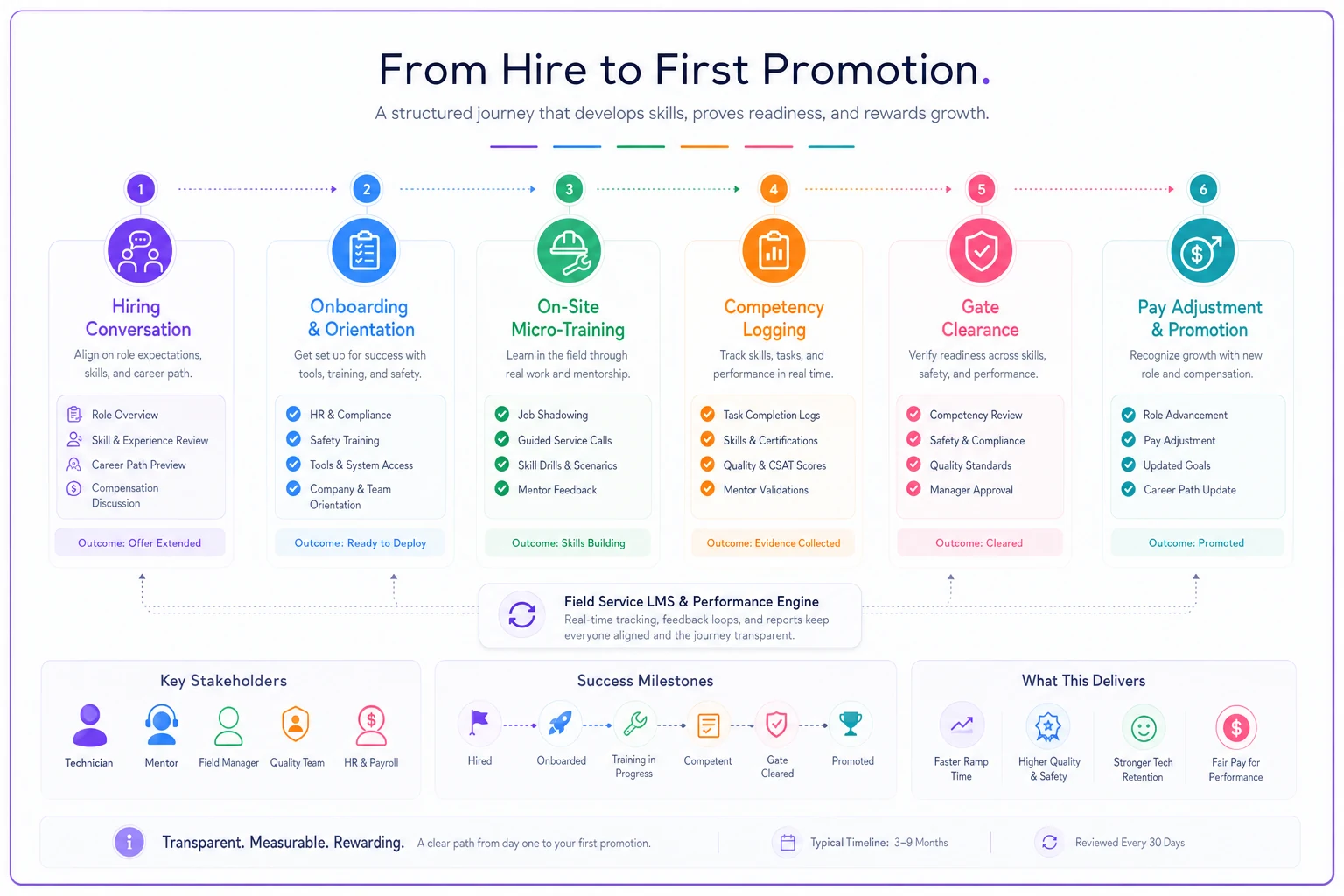
A simple diagram like this makes it obvious where information flows and which checkpoints trigger pay changes.
A realistic before/after
Consider a regional HVAC and refrigeration outfit running about 22 techs. Annual technician turnover was sitting around 34% — roughly seven or eight people a year walking out, most of them in the 2–4 year range, which is exactly the band you least want to lose because they're finally profitable.
Exit interviews all pointed at pay. But when they mapped it out, the real problem was that "senior tech" was an informal title handed out by favoritism, promotions had no criteria, and pay bumps only happened when someone threatened to quit. Their strongest people had no reason to believe effort translated into anything.
They spent a quarter building the boring stuff: four defined rungs, a competency matrix, gates tied to onboarding, and pay bands attached to each rung with a known timeline. No dramatic pay overhaul — total comp went up only modestly. The change was structure and visibility, not throwing money at the problem.
Over the following year, turnover dropped into the high teens. The counteroffer conversations mostly stopped, because techs could see the next rung instead of only seeing the exit. One unexpected side effect: hiring got easier, because candidates who'd bounced around other shops recognized that a real ladder was worth staying for.
They didn't out-pay the market. They out-structured it.
When this makes sense — and when it doesn't
This isn't universal. A few honest calls:
-
When it makes sense You've got more than about six techs, skill levels are uneven, and you're losing people in the 2–4 year band. That's the sweet spot where structure pays off fast.
-
When it's premature Two or three techs and you personally know every job they run. A formal matrix here is overhead you don't need yet.
-
When it's a bad idea If you're not actually willing to promote based on the gates — if the owner intends to keep hand-picking favorites — don't build the ladder at all. A ladder you don't honor is worse than no ladder, because now you've promised fairness and visibly broken it.
That accelerates the exits.
Rolling it out without overwhelming everyone
Don't try to install all five links at once. The chain is easier to build one link at a time, and rushing it usually means it gets ignored.
-
Define the rungs. Name your levels and write a one-line description of each. Keep it to three or four levels to start.
-
Build a rough competency matrix. Don't aim for perfect. Get your senior techs to help define what "good" looks like at each level — they know better than you do.
-
Connect onboarding to the matrix so new hires enter the system already being measured against it.
-
Wire the pay bands to the rungs and make them visible. This is the step that makes people believe the rest is real.
-
Layer in continuous micro-training so the gates are actually achievable.
Treat this like any other operational change — the same discipline you'd apply in a broader field service adoption playbook with pilot-to-scale templates and KPI gates applies here. Pilot the ladder with one crew, work out the friction, then expand. Don't big-bang it across the whole company on day one.
Pilot the ladder with one crew, iterate quickly on the checklist and matrix, then expand once it's low-friction.
One caution: tracking who's cleared what across thirty techs will drown you in spreadsheets if you try to run it by hand. A workflow platform that keeps competency records, gate status, and job performance data in one place quietly earns its cost — not because it's fancy, but because manually reconciling all of that is exactly the kind of admin that dies in a drawer within two months. The system only works if the tracking is low-effort enough to actually get done.
The part nobody wants to hear
The reason most shops don't have a real career ladder isn't that they don't know how. It's that a real ladder takes decision-making power away from the owner. You can't play favorites when the gates are public. You can't dodge a raise when the pay band is written down. You have to promote the quiet competent tech over the loud mediocre one because the matrix says so.
That's the actual work. The matrix is the easy part. Committing to run your people decisions by a system instead of by mood — that's what keeps techs, and that's what most owners quietly resist.
Build the chain. Honor it even when it's inconvenient. The techs who were about to leave will notice before you do.
Ready to optimize your field operations?
Join 2,000+ service teams using Romrly to boost productivity, reduce downtime, and enhance customer satisfaction.