
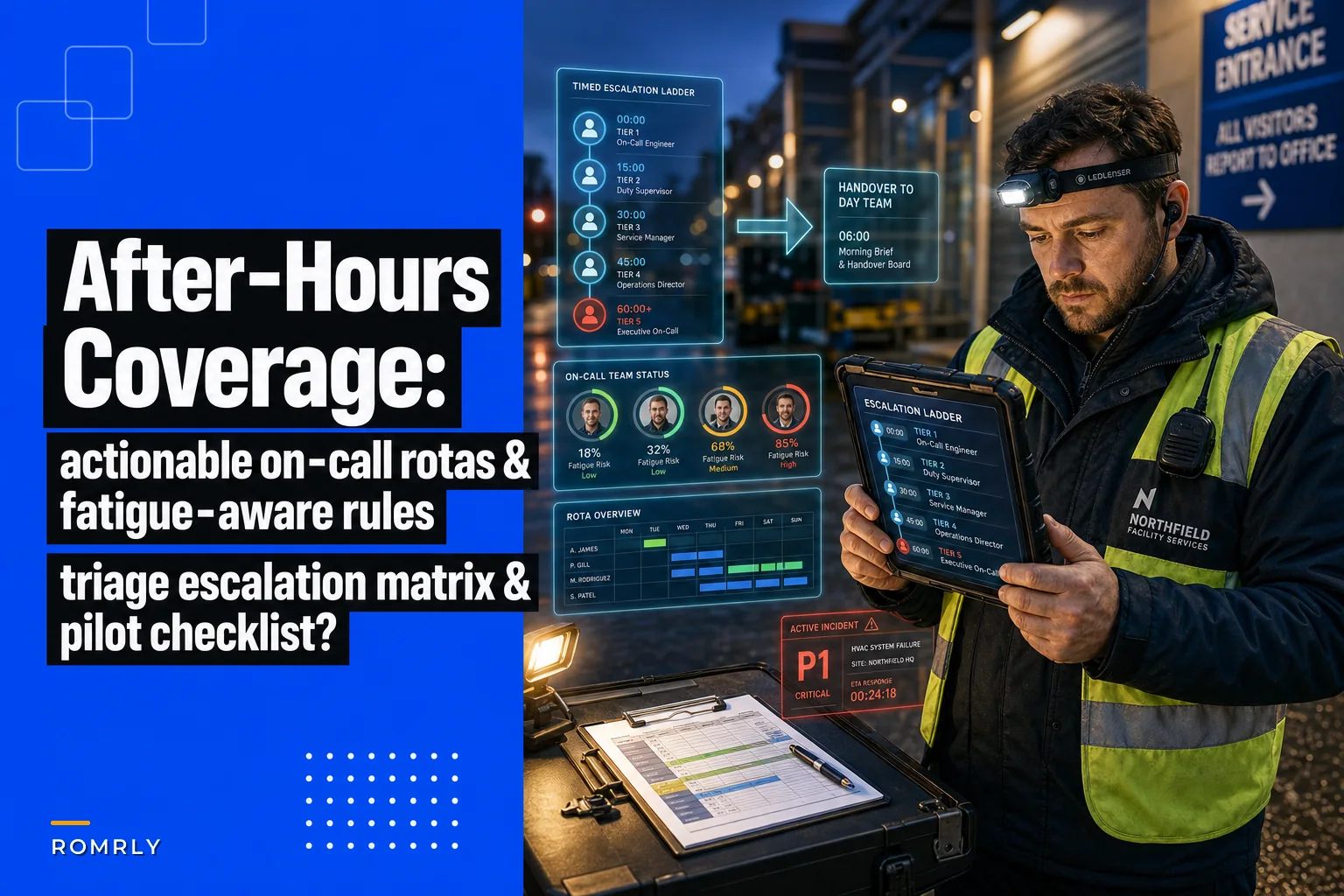

The after‑hours side of a field service business tends to run on habit rather than design. Someone volunteers to "carry the phone," a manager becomes the unofficial backstop, and the whole thing works fine right up until it doesn't. Then you get a burned‑out lead tech, a missed emergency because two people assumed the other was covering, and a payroll dispute over whether a 4am callout counts as overtime or a flat callout fee.
This is a design problem, not a staffing problem. Most shops don't have too few people to cover nights. They have no explicit model for who covers what, when they're allowed to say no, and how a call climbs the ladder when the first person doesn't pick up. So let's build that model — rotas, fatigue rules, the escalation matrix, and the pay structure that makes it actually stick.
Why after‑hours coverage quietly falls apart
The failure mode is almost always the same, and it's rarely dramatic on any single night. It's cumulative.
A shop starts with an informal arrangement: two senior techs "trade off" weekends. No written rotation, so trades happen by text. One tech gets busy, forgets to confirm, and both assume they're off. A commercial refrigeration call comes in at 11pm, goes to voicemail twice, and the customer calls a competitor by midnight. Nobody did anything obviously wrong — the system just had no defined owner for that hour.
The second common pattern is invisible fatigue stacking. Your on‑call tech works a full Friday, takes three callouts overnight, then shows up on the schedule for planned PM work Saturday morning. On paper they're "available." In reality they've had maybe four hours of sleep and are driving a service van to a rooftop unit. Nobody tracks cumulative hours because callout time lives in a different system than the planned schedule. The two never get reconciled until something goes wrong.
Both problems share the same root: after‑hours work is treated as an exception, so it never gets the same operational rigor as daytime dispatch. For most service businesses, after‑hours represents somewhere between 15–25% of emergency revenue and a disproportionate share of operational risk.
The operator‑ready rota: build the rotation before you need it
A working on‑call rota answers five questions in writing, before anyone gets woken up:
Eliminate field service chaos with Romrly.
Romrly helps you assign, track, and complete service jobs efficiently and on time.
- Unified job scheduling
- Technician dispatch & tracking
- Customer notifications & updates
No credit card required
-
Who is primary on‑call for each date/shift block
-
Who is the secondary/backup if primary doesn't respond within X minutes
-
What skill tier each block requires (a gas line emergency is not the same as a routine no‑cool call)
-
Who owns escalation when it's a management decision rather than a technical one
-
How swaps get recorded so the source of truth is never a text thread
The skill tier point matters more than most shops expect. A flat "on‑call tech" model breaks the moment a call needs a specialist. Mixing skill into the rota — primary generalist plus a "specialist reachable" slot for gas, electrical, or controls — prevents the ugly 1am scenario where a junior tech is standing in front of a problem they legally shouldn't touch alone.
Here's a basic two‑week block that most small teams can actually staff:
| Block | Primary (Tier 1) | Backup (Tier 1) | Specialist reachable (Tier 2) | Manager escalation |
|---|---|---|---|---|
| Mon–Thu nights | Rotates weekly | Next in rotation | On‑call phone, gas/controls | Ops lead |
| Fri–Sun | Weekend volunteer pool | Assigned pair | Same as weekday | Ops lead / owner |
| Holidays | Pre‑committed 60 days out | Paid standby | Pre‑arranged | Owner |
The single biggest rota mistake is letting the rotation live in one person's head or a shared calendar nobody maintains. The moment a swap happens verbally, your matrix is fiction. Every swap needs to update the same record dispatch looks at when a call lands — otherwise the person who thinks they're off and the person the system thinks is on will both be wrong at the worst possible time.
Fatigue‑aware shift rules that don't just live on paper
This is the part most operating models skip, and it's the one that protects both your people and your liability exposure. A tech who's been awake for 20 hours driving to a callout is a risk to themselves, the customer, and your insurance position.
Hard rule 1 — Minimum rest before planned work. If a tech takes a callout ending after a set hour (say, past 1am), their planned start the next day shifts, or they come off the morning board entirely. Not optional, not something they "power through."
Hard rule 2 — Cumulative hours cap across planned and callout combined. Callout hours count toward the same weekly ceiling as scheduled hours. If someone's approaching the cap, the next call routes to backup automatically. The mistake most operations make is tracking callout time separately and never summing the two.
Hard rule 3 — No solo high‑risk work when fatigued. Rooftop, confined space, energized electrical, and gas work all get a "second person or wait until daylight" flag after a certain hour or hours‑awake threshold. Some of these jobs genuinely can wait until 6am and cost you nothing but a slightly annoyed customer.
Soft rule — Consecutive nights. Nobody carries primary on‑call more than a set number of nights in a row without a break. Rotating burnout onto one "reliable" person is how you lose that person in eight months.
Automate the rest‑before‑planned flag in your scheduling platform so it pulls people off morning routes automatically after late callouts.
Fatigue rules only work if the system enforces them. If enforcement depends on a tired person deciding to follow a policy at 2am, it won't happen consistently. A scheduling platform that reconciles callout logs against the next day's board earns its keep right here — flagging "Marcus took two calls after 1am, pull him off the 7am PM route" before dispatch ever assigns it. Not as a gimmick, just as the reconciliation step humans reliably skip when they're rushing.
The triage escalation matrix: who gets called, and when it climbs
An escalation matrix turns "we called around and eventually someone answered" into a predictable ladder. The core idea is simple: every after‑hours call has a defined path with time limits at each step, so nothing stalls in a gap.
-
Call intake classifies severity — true emergency, urgent‑but‑waitable, or next‑business‑day. Intake needs a script for this; guessing wastes tier‑1 techs on non‑emergencies.
-
Primary on‑call gets the ping. No acknowledgment in 10 minutes — it auto‑escalates.
-
Backup gets it next, same window.
-
Specialist reachable is pulled in parallel, not sequentially, when the job needs their skill. You don't want to burn 20 minutes on tier‑1 before realizing it's a gas job.
-
Manager/owner is the final step, and only for decisions techs shouldn't own alone: authorizing overtime spend, declining unsafe work, committing to a same‑night parts run.
The severity classification at step one is where most matrices leak. If everything coming in overnight gets treated as a five‑alarm emergency, you'll wake specialists for jobs that could've waited, your fatigue rules collapse, and your on‑call people start dreading the phone. Getting intake triage right — and having reserve capacity planned rather than improvised — connects directly to how you handle same-day emergency requests without derailing planned work. The after‑hours matrix is really the night‑shift extension of that same triage discipline.
One detail worth stealing: put a hard time cap on each escalation step and log the timestamp automatically. "Called primary at 11:04, no ack, escalated to backup at 11:14, acknowledged 11:16" is a defensible record. "We tried to reach people" is not — and that's exactly the gap that turns into an SLA dispute.
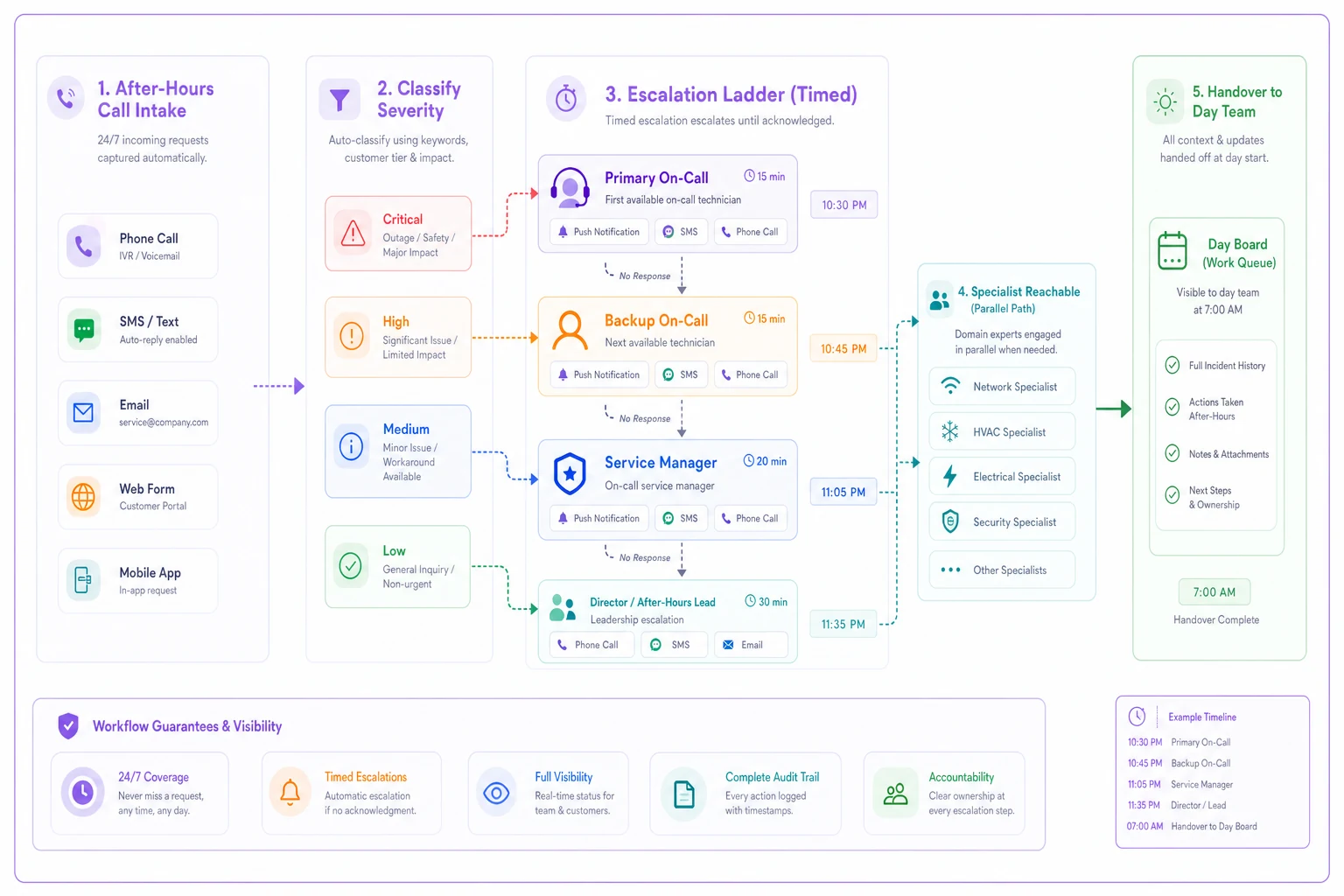
A simple visual of the ladder helps align expectations and shows where timestamps must be captured during each step.
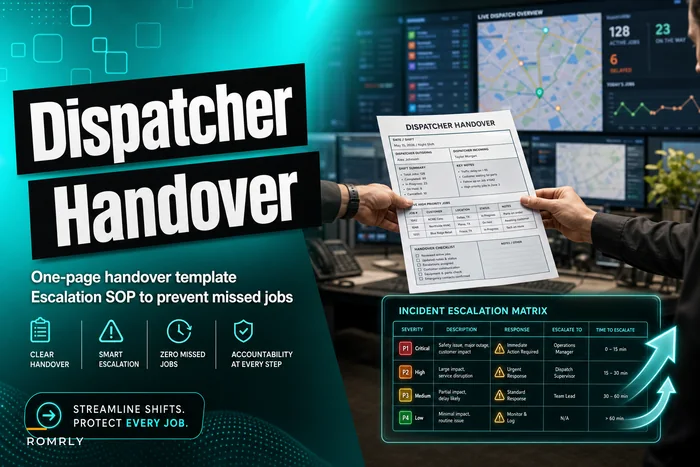
The matrix also needs to survive the shift change into morning. A callout that started at 4am and is still open at 7am has to hand cleanly to the day board. That's the same handover discipline covered in the dispatcher shift handover template and incident escalation matrix — the after‑hours ladder should feed directly into that morning handoff, not restart from scratch.
Pay and penalty wiring: the part that quietly causes the most conflict
You can build a perfect rota and matrix and still lose your best techs if the money is unclear. After‑hours pay disputes are corrosive precisely because they feel personal — the tech got out of bed, drove 40 minutes, and now there's an argument about whether that hour counts.
-
Standby/on‑call pay — a flat amount for carrying the phone, whether or not a call comes. This is what keeps people willing to volunteer.
-
Callout minimum — a guaranteed minimum (commonly 2–3 hours) for any callout, even a 20‑minute reset, so a middle‑of‑the‑night trip is never "not worth it."
-
Overtime rate rules — when hours cross into OT, and how callout hours stack onto the weekly total.
-
Travel time policy — is the drive paid? Most disputes hide here.
-
Penalty/protection clauses — what happens when a tech is called but the job cancels en route, or when a swap wasn't honored.
The most common wiring mistake is disconnecting the pay logic from the time records. If the on‑call log lives in one place and payroll pulls from another, someone reconciles by hand every pay period, gets it wrong occasionally, and each error erodes trust. When the callout timestamps that drive escalation also feed the pay calculation, the number the tech sees matches the record — no negotiation, no memory contest.
A quick real‑world scenario
A regional HVAC and refrigeration shop — around 14 techs, heavy commercial refrigeration clients with hard SLAs — was running on the "two seniors trade weekends" model. Over a rough quarter they missed a handful of after‑hours calls, racked up two SLA credit claims, and lost one of their two on‑call seniors who had been quietly absorbing the majority of nights.
They didn't hire anyone. They built a written eight‑person rotation with primary and backup slots, added a specialist‑reachable position for gas and controls, set a hard rule that any callout ending after 1am pushed the next morning start, and put a 10‑minute auto‑escalation on the ladder. Standby pay and a 2‑hour callout minimum got documented and tied to the same log dispatch used.
Over the following couple of months, missed after‑hours calls dropped to essentially zero, pay disputes stopped, and the remaining senior tech went from roughly 15–18 nights a quarter to something closer to 6. Emergency revenue didn't spike — the win was that they stopped leaking it and stopped nearly losing the people who carried it. A few thousand dollars a quarter in avoided SLA credits, plus the much harder‑to‑price value of not replacing a senior tech.
When this level of structure makes sense — and when it doesn't
Build the full model when after‑hours is a real revenue line with SLA commitments, you have enough techs that rotation is actually possible, or you've already had a near‑miss on safety or a missed emergency. If any of those apply, informal coverage is a liability you're one bad night away from paying for.
Keep it lighter when you're a three‑person shop where everyone already knows the drill and after‑hours is a handful of calls a month. A full matrix would be overhead you don't need — though even small operations benefit from writing down the callout pay rules and keeping a single backup number somewhere findable.
Who should not bolt this on as‑is: shops where the daytime schedule is already chaos. An after‑hours matrix built on top of a broken daytime board just creates more chaos with worse sleep. Fix the daytime operating model first; the night model is an extension of it, not a substitute.
A pilot checklist to roll it out without breaking things
Don't flip the whole thing on at once. Run a 30–60 day pilot and watch what actually happens.
-
[ ] Write the rotation for the next 8 weeks — primary, backup, specialist reachable — and get every named person to confirm their blocks
-
[ ] Document severity classes and a one‑line intake script for whoever answers the phone
-
[ ] Set the fatigue rules explicitly
rest‑before‑planned threshold, weekly cumulative cap, high‑risk solo‑work flag, consecutive‑night limit
-
[ ] Define escalation time caps (10 minutes per step is a reasonable starting point) and confirm timestamps are logged, not remembered
-
[ ] Wire the pay
standby amount, callout minimum, OT stacking, travel policy — in writing, tied to the same log
-
[ ] Confirm the after‑hours ladder hands cleanly into the morning handover
-
[ ] Pick 2–3 metrics to watch
missed or unacknowledged calls, callouts ending after your rest threshold, nights‑per‑tech distribution
-
[ ] Hold a short retro at day 30 — where did escalation stall, where did fatigue rules get ignored, where did pay get argued
-
[ ] Adjust rotation weighting and rest thresholds based on what the pilot showed, then extend
The day‑30 retro is the step people skip, and it's the most valuable one. The first version of any rota is wrong in small ways — someone is over‑weighted, a severity class is miscalibrated, one escalation step is too slow. You only find those things by running it live and actually looking at the timestamps afterward.
The point of all this isn't to bureaucratize the night shift. It's to make sure that at 2am, when someone's cold storage is failing, the right person gets the call, the tired person gets protected, and the money is never in question. Get those three things right and after‑hours stops being the part of your operation you cross your fingers about.
Ready to optimize your field operations?
Join 2,000+ service teams using Romrly to boost productivity, reduce downtime, and enhance customer satisfaction.