

The moment your field-service operation depends on more than two vendors talking to each other, you've signed up for a problem most managers don't see until it's already costing them. Your dispatch platform pushes jobs to a subcontractor's app. Your asset-monitoring feed drops events into your work-order system. A parts distributor's API tells you what's in stock. Your billing platform pulls completion data from three places. Every one of those connections is a promise — and promises between companies you don't control tend to drift.
What makes this hard isn't the first integration. It's the fifth, the tenth, the version upgrade a vendor ships on a Tuesday without telling anyone, the field that silently changes from a string to an object and breaks your reconciliation for six hours before anyone notices. API governance field service work is the discipline of making those promises explicit, testable, and recoverable — so a single vendor's change doesn't cascade into missed SLAs and angry customers.
This isn't an abstract engineering concern. When these integrations break, technicians get stranded without job details, parts show as available that aren't, and finance can't close the month because completion events never arrived. The breakage is operational first and technical second.
Why multi-vendor integrations break in ways single-vendor ones don't
Inside a single platform, everyone shares the same database and the same release calendar. When something changes, it changes everywhere at once, and the vendor tests it before shipping. The contract between parts of the system is implicit but enforced.
Across vendors, none of that holds. Each company ships on its own schedule, defines its own data shapes, and has zero incentive to coordinate with your other vendors. Failures across multi-enterprise setups tend to cluster around three predictable seams:
-
Semantic drift — the field is still called
status, but the vendor quietly added a new value (partially_completed) that your system doesn't know how to handle, so those jobs fall into limbo. -
Schema changes without versioning — a vendor "improves" their payload, your parser chokes, and you don't find out until jobs stop flowing.
-
Timing and ordering assumptions — your system assumed the "parts shipped" event always arrives before "technician dispatched," and one day it doesn't.
A typical example: a mid-size HVAC service company integrated with a new monitoring vendor for predictive alerts. Four months in, everything was working fine. Then the vendor rolled out a regional data-center migration and the timestamp format shifted from UTC to local time without a version bump. Alerts were suddenly being triaged with a 5-to-8-hour skew, and dispatch was deprioritizing genuinely urgent jobs. Nobody shipped bad code. The contract was just never written down, so there was nothing to test against.
That's the core issue: in multi-vendor ecosystems, the thing that breaks is rarely the code. It's the unstated agreement about what the data means and when it arrives. Governance exists to turn those agreements into artifacts you can actually verify.
The contract is the foundation — but it has to be operator-readable
An API contract template, in this world, isn't just an OpenAPI spec sitting in a repo somewhere. For field-service operations it needs a layer your dispatchers and ops leads can reason about, because they're the ones who feel it when something slips.
Eliminate field service chaos with Romrly.
Romrly helps you assign, track, and complete service jobs efficiently and on time.
- Unified job scheduling
- Technician dispatch & tracking
- Customer notifications & updates
No credit card required
A practical contract template for a field-service integration covers five things:
-
The data shape — field names, types, required vs optional, and allowed enum values. This is the part engineers usually nail.
-
The semantics — what each field means operationally. "
etais the technician's arrival window start, in the customer's local timezone, not dispatch's." That one sentence prevents a whole class of disputes. -
The timing guarantees — how fast events must arrive, in what order, and what happens on retries. Does the vendor guarantee at-least-once delivery? Then you need idempotency keys.
-
The failure modes — what the vendor sends when something goes wrong, and how you're expected to respond.
-
The change policy — how much notice you get before a breaking change, and what counts as breaking.
That fifth point is where most multi-enterprise relationships quietly fall apart. If your contract doesn't define what a "breaking change" is and what notice period applies, you've essentially given every vendor permission to surprise you.
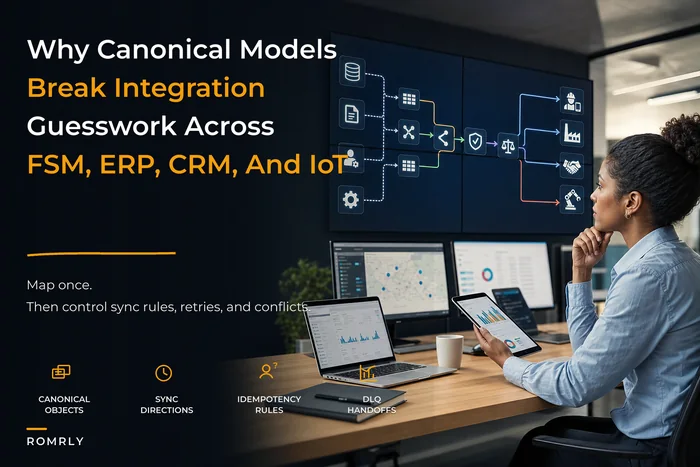
The teams that get this right tie their contracts back to a shared canonical model so each vendor's payload maps cleanly into one internal representation. If you haven't nailed down that internal model yet, that work comes first — a well-built canonical object model with explicit sync and conflict-resolution rules is what makes vendor contracts translatable instead of a pile of one-off mappings.
Conformance tests: proving the promise, continuously
A contract nobody tests is a wish. Conformance tests are how you verify that a vendor's live behavior still matches what they promised — not once at integration time, but on a schedule, indefinitely.
The distinction that trips people up: integration tests check your code against your assumptions. Conformance tests check the vendor against the contract. They run against the vendor's real or sandbox endpoint and fail loudly when reality drifts from the agreement.
What an operator-ready conformance recipe actually contains:
-
A set of canonical request/response pairs representing the real cases you depend on — not edge cases engineers dream up, but the job types, part lookups, and status transitions your business actually runs.
-
Assertions on semantics, not just structure — not only "is
etaa valid timestamp" but "is it within a plausible range given the dispatch time." -
Negative tests — send a malformed request and confirm the vendor returns the documented error, not a 200 with silent garbage.
-
Timing checks — confirm events arrive within the contracted window under normal load.
| Test type | What it verifies | When it runs | Who reacts when it fails |
|---|---|---|---|
| Structural conformance | Payload shape matches schema | Every deploy + daily | Integration engineer |
| Semantic conformance | Field meanings and ranges hold | Daily | Ops lead + engineer |
| Timing/SLA conformance | Event latency and ordering | Continuous sampling | Dispatch ops |
| Negative/error conformance | Documented failure behavior | Weekly | Integration engineer |
| Idempotency conformance | Duplicate handling is safe | Weekly | Engineer |
One mistake that comes up repeatedly: teams run conformance tests against vendors they build integrations with, and skip the ones they receive data from. The inbound feeds — monitoring alerts, parts availability, subcontractor completions — are exactly the ones that drift silently because you don't control the release. Those deserve the heaviest conformance coverage, not the lightest.
The interface registry: knowing what talks to what
Once you're past a handful of integrations, nobody on the team can hold the whole map in their head. Which systems consume the "job completed" event? If a vendor changes their parts-lookup schema, what breaks downstream? When a dispatcher reports weird data, where did it originate?
An interface registry answers those questions, and it's less exotic than it sounds. It's a maintained inventory of every interface — who owns it, which contract version it's on, what consumes it, and what its current conformance status is. Done well, it turns "let me ask around" into a lookup.
A workable registry entry tracks:
-
Interface name and direction (inbound/outbound/bidirectional)
-
Vendor and internal owner — one named person on each side, not a team alias
-
Contract version in production and the last date it was validated
-
Consumers — every internal system or workflow that depends on this feed
-
Conformance status — green/amber/red from the latest test run
-
Change-notice contact — the actual human the vendor pings before breaking things
Wire registry updates into the release process so entries are updated automatically when interface changes are deployed.
The payoff shows up during incidents. When a feed misbehaves, the registry tells you in seconds which downstream processes are at risk and who to call. Without it, every integration incident becomes an archaeology project while jobs pile up. This kind of registry discipline sits naturally inside a broader approach to field-service technology standards that keep integrations scalable rather than growing into a tangle nobody can trace.
One pattern worth flagging: registries rot the instant they stop being load-bearing. If updating the registry is a separate chore disconnected from how changes actually get deployed, people skip it and it goes stale within a quarter. The registries that survive are the ones wired into the release process — you can't ship an interface change without the registry entry updating. Operations software helps here by making that entry update a natural byproduct of the workflow rather than a manual form someone has to remember, and by letting automation watch conformance status so an amber flag reaches the right owner before it becomes a red one.
Staging-to-prod rollout choreography
A scenario that plays out constantly: a vendor announces a new API version. You test it in staging, it looks fine, you flip production over. Except your staging environment was pointed at the vendor's sandbox, which was already running the new version — so your test proved nothing about the cutover itself. The first time production traffic hits the changed endpoint is in production. That's not a rollout. That's a hope.
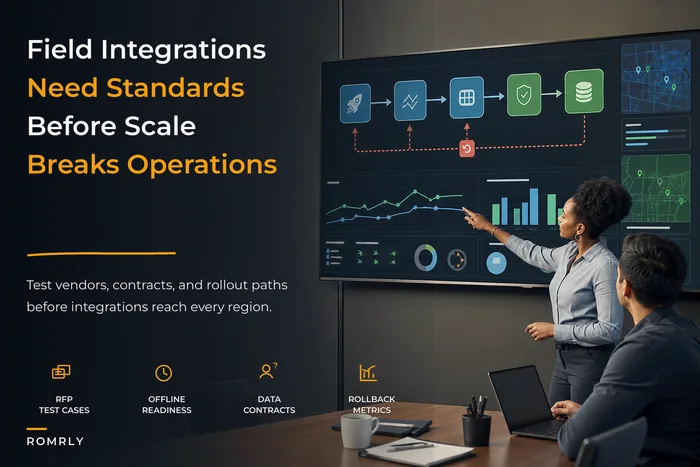
Choreographing a safe rollout across enterprises you don't control takes a different sequence than a single-system deploy:
-
Contract update first. Agree on the new contract version with the vendor before anyone writes code. Define what changed and whether it's breaking.
-
Conformance suite updated to the new version and run against the vendor's sandbox. This catches shape and semantic drift early.
-
Parallel-run in production. Where you can, consume both old and new versions simultaneously and compare outputs on live traffic. Discrepancies here are gold — they're the drift you'd otherwise discover during an incident.
-
Shadow a subset of real jobs through the new path without acting on the results, so dispatchers and finance can eyeball the output against known-good data.
-
Progressive cutover by segment — one region, one job type, or one subcontractor at a time, never the whole book of business at once.
-
Hold the old path warm for a defined window so rollback is a config flip, not a redeploy.
The real-world failure here is cutting over everything on a single date because "the vendor's deadline is the 30th." Vendor deadlines are negotiable far more often than teams assume, and a staged cutover that runs two weeks longer is vastly cheaper than one bad weekend of broken job flow.
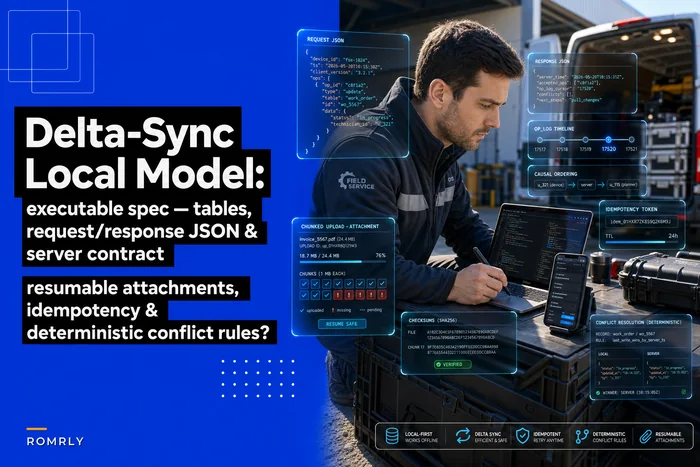
For integrations that touch mobile and offline workflows, the choreography has an extra wrinkle: field devices may be running older client versions for days after your backend cuts over. Your rollout has to account for techs in the field still sending yesterday's payload shape. This is where a disciplined delta-sync protocol and local data-model spec earns its keep — it defines how mismatched client and server versions coexist without corrupting job records.
Rollback and readiness test-cases: assume you'll need them
Most teams write a rollback plan that says "revert to the previous version." Then the moment arrives, and they discover the new version already wrote data in a shape the old version can't read — so reverting the code doesn't revert the damage. Rollback isn't a button. It's a set of conditions you have to engineer for in advance.
Readiness test-cases are the checklist you run before you're allowed to cut over, and the triggers that tell you when to roll back. A practical readiness checklist for a multi-vendor integration change:
-
New contract version signed off by both vendor and internal owner
-
Conformance suite passing against the new version in sandbox
-
Parallel-run discrepancy rate below your agreed threshold
-
Rollback path tested end-to-end, including any data written in the new shape
-
Old version held warm with a defined decommission date
-
Interface registry updated with new version and consumers re-confirmed
-
On-call owner named and available for the cutover window
-
Clear, pre-agreed rollback triggers (error rate, latency, discrepancy count)
The rollback triggers deserve special attention because teams almost always define them too vaguely. "If things look bad" is not a trigger. "If the completion-event latency exceeds 15 minutes for more than 20 minutes, or if the discrepancy rate between old and new paths exceeds 2%, roll back automatically" is a trigger. The difference is whether someone has to make a judgment call at 2 a.m. under pressure, or whether the system makes it for them.
A short example from the field: a commercial refrigeration service group was onboarding a new parts-distributor API. Their readiness process required a parallel run comparing old and new stock-availability responses for two weeks. During that window they caught that the new API reported "available" for parts that were available anywhere in the distributor's network, not at the regional warehouse they actually drew from. Under the old contract, "available" meant local. Same word, completely different meaning. Because they caught it in parallel-run instead of production, they renegotiated the field semantics before cutover. Had they skipped the readiness window, technicians would have been dispatched expecting parts that were three days away — roughly a dozen first-visit failures a week, each one a wasted truck roll and an SLA ding.
When heavy governance actually makes sense — and when it doesn't
All of this is real work, and it's not free. Spinning up contracts, conformance suites, a registry, and rollout choreography for an integration you'll use twice is overkill. The honest guidance:
This makes sense when:
-
You have three or more vendors whose data drives dispatch, parts, or billing decisions.
-
Integration failures translate directly to missed SLAs or revenue leakage.
-
Vendors ship on schedules you don't control and have historically surprised you.
-
Multiple internal systems consume the same external feed, so one break fans out.
This is overkill when:
-
You have one or two stable integrations with vendors who coordinate releases with you.
-
The data is informational, not operational — a nice-to-have dashboard feed, not the thing that routes trucks.
-
You're a small shop where one person can genuinely hold the whole integration map in their head and nothing moves that fast.
Who should NOT start here: if your internal canonical model is still a mess and every system defines "job" differently, governance on the vendor boundary won't save you. Fix the internal model first; otherwise you're writing contracts against a moving target of your own making.
How the pieces work together as one system
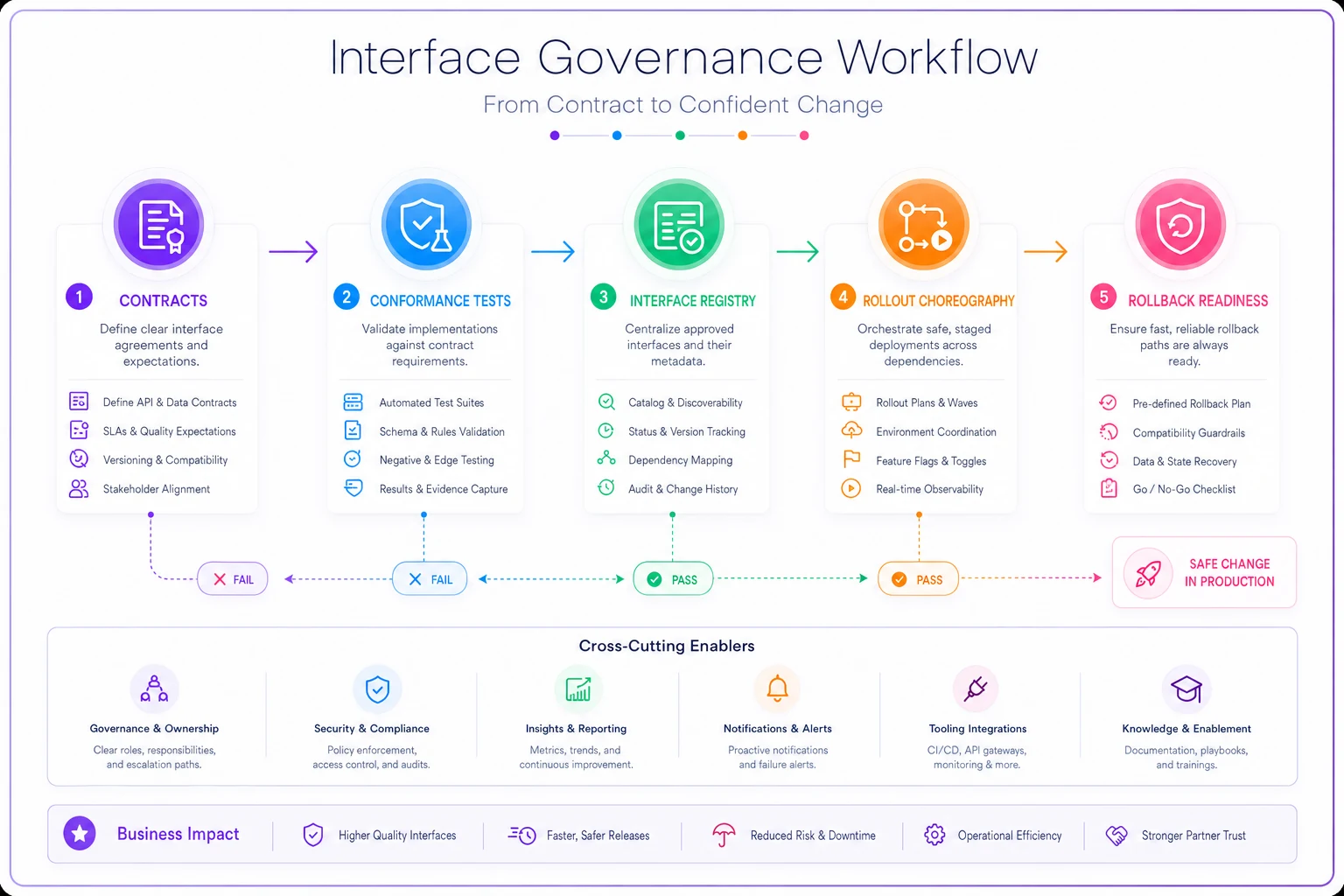
Step back and the whole thing is a loop, not a checklist. The contract defines the promise. The conformance tests verify the promise continuously. The registry tells you who depends on each promise. The rollout choreography lets you change a promise safely. The rollback and readiness cases let you recover when a change goes wrong anyway.
Pull any one piece out and the others weaken. Contracts without conformance tests are documentation nobody trusts. Conformance tests without a registry tell you something broke but not who's affected. A registry without rollout choreography is an accurate map of a system you can't safely change. And rollout choreography without rollback cases is a one-way door you walk through holding your breath.
Here's a simple workflow view of how these pieces connect:
What growing field-service operations eventually figure out is that the cost of this discipline is roughly flat, while the cost of not having it scales with every vendor you add. The first integration you can manage by hand. By the time you're coordinating dispatch, monitoring, parts, subcontractors, and billing across six or seven external systems, the manual approach means every vendor change is a small fire and every incident is a scramble to figure out what connects to what. Operations platforms that keep the registry live, run conformance checks on a schedule, and route the right alert to the right owner turn that chaos into a routine — not by replacing the governance, but by making it something your team actually keeps up instead of abandoning after the second busy week.
The managers who stay ahead of this don't treat integrations as a one-time engineering task that's "done" when the data flows. They treat the boundary between their business and every vendor as a living agreement that needs the same operational attention as the trucks and the techs. Because when that boundary drifts and nobody's watching, the first people to find out are always the customers.
Ready to optimize your field operations?
Join 2,000+ service teams using Romrly to boost productivity, reduce downtime, and enhance customer satisfaction.