

The first integration always works. You wire your FSM platform to your accounting system, a vendor rep helps out, everyone's happy, and the demo looks clean. Then you add the second integration. Then the parts supplier feed. Then IoT telemetry. Then a dispatch optimizer. Somewhere around the fourth or fifth connection, things start behaving strangely — job statuses don't match between systems, a technician's completed work order shows "open" in billing, and nobody can explain why.
What's actually breaking isn't any single connection. It's that there's no shared set of rules every system has to follow. Field service technology standards are the boring, unglamorous scaffolding that decides whether your tech stack can grow past three tools without becoming a maintenance nightmare. Most service businesses don't think about them until the pain is already expensive.
This post is about building that scaffolding before you buy the next platform — the procurement standards, the data contracts, the offline/telemetry minimums, and the rollout rituals that keep a growing integration surface from collapsing under its own weight.
The real problem: every vendor speaks its own dialect
Here's a pattern that shows up across nearly every field service operation that's grown past a couple of systems. Each vendor models the world slightly differently. One platform calls it a "work order," another calls it a "job," a third calls it a "ticket," and a fourth splits it into a "request" and a "visit." A technician is a "resource" in one system, an "employee" in another, and a "user ID" in the mobile app.
None of this matters when you have one system. It matters enormously when you have six, because every integration becomes a translation layer — and translation layers are where data quietly rots.
In real operations, this usually surfaces as reconciliation drift. Your dispatch system says you closed 412 jobs last month. Billing shows 405. Finance spends two days chasing the missing seven, finds three duplicate records and four that never synced, and everyone agrees to "look into it." Next month it happens again. The problem isn't the seven jobs — it's that no one agreed on what a "closed job" means across systems, or who owns that definition.
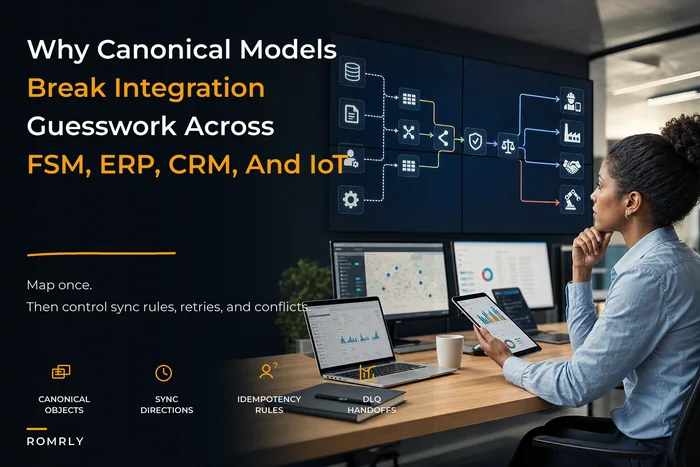
Standards fix this by forcing the question before the integration exists: what is the canonical shape of a work order, and every system either conforms to it or translates cleanly at the boundary. If you've already built a canonical object model with sync rules and conflict resolution, you're halfway there. This post extends that thinking outward — to the vendors and platforms you buy, not just the data you own.
What breaks at scale (and why it sneaks up on you)
Small stacks hide their weaknesses. With two systems and 15 technicians, a human can catch most errors by eyeballing them. The dispatcher notices the weird job. The office manager remembers that customer. Institutional memory does the work that standards should be doing.
Eliminate field service chaos with Romrly.
Romrly helps you assign, track, and complete service jobs efficiently and on time.
- Unified job scheduling
- Technician dispatch & tracking
- Customer notifications & updates
No credit card required
Then you double the fleet, add a region, bring on subcontractors, and suddenly the human safety net has holes. Failure points multiply in ways that aren't obvious from any single tool:
-
Field concurrency conflicts — two systems updating the same record from different sources, with no rule for who wins.
-
Silent schema drift — a vendor pushes an update that renames a field, and your integration keeps running while quietly writing nulls.
-
Telemetry floods — you add IoT feeds and event volume is suddenly 40x what it was, and half your integrations weren't built for that throughput.
-
Offline reconciliation gaps — a tech works four hours in a basement with no signal, and the sync-back logic wasn't designed for a batch that large or that stale.
-
Auth sprawl — each integration has its own credentials, its own token rotation, and no one has a full map of what's connected to what.
The insidious part is that none of these announce themselves. They accumulate as small discrepancies until a big customer disputes an SLA credit or finance closes the books three days late, and someone finally traces it back to a data contract that never existed.
Worth naming explicitly: the businesses that scale integrations cleanly aren't the ones with the best individual tools. They're the ones who decided early what "good" looks like — and made every vendor meet that bar.
The procurement lever most managers skip
By the time integration pain is visible, you're usually locked into contracts. The cheapest place to enforce standards is during purchasing — before the money moves and before switching costs pin you down. Almost everyone underinvests here.
A serious procurement process for field service technology should test the things that actually break at scale, not just the feature checklist a sales rep walks you through. That means putting real, operationally-flavored test cases in front of vendors and making them prove it.
Vendor RFP test-cases worth demanding
-
Concurrent edit test — Two systems update the same work order within the same minute. Show me exactly which write wins and why, and where the losing write goes.
-
Stale offline sync — A device comes back online with 6 hours of queued changes, some conflicting with server-side updates made in the meantime. Walk me through the resolution.
-
Schema change handling — You add a required field next quarter. What happens to existing integrations? Do they fail loud or fail silent?
-
Rate and volume ceiling — At what event-per-second rate does your API start throttling, and what's the documented backpressure behavior?
-
Bulk export under load — Can I pull a full month of job records for audit without degrading production performance?
-
Webhook reliability — If your webhook endpoint fails to reach me three times, what's the retry and dead-letter behavior?
The vendors who answer these crisply are the ones you can grow with. The ones who deflect to "we'll handle that in implementation" are telling you something important.
Canonical API and data-contract templates
The single highest-leverage standard you can create is a canonical data contract — a written, versioned definition of your core objects that every integration must map to. Not the vendor's model. Yours.
Think of it as the customs checkpoint between systems. Nothing crosses the border without conforming to the agreed shape. When a new tool arrives, the integration work becomes "map this vendor's fields to our canonical contract" rather than "figure out how these two systems disagree."
| Contract element | What it defines | What breaks without it |
|---|---|---|
| Core object schema | Field names, types, required vs optional | Silent nulls, mismatched records |
| Identity/keys | Which IDs are canonical across systems | Duplicate jobs, orphaned records |
| State machine | Valid statuses and legal transitions | "Closed" jobs reopening, stuck states |
| Timestamps & timezone | UTC storage, event-time vs sync-time | Scheduling errors, SLA miscalculation |
| Versioning rule | How schema changes roll out | Breaking changes shipped without warning |
| Ownership | Which system is source-of-truth per field | Two systems overwriting each other |
Pro-tip: Version the contract like software and provide a clear deprecation window for consumers.
That last row — source-of-truth per field — is the one people forget, and it causes the most damage. The billing system might own the invoice amount, but the dispatch system owns the job status. Write it down. Otherwise both will claim authority and quietly fight over the same record.
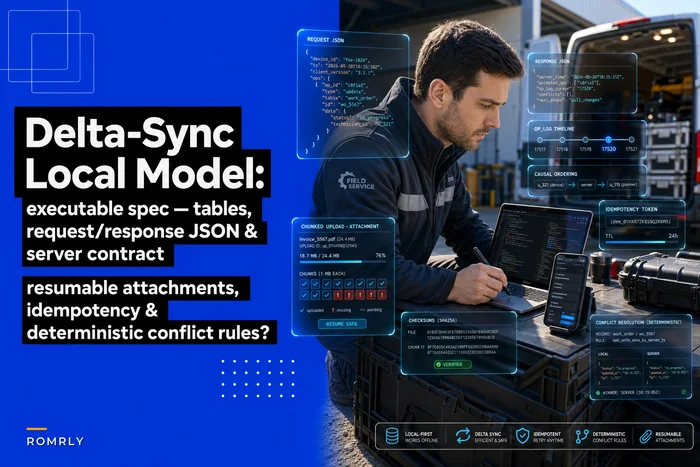
A good practice is to version the contract like software: work-order-v1, work-order-v2, with a deprecation window when you change it. This discipline is exactly what makes offline-first delta-sync and local data models survivable at scale — the sync logic depends on a stable, versioned contract underneath it.
Offline, telemetry, and ML minimums
Field service is not an office environment, and any standard that assumes reliable connectivity will fail in a parking garage. Your technology standards need explicit minimums for messy realities.
Offline minimums. Every mobile-facing platform you buy should meet a floor: it must queue changes locally, survive a full shift offline, sync deterministically when connectivity returns, and never lose a completed work order because the app crashed mid-sync. If a vendor can't commit to those four things, they don't belong in a field operation. The number of platforms that demo beautifully on office WiFi and fall apart in the field is genuinely high.
Telemetry minimums. As you add connected assets and IoT feeds, define the event standard up front: every event needs a stable device ID, an event timestamp (not just an arrival timestamp), a schema version, and defined behavior for late or duplicate events. Without this, telemetry becomes noise, and you end up building alert-suppression logic that never fully works because the underlying events were never structured properly.
ML minimums. If a platform includes predictive scoring — parts demand, failure prediction, routing suggestions — you should demand a few non-negotiables before trusting it in production:
-
The model's inputs are documented and available to you.
-
Predictions are explainable enough to override with a reason.
-
There's a fallback when the model is unavailable — the operation must still run.
-
Model performance is monitored, not assumed stable forever.
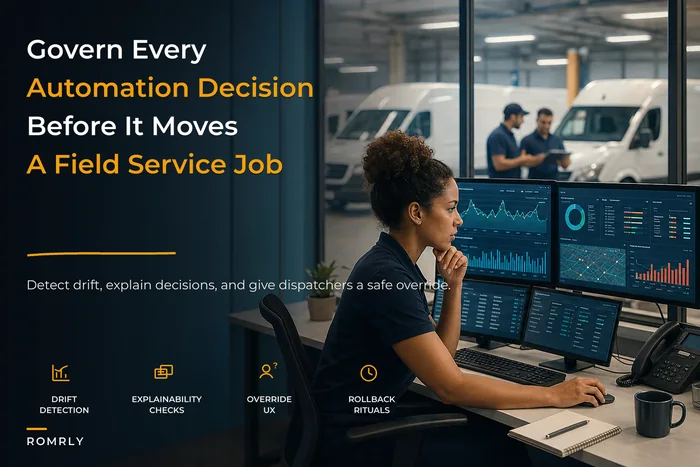
Buying ML you can't inspect or override is how you end up with a black box making dispatch decisions that no one can explain to an angry customer. The same governance principles that apply to running automation and ML in field operations apply doubly to ML you buy rather than build — you have even less visibility into it, so the contractual minimums matter more.
Rollout and rollback choreography
Standards on paper don't survive contact with production unless you also standardize how you deploy changes. This is what separates teams who ship integrations calmly from teams who dread every vendor update.
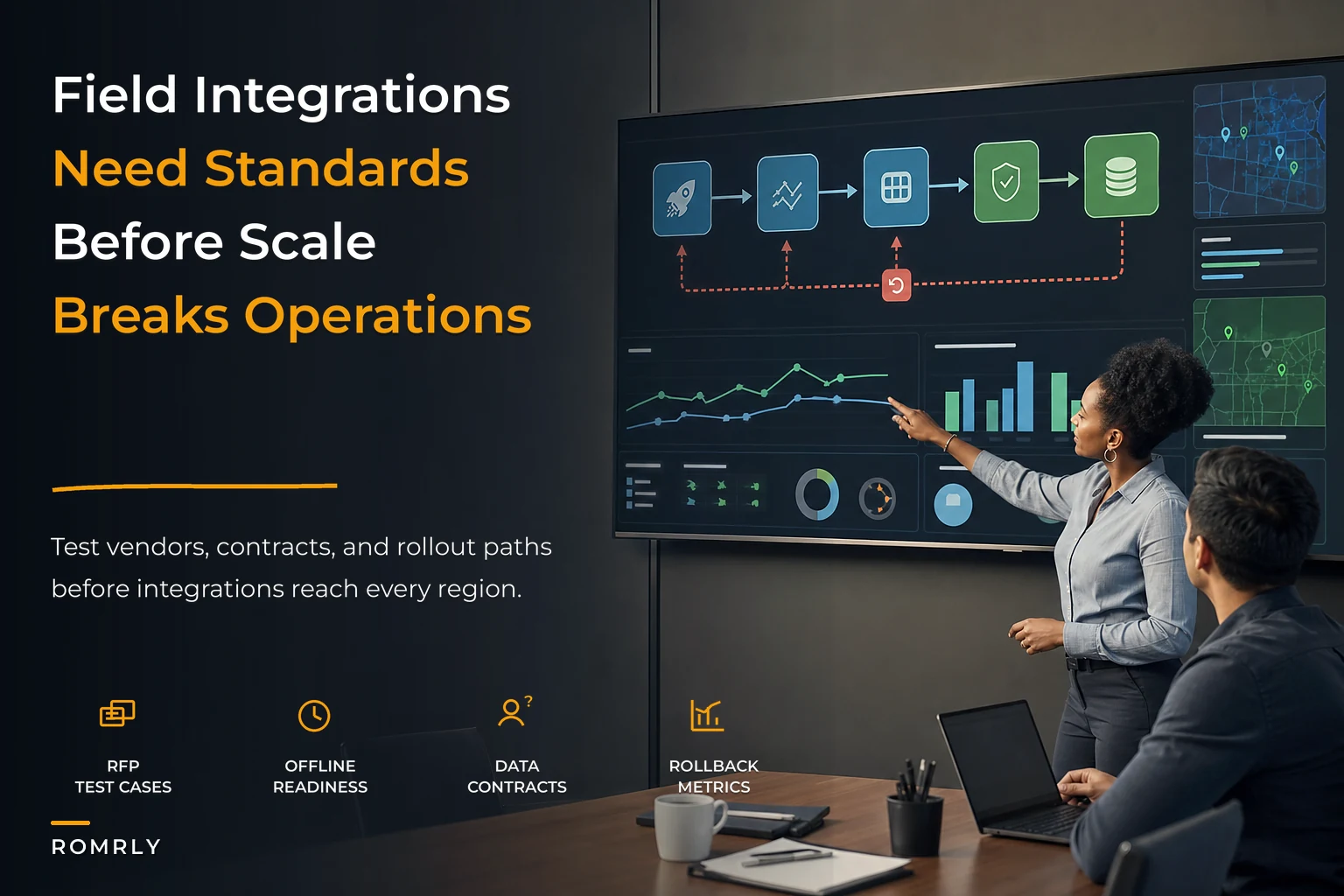
The core idea: no integration change goes live for everyone at once, and every change has a defined way to be undone. Here's a workable choreography:
-
Shadow phase. Run the new integration in parallel, reading and writing to a staging copy, comparing outputs against the current system without touching production. Watch for discrepancies for at least a full billing or dispatch cycle.
-
Canary phase. Enable it for one region or one small crew. Real data, small blast radius. Define specific metrics that would trigger a rollback — sync error rate, reconciliation drift, job completion mismatches.
-
Progressive rollout. Expand region by region, checking the same metrics at each step.
-
Rollback readiness. Before every phase, confirm you can revert cleanly — including any data written during the new integration's run. A rollback that leaves orphaned records isn't really a rollback.
-
Post-rollout reconciliation. After full deployment, run a full data reconciliation against the previous state and confirm counts match.
Visualizing the phases and the rollback path can help teams agree on metrics and escape hatches.
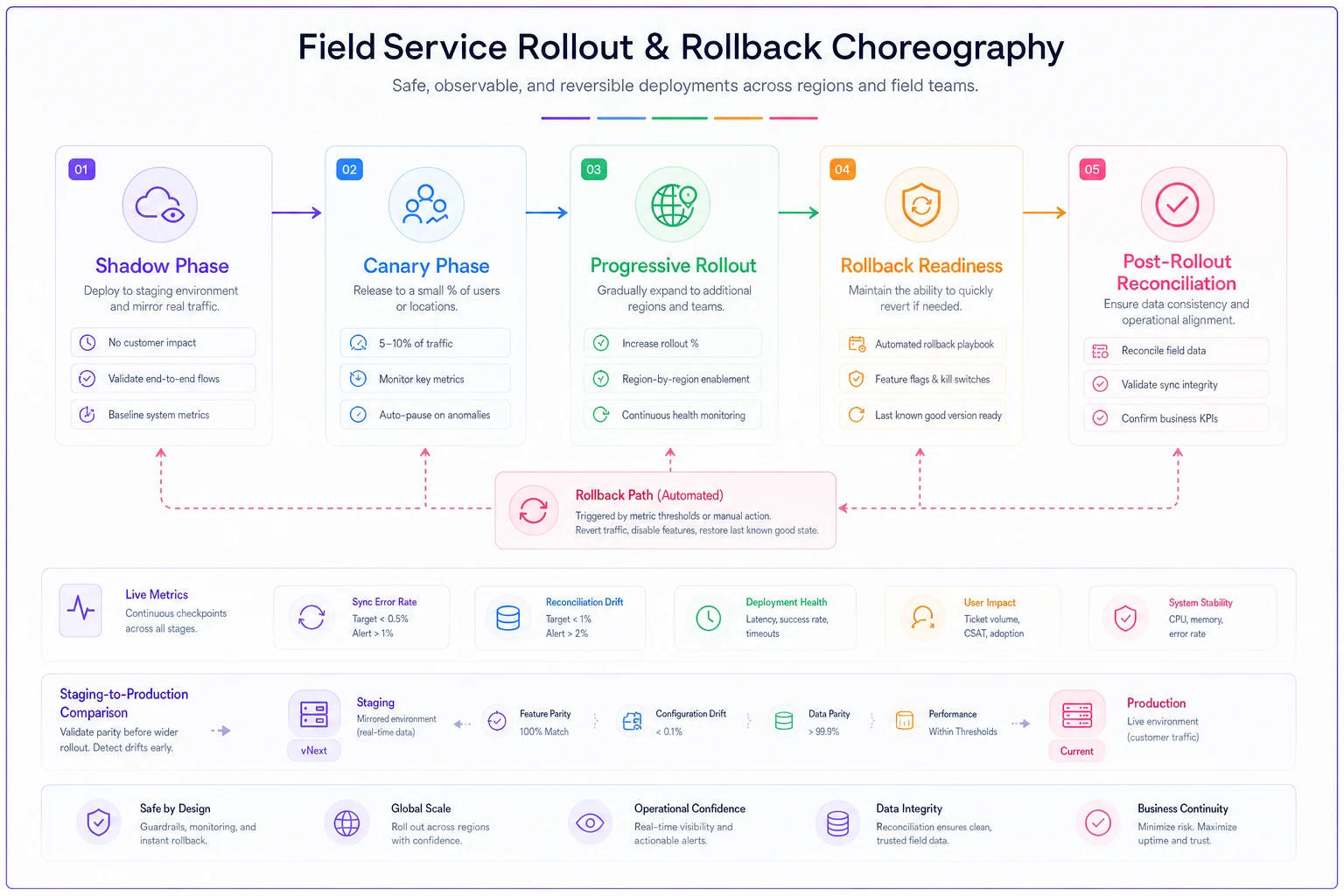
The mistake that comes up repeatedly: teams plan the rollout in detail and completely skip the rollback plan. Then a vendor update corrupts three days of job records, and the only option is frantic manual cleanup because nobody defined how to undo the change. Assume every deployment might fail and design the exit before you design the entrance.
Governance rituals that keep standards alive
The hardest part of standards isn't writing them — it's keeping them from decaying. Standards rot the moment enforcement stops, and enforcement requires small repeated rituals rather than heroic one-time efforts.
-
Contract review before every new integration. No new vendor connects until someone maps it to the canonical contract and signs off. Takes an hour. Saves weeks.
-
Quarterly integration inventory. A living map of every connected system, what it reads, what it writes, and who owns it. This is also your security surface — auth sprawl gets contained here.
-
Schema change log. Every contract version change gets recorded with a reason and a deprecation date. When something breaks six months later, the log tells you what changed.
-
Reconciliation cadence. A scheduled check comparing record counts across systems, run often enough that drift is caught in days, not quarters.
-
Vendor scorecard. Track each vendor's uptime, breaking changes, and how they handled incidents. Informs renewal decisions with evidence instead of gut feel.
The businesses that maintain these rituals treat their integration layer like an asset that needs maintenance — the same way they'd service a truck. The ones that don't treat it like a one-time project, then wonder why it degrades.
A real scenario: the mid-size HVAC operation
Consider a regional HVAC service company running about 60 technicians across three branches. They'd grown by adding tools reactively — an FSM platform, then separate accounting, then a parts supplier integration, then IoT monitoring on their maintenance-contract equipment. Five systems, all connected point-to-point, no shared contract.
The symptom that finally forced action wasn't dramatic. Monthly close kept slipping. Finance was spending roughly three to four days each cycle reconciling job records that didn't match between dispatch and billing. On top of that, they were losing SLA credits on maintenance contracts because IoT alerts and work orders lived in different systems with no reliable link between an alert and the job that resolved it — somewhere around $2k–$3k in credits a month, plus the harder-to-measure cost of customer frustration.
They didn't rip anything out. They defined a canonical work-order contract, retrofitted each integration to map to it, and added a nightly reconciliation check. The rollout ran region by region over about two months using a shadow-then-canary approach.
The results weren't miraculous, but they were real. Monthly close dropped to about a day of reconciliation work. The recurring SLA credit leakage largely stopped once alerts and jobs shared a canonical link. And the part they didn't expect — the next integration they added took a fraction of the time, because they were mapping to a stable contract instead of negotiating between two vendor models. The standard paid for itself twice: once in fixed problems, once in speed on the next project.
When this actually makes sense — and when it doesn't
When it makes sense: You have three or more connected systems, you're actively planning to add more, you've felt reconciliation pain, or you're scaling fleet size or regions. If integrations are on your roadmap, building the standard first is almost always cheaper than retrofitting later.
When it's premature: You have one or two systems and no near-term plan to expand. Building a formal canonical contract for a two-system stack is over-engineering. A lightweight field-mapping doc is enough until complexity grows.
Who should hold off: Very small operations still figuring out their core workflows. If your processes are still changing week to week, freezing them into a rigid data contract will just create friction. Get the operation stable first, then standardize how it connects. Standards codify what you've learned — they're a poor tool for figuring things out.
The mindset shift
Teams that scale their technology cleanly stop thinking about integrations as individual projects and start thinking about them as a system with rules. Every new tool isn't a fresh negotiation — it's a known process: map to the contract, meet the minimums, deploy through the choreography, add it to the inventory.
That shift is what turns technology from a growing liability into something that actually compounds. You can add the sixth platform as calmly as you added the second, because the scaffolding was built to hold it. Standards aren't the exciting part of running a field service operation — but they're the difference between a tech stack that helps you grow and one that quietly makes every future decision harder.
Build the standard while it's cheap. Enforce it with small rituals. And make every vendor meet your bar, not the other way around.
Ready to optimize your field operations?
Join 2,000+ service teams using Romrly to boost productivity, reduce downtime, and enhance customer satisfaction.