

There's a specific kind of failure that shows up once you've automated enough of your operation. It's quiet. Nobody gets an alert. The routing engine keeps suggesting jobs, the ETA predictions keep populating the customer texts, the inventory scoring keeps flagging what to restock. Everything looks like it's working.
Then a dispatcher notices the auto-assigned routes have been sending the wrong tech to a job type they can't handle. Not once — for about three weeks. The model started making a slightly worse decision, then a slightly worse one, and because nobody was watching the decisions (only the uptime), it drifted well past the point where a human would have caught it manually.
That's the real problem with automation in field service. It doesn't fail loudly like a server going down. It fails by being confidently wrong in ways that blend into normal operations. And the more you automate — routing, ETA enrichment, parts scoring, priority triage — the more surface area you have for silent, compounding errors.
Governance is what stands between "we automated dispatch and it saved us hours" and "we automated dispatch and now we're eating SLA penalties we can't even explain." This is a system-level topic, not a checklist you run once.
Why automation drifts in field ops specifically
Field service is unusually hostile to models. Your inputs are messy in ways a clean SaaS product never deals with.
A routing model trained on last spring's job mix starts making worse calls when your customer base shifts toward a new equipment type. An ETA model that was accurate at 40 jobs a day gets sloppy at 90 because congestion patterns change nonlinearly. An inventory scoring model that ranked parts well suddenly over-orders because a vendor changed lead times and nobody updated the feature the model reads.
The pattern underneath all of these is the same: the world moved, and the model didn't know. In stable environments this happens slowly. In field service it happens every time you add a territory, sign a big contract, lose a senior tech, or hit a seasonal spike.
A few common drift triggers worth naming, because these are the ones that sneak past people:
-
Feature staleness — a data feed the model depends on quietly stops updating (a technician skill flag, a vehicle capacity field), and the model keeps scoring off frozen data.
-
Label leakage over time — the "ground truth" you compare against shifts. If dispatchers start overriding the model constantly, your accuracy metrics look fine because the humans are quietly fixing it.
-
Population shift — new job types, new SLAs, new geography. The model was never trained on this and has no way to signal that.
-
Upstream schema changes — someone renames a field or changes units, and the model reads garbage as if it were signal.
Drift almost never gets caught by the team that owns the model. It gets caught by a dispatcher or a tech who says "this doesn't feel right anymore" — and by then the damage has a three-week head start. Governance exists to shorten that gap from three weeks to three days, and eventually to same-day.
The three things every automated decision needs
Before you build monitoring recipes, it helps to agree on what "governed" even means for a single automated decision. In practice, three properties matter:
Eliminate field service chaos with Romrly.
Romrly helps you assign, track, and complete service jobs efficiently and on time.
- Unified job scheduling
- Technician dispatch & tracking
- Customer notifications & updates
No credit card required
-
It can be explained. A dispatcher can ask "why did it assign this?" and get an answer that isn't "the algorithm said so."
-
It can be overridden. A human can reject the recommendation without fighting the software, and that override is captured.
-
It can be rolled back. If a model version turns out to be bad, you can return to the previous behavior fast, without a deploy that takes a day.
If any one of those three is missing, you don't have automation — you have a black box making operational decisions that you can't inspect, correct, or reverse. Most teams have the first version of automation (it makes decisions) long before they have the governance version (it makes accountable decisions). Closing that gap is the whole job.
Monitoring recipes that actually catch things
Uptime monitoring tells you the model is running. It tells you nothing about whether it's running well. You need decision-quality monitoring, which is a different animal.
Here's the practical distinction, because it trips people up:
| What you monitor | What it tells you | What it misses |
|---|---|---|
| Service uptime / latency | The endpoint responds | Whether responses are any good |
| Prediction volume | The model is being called | Whether calls are correct |
| Override rate | How often humans reject it | Nothing — this is gold |
| Prediction distribution | Shift in what it's recommending | Needs a baseline to compare |
| Outcome vs. prediction | Real accuracy over time | Delayed — outcomes lag |
The two monitoring signals that pay for themselves fastest are override rate and prediction distribution drift.
Override rate is the single most honest metric in automated dispatch. If your routing engine's suggestions are getting overridden 8% of the time and that creeps to 22% over a month, something changed — even if you can't yet say what. Dispatchers vote with their overrides. Watch that number per model, per job type, per dispatcher. A spike concentrated in one job type usually means population shift. A spike concentrated in one dispatcher usually means a training or trust issue, which is a different problem entirely.
Prediction distribution drift is the early-warning version. You take a rolling baseline of what the model used to recommend — the mix of assignments, the spread of ETAs, the distribution of inventory scores — and you alert when the shape of that distribution moves past a threshold. The model recommending 30% more "urgent" parts this week than the trailing 8-week average doesn't prove anything is wrong. It proves something is worth a human look.
-
Real-time hard guardrails only (impossible ETAs, assignments that violate skill or capacity constraints). These block, they don't just alert.
-
Daily override rates and distribution drift, reviewed by whoever owns dispatch quality — not a data scientist, an operator.
-
Weekly outcome-vs-prediction accuracy, since outcomes lag and don't make sense to check hourly.
-
Monthly a model review ritual (covered below).
One mistake worth calling out specifically: alerting on everything. If your governance system pages someone forty times a day, you've just rebuilt the alert-fatigue problem inside your governance layer. Threshold your alerts to the ones a human would actually act on.
The override experience is a governance tool, not a fallback
Most teams treat the manual override as an escape hatch — the thing you do when the software is wrong. That framing wastes the most valuable data you have.
Every override is a labeled training example and a drift signal at the same time. A dispatcher who reassigns a job the model suggested is telling you, precisely, that the model made a decision a human disagreed with — and, if your UX captures it, why.
The override interface deserves real design attention:
-
Make overriding fast. If it takes six clicks, dispatchers will stop using the model instead of correcting it, and you lose the signal.
-
Capture a reason code, but keep the list short. "Wrong skill," "customer constraint," "traffic/known local issue," "gut call." Five options a dispatcher can pick in a second beat a free-text box nobody fills in.
-
Show the model's reasoning at the moment of override. If the dispatcher can see "assigned because nearest available + skill match," they can tell you which part was wrong.
-
Make overrides visible in aggregate, not just logged. A weekly view of "top override reasons by job type" turns thousands of individual corrections into a roadmap for what to fix.
This connects directly to how you run scheduling in the first place. If your underlying scheduling governance rules are shaky, the model inherits that mess and the overrides pile up. Clean rules upstream mean fewer overrides downstream, and the overrides you do get are more meaningful.
The human-in-the-loop pattern that works best isn't "human approves everything" (too slow, defeats the point) or "human sees nothing" (dangerous). It's tiered autonomy:
-
Low-stakes, high-confidence decisions run automatically. Routine parts scoring, standard route ordering.
-
Medium-stakes or lower-confidence decisions run automatically but flag for after-the-fact review. Most ETA enrichment lives here.
-
High-stakes decisions require a human in the loop before execution. Reassigning an emergency job, overriding an SLA-critical route.
The tier is set by the consequence of being wrong, not by how fancy the model is. That distinction matters more than people expect.
Rollback choreography: the part everyone skips until it hurts
Here's the scenario that separates teams with real governance from teams with good intentions. A new model version ships Tuesday. By Thursday, override rates have doubled and the distribution drift alert is red. Everyone agrees the new version is worse.
Now what? If your answer involves a code deploy, a data science review, and a staging test, you're looking at a day or more of a known-bad model making live dispatch decisions. That's the gap rollback choreography closes.
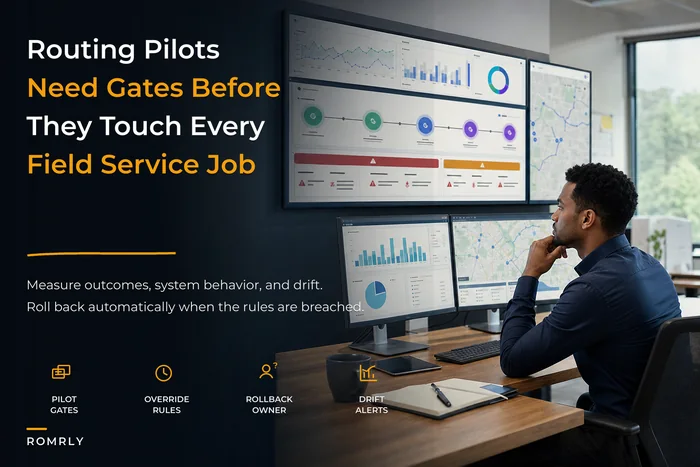
The principle: model versions should be switchable like a light switch, independent of your deploy pipeline. The previous known-good version stays warm and callable. Rolling back means pointing traffic at it, not rebuilding anything.
-
Detect — a monitoring threshold trips (override spike, distribution drift, guardrail violations climbing).
-
Triage — one named owner decides within a fixed window (say 30 minutes) whether this is real or noise. Ambiguity defaults to caution.
-
Freeze or fall back — either revert to the previous model version or drop that decision type to manual/tiered-human mode temporarily.
-
Communicate — dispatchers get a one-line notice
"Routing is on manual assist today, model paused." No mystery, no eroded trust.
-
Diagnose — figure out why offline, without the clock running on live damage.
-
Re-enable with a canary — bring the fixed version back on a slice of traffic (one territory, one job type) before full rollout.
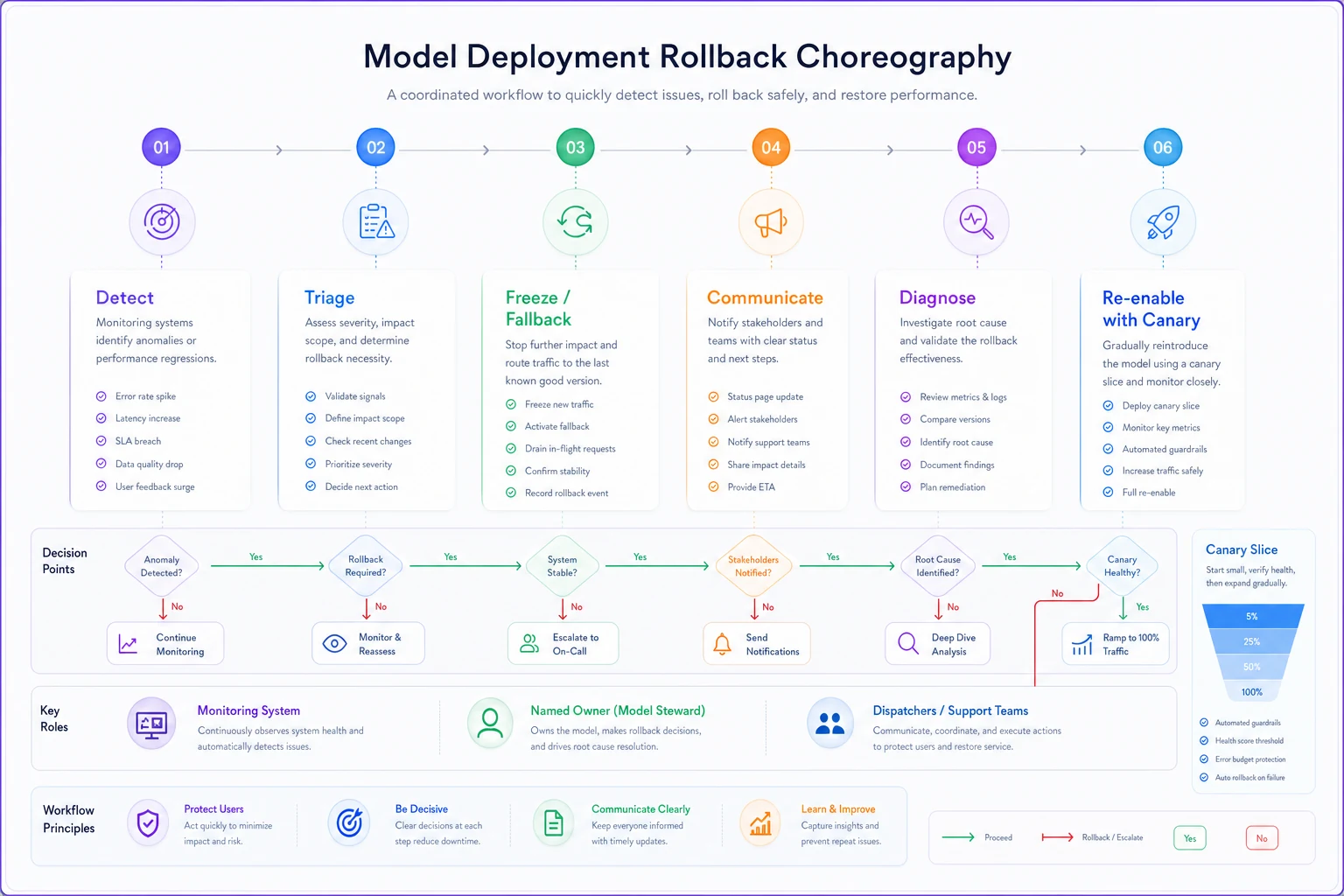
The step people forget is #4. When automation quietly changes behavior, dispatchers notice and stop trusting the whole system — including the parts that are fine. A one-line explanation preserves trust far more than pretending nothing happened.
One more choreography detail worth flagging: rollbacks should degrade to a known-safe manual mode, not to chaos. If pausing the routing model means dispatchers suddenly have zero guidance, you've traded a bad model for an overwhelmed team. The fallback state should be the old, boring, manual process the team already knows — which means you can't let those manual skills atrophy completely, even after automation is running well.
Review rituals: making this a habit, not a fire drill
Monitoring catches problems. Rituals prevent them from becoming normal. The difference between a governed operation and a lucky one is whether model review is on a calendar.
A monthly model review that stays useful covers:
-
Override trends — which models, which job types, trending which way.
-
Drift alerts fired — did we catch things? Any that we caught late?
-
Rollbacks and near-rollbacks — what triggered them, what we learned.
-
Explainability spot-checks — pull five recent automated decisions and ask "could we explain this to a customer or an auditor?" If not, that's a finding.
-
New population risks — did we add a territory, a contract, a job type the models haven't seen?
Keep it to operators plus whoever owns the models. The failure mode is turning it into a data-science-only meeting where the people who actually see the decisions land — dispatchers, supervisors — aren't in the room. They're the ones who know the model's been "acting weird," and their observations are your earliest warning system.
Tie the review to your metrics so it's grounded in numbers, not vibes. A well-built KPI framework already tracks first-time-fix, SLA attainment, and travel time — those downstream numbers are where a drifting model eventually shows up. If first-time-fix quietly dropped two points and it correlates with a model version change, that's your review finding the smoking gun.
When heavy governance makes sense — and when it's overkill
Not every automated decision needs the full apparatus. Building rollback choreography and daily drift monitoring for a model that suggests which knowledge article to show a tech is a waste of effort.
When full governance is worth it:
-
The decision affects SLA compliance or contractual penalties.
-
The decision is hard or expensive to reverse (a wrong parts order, a truck roll to the wrong site).
-
The model touches many jobs a day, so small error rates compound fast.
-
You're in a regulated or audited context where "explain this decision" is a real question you'll be asked.
When it's overkill:
-
The automation is advisory and a human decides anyway.
-
The decision is trivially reversible and low-cost when wrong.
-
Volume is low enough that a person is effectively reviewing everything already.
If your underlying data is inconsistent — technician skills tracked in three places, job types that mean different things to different dispatchers — automation will amplify that mess faster than governance can catch it. Fix the data foundation first. A model built on contradictory inputs doesn't need governance; it needs to not exist yet.
A real scenario
A regional HVAC and refrigeration company running roughly 70–90 jobs a day rolled out automated routing with ETA enrichment. First few months, great — travel time dropped noticeably, dispatchers had breathing room.
Then they onboarded a light-commercial contract with different equipment and tighter SLAs. The routing model, trained mostly on residential work, started assigning jobs to techs who lacked the specific certification about a fifth of the time. No alert fired — the model was "confident." Dispatchers were manually fixing some of it, which made the accuracy dashboards look fine while first-time-fix on the new contract sagged.
What surfaced it was override data, not an outage. Once they started tracking override rate by job type, the commercial category jumped out — overrides there were running two to three times the residential rate. That pointed straight at a population-shift problem the model couldn't self-report.
The fix wasn't glamorous: they added a skill-match hard guardrail (block, don't suggest), dropped commercial routing to tiered-human mode until the model was retrained on the new job type, and added override-rate-by-job-type to a weekly review. First-time-fix on the commercial contract recovered over the following couple months, and — more importantly — they now had a repeatable way to catch the next shift before it cost them SLA credits.
The lesson wasn't "the model was bad." The model was fine for what it knew. The governance gap was that nobody had a signal for what it didn't know.
Where this connects to the rest of your operation
Automation governance isn't a bolt-on. It threads through nearly everything. Your override reason codes are, over time, a documented record of edge cases — genuinely useful raw material for operational knowledge management, since the situations where the model gets it wrong are exactly the tricky judgment calls worth capturing for newer dispatchers and techs.
As you automate more of field operations, the risk shifts from "humans make mistakes" to "the system makes the same mistake at scale, silently." Governance is how you keep the leverage of automation without inheriting a new class of invisible failures. It's not about trusting the model less — it's about building the instruments so that trust is earned, monitored, and reversible.
Start with the two cheapest, highest-value pieces: track override rates per decision type, and make sure any model version can be rolled back in minutes, not days. Those two alone will catch most of the trouble before it reaches your customers — and they buy you the room to layer in the rest as your operation grows.
Ready to optimize your field operations?
Join 2,000+ service teams using Romrly to boost productivity, reduce downtime, and enhance customer satisfaction.