

Most field service operations don't fail their routing system on day one. They fail it three months in, when the algorithm that looked great in the pilot starts making decisions nobody can explain, dispatchers start overriding it "just to be safe," and someone in operations quietly reverts half the region back to manual scheduling without telling anyone. By then you've lost the thread — you can't tell whether the routing engine is actually helping, hurting, or just adding noise.
That gap between deploying a routing system and governing it is where most of the money leaks. Scheduling governance in field service isn't about picking the smartest algorithm. It's about building the rules, gates, and rollback triggers that let you trust the system's decisions — and catch it when it drifts.
This is the part almost nobody sets up in advance, and it's the part that decides whether automated routing survives contact with real operations.
Why routing systems quietly degrade
A routing algorithm doesn't "break" the way a truck breaks. It degrades. And it degrades because the world it was tuned on stops matching the world it's actually operating in.
A typical example looks like this: you tune your routing logic in spring, when travel times, job durations, and technician skill coverage all sit in a comfortable range. Then summer hits, three techs go on leave, two new hires join who take 40% longer on the same job types, and a big customer changes their access-window rules. The algorithm doesn't know any of that changed. It keeps optimizing for a reality that no longer exists, and outputs slowly get worse while every individual decision still looks defensible.
The degradation is almost never dramatic. It's a few extra minutes of travel per job. A slightly worse skill match. One more SLA miss per day per region. None of it trips an alarm because none of it is obviously wrong. It just adds up.
The governance problem here is measurement, not intelligence. If you can't see the drift, you can't respond to it. And if your dispatchers can feel the drift before your dashboards can show it, they'll start working around the system — which corrupts the very data you'd need to fix it.
The pilot evaluation gate: earn the rollout
Before any routing logic touches a full region, it should have to pass through a defined gate. Not a vibe check. A gate with pass/fail thresholds decided before you look at the results.
Eliminate field service chaos with Romrly.
Romrly helps you assign, track, and complete service jobs efficiently and on time.
- Unified job scheduling
- Technician dispatch & tracking
- Customer notifications & updates
No credit card required
The mistake most teams make is running a pilot and then deciding what "good" looks like after seeing the numbers. That's how you end up rationalizing a mediocre rollout. If the engine hit 71% first-time-fix and your manual baseline was 74%, but the pilot "felt smoother," you'll talk yourself into shipping it. Set the bar first.
A workable pilot gate covers a handful of dimensions:
| Dimension | Baseline (manual) | Pilot must hit | Fail action |
|---|---|---|---|
| On-time arrival % | ~88% | ≥ baseline, no worse | Hold rollout |
| Avg travel time/job | 34 min | ≤ 34 min | Investigate, don't ship |
| First-time-fix % | ~74% | Within 2 pts of baseline | Hold rollout |
| Dispatcher override rate | n/a | < 15% of jobs | Re-tune before scaling |
| SLA breach count/week | 6 | ≤ 6 | Rollback trigger |
The override rate row matters more than people expect. If dispatchers are overriding 30–40% of the algorithm's assignments during a pilot, the pilot didn't succeed — it just gave you a very expensive way to schedule manually. High override rates are the earliest, most honest signal that the system isn't trusted or isn't right yet.
Run the pilot on a region that's representative, not the easiest one. Teams love to pilot on their tightest, best-run territory because it makes the numbers look good. That's exactly backwards. You want to know how the routing engine behaves under normal mess, not under ideal conditions. If you've done work on service territory design already, use a territory that reflects your average, not your showcase.
Dispatcher override guardrails: the part everyone gets wrong
There's a real tension at the center of scheduling governance. You want dispatchers to be able to override the algorithm, because they see things it can't — a customer who's a nightmare on Fridays, a tech who's having a rough week, a road closure the system doesn't know about. But if overrides are unlimited and untracked, you lose all ability to evaluate whether the system works, and you slowly slide back into pure manual dispatch while paying for automation.
The answer isn't to lock dispatchers out. It's to make overrides structured.
-
Requires a reason code. Not a free-text box people ignore — a short list: access constraint, skill mismatch, customer request, safety, tech condition, known algorithm error. Reason codes turn overrides into data.
-
Sets a soft ceiling. If a dispatcher overrides more than, say, 20% of assignments in a shift, that's a flag — not a punishment, a review trigger. Either the algorithm is wrong in a systematic way, or the dispatcher needs coaching, or a data feed is stale. All three are worth knowing.
-
Distinguishes overrides that improve outcomes from ones that don't. When a dispatcher reroutes a job, you want to know later whether that job went better or worse than the algorithm's plan would have. Over time this tells you which override reasons are legitimate and which are just habit.
Keep the reason-code list short and review it monthly so new override patterns get captured quickly.
The pattern worth watching for: a small number of dispatchers who override constantly, always with the same reason code, and whose overrides don't measurably improve outcomes. That's not intuition — that's distrust hardening into a workaround. The guardrails exist to surface exactly that.
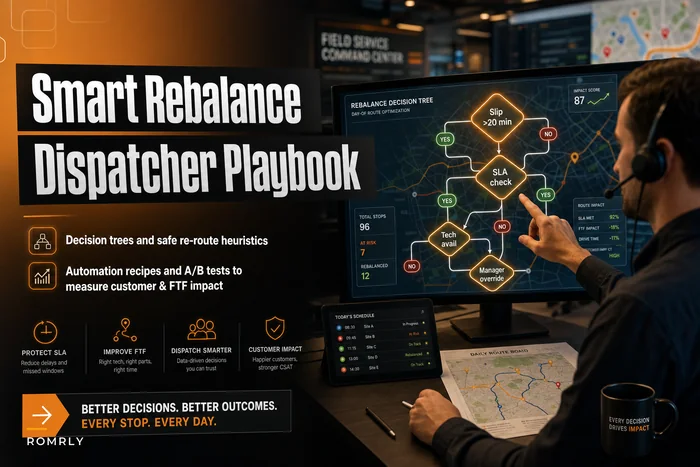
For the actual day-of decision logic dispatchers use when they do step in, it's worth pairing this with clear dispatcher decision trees and safe re-balance heuristics so overrides follow a consistent logic instead of gut feel that varies person to person.
Rollback criteria: decide before you're panicking
The single most useful thing you can do is define your rollback triggers in writing, before go-live, while everyone is calm.
Without them, here's how it actually goes. Something goes sideways — a bad week of SLA misses, an angry key account, a spike in overtime. Now it's Thursday afternoon, the ops manager is stressed, and the debate turns emotional. "Is it the algorithm or just a bad week?" Half the room wants to kill the whole system, half wants to defend it. Nobody agreed in advance what "too bad" means, so you're negotiating criteria in the middle of a fire.
Predefined rollback criteria end that argument. They look something like:
-
Immediate rollback if SLA breaches exceed 2x the baseline weekly count for two consecutive weeks.
-
Immediate rollback if on-time arrival drops below a hard floor (e.g., 80%) for any full week.
-
Partial rollback (revert one region to manual) if override rates exceed 35% and outcomes aren't improving.
-
Freeze and investigate (stop new tuning, hold current logic) if any core metric drifts more than 10% from baseline without an obvious external cause.
The distinction between full rollback, partial rollback, and freeze is what keeps you from overreacting. Most problems don't require nuking the whole system — they require pulling one region back, or stopping changes while you diagnose. Having three levels of response instead of a single on/off switch is the difference between governance and panic.
Rollback also has to be genuinely easy to execute. If reverting to manual scheduling takes a database migration and two days of engineering, nobody will do it until things are catastrophic. The ability to flip a region back to manual dispatch in an hour should be a design requirement, not an afterthought.
What monitoring actually needs to show
Dashboards for scheduling governance fail in a specific way: they show you outcomes but not drift. You see today's on-time percentage, but not whether it's been sliding half a point a week for a month. Outcome metrics tell you where you are. Governance needs to tell you where you're heading.
A monitoring setup for routing governance should separate three layers:
-
Outcome metrics — on-time %, first-time-fix, SLA breaches, travel time. The results.
-
System-behavior metrics — override rate by dispatcher and reason, % of jobs assigned by algorithm vs manual, how often the top-ranked assignment was actually chosen. How the engine and the humans are interacting.
-
Drift indicators — rolling 4-week trend on each core metric, plus flags when the gap between predicted and actual job duration widens. The early warning system.
That middle layer is where most teams have nothing. They track results and nothing about how those results are being produced. So when outcomes slip, they can't tell whether the algorithm got worse or the humans stopped following it. Those two problems have completely different fixes, and you can't tell them apart without behavior metrics.
If you already run a broader KPI framework wired to dashboards by role, the routing governance metrics should live inside it rather than in a separate report nobody opens. Governance data that lives in its own silo gets checked for the first two weeks and then forgotten.
One more thing worth building: a weekly review cadence tied to the dashboard, with one owner. Not a committee — one person who looks at the drift indicators every Monday and either says "green, continue" or opens an investigation. Governance without a named owner and a fixed cadence quietly stops happening within a month.
Here's a simple monitoring workflow to visualize how metrics, behavior tracking, and drift alerts connect.
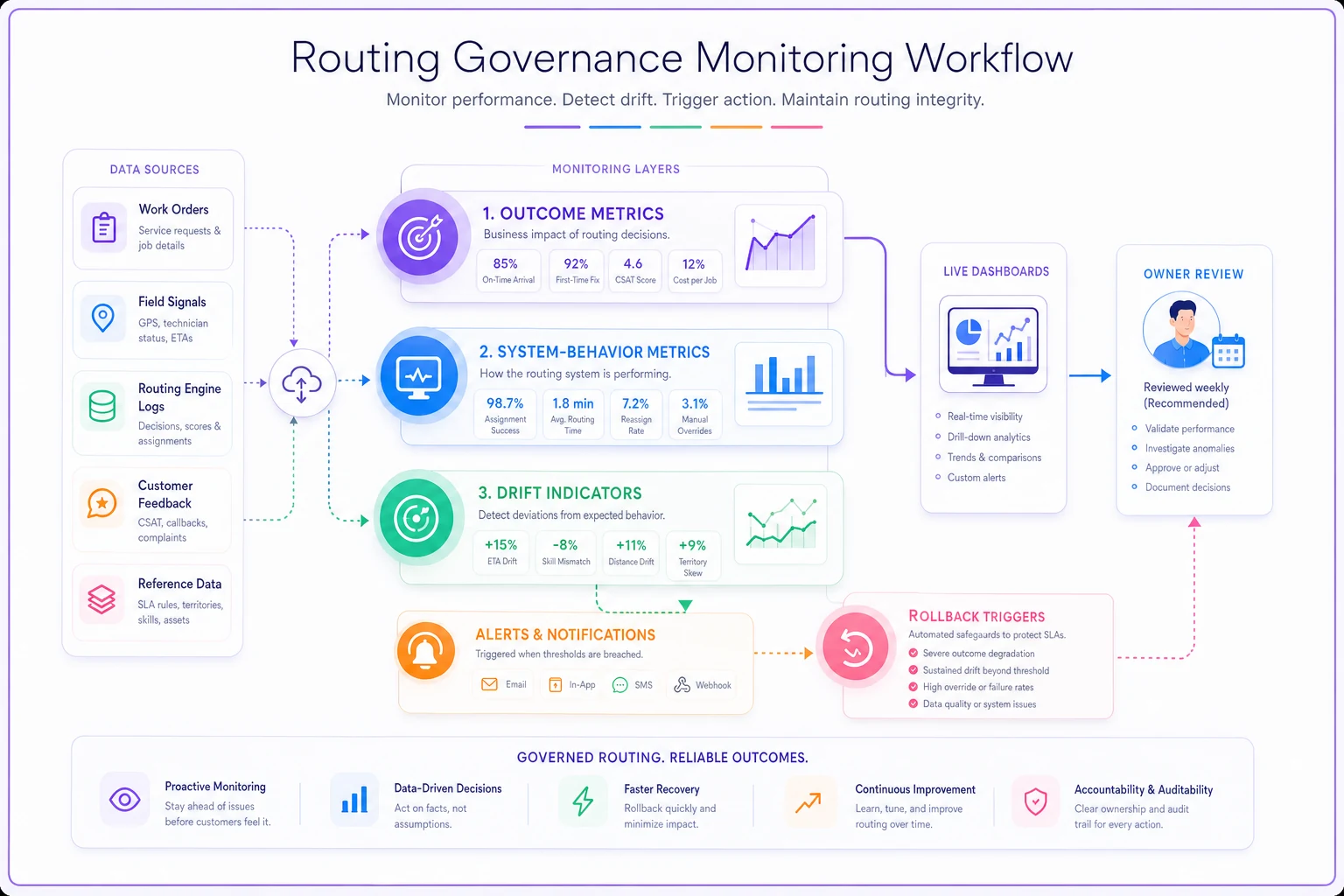
Use this workflow to align dashboards, ownership, and rollback triggers so drift is visible before it becomes a crisis.
A real scenario
A regional HVAC service company running about 22 technicians across three territories rolled out algorithmic routing to cut travel time and rebalance workloads. The pilot on one territory looked fine — travel time down, arrivals steady. So they scaled to all three.
Six weeks later, overtime was creeping up and two mid-size accounts were complaining about missed windows. Nobody could say why. The dashboard showed on-time arrival around 84% — down from about 89% before, but not alarming on any single day. What they didn't have was any visibility into override behavior.
When they finally pulled it apart, the pattern was clear: two dispatchers in the newest territory were overriding roughly 40% of assignments, almost all tagged "skill mismatch." The routing engine didn't have updated skill certifications for four recently cross-trained techs, so it kept assigning them jobs the dispatchers didn't trust them on — and the dispatchers kept manually loading those jobs onto the two most senior techs, who then ran into overtime.
The fix wasn't the algorithm. It was a stale data feed plus no visibility. They corrected the skill records, set an override ceiling with reason-code tracking, and added a weekly drift review. Over the next month, override rates in that territory dropped from around 40% to under 15%, overtime came back down toward its prior range, and on-time arrival recovered to roughly 88%. No rollback needed — but only because they finally had the instrumentation to find the actual problem instead of blaming the engine and reverting everything.
When tight governance makes sense — and when it doesn't
Not every operation needs this level of structure.
This makes sense when:
-
You're running enough daily jobs (roughly 60+ across the operation) that manual dispatch genuinely can't optimize well, and the algorithm's decisions materially affect cost.
-
You have SLA commitments where breaches carry real financial or relationship cost.
-
You've got multiple dispatchers or territories, so inconsistency between people is a real risk.
This is overkill when:
-
You're a small crew where one dispatcher knows every tech and every customer personally. At that scale, human judgment beats the algorithm often enough that heavy governance is just paperwork.
-
Your job volume is low and predictable. If routing decisions barely vary day to day, there's little to govern.
Who should not do this yet: any operation that hasn't first stabilized its underlying data — skill records, job-duration estimates, access windows. Governance on top of bad data just gives you a very organized way to trust wrong decisions. Fix the feeds first, then govern the routing.
A rollout checklist worth stealing
Before you scale any routing logic past a pilot, confirm you have:
-
[ ] Pass/fail pilot gates defined before the pilot runs
-
[ ] A representative pilot territory, not your easiest one
-
[ ] Reason-coded overrides with a soft ceiling
-
[ ] A method to compare override outcomes vs the algorithm's plan
-
[ ] Written rollback criteria at three levels (full, partial, freeze)
-
[ ] Rollback that can actually be executed in under an hour
-
[ ] Dashboards covering outcomes, system behavior, and drift
-
[ ] A named owner and a fixed weekly review cadence
-
[ ] Clean underlying data on skills, durations, and access windows
If you can't check most of these off, you don't have a routing system — you have a routing experiment running in production without a control panel.
Scheduling governance for field service isn't a constraint on your routing algorithm. It's what makes the algorithm usable at all. The engine will make thousands of decisions you can't personally review. Governance is the set of gates, guardrails, and triggers that let you delegate those decisions without losing the ability to catch, question, and reverse them.
The operations that get real value from automated routing aren't the ones with the smartest algorithm. They're the ones that built the boring infrastructure around it — the reason codes, the drift indicators, the predefined rollback thresholds, the one person who checks the dashboard every Monday. That infrastructure is unglamorous. It's also exactly what separates a routing system you trust from one you quietly abandon three months in.
Ready to optimize your field operations?
Join 2,000+ service teams using Romrly to boost productivity, reduce downtime, and enhance customer satisfaction.