

Two months ago, an HVAC contractor in Phoenix got hit with $47,000 in OSHA penalties. Not because their techs were cutting corners—they were actually pretty careful on the job. They failed because when the inspector asked for incident documentation from March, they spent three hours digging through WhatsApp photos, email threads, and handwritten forms stuffed in filing cabinets.
The inspector wanted to see corrective action tracking for a minor fall incident. The company had done the training, fixed the ladder issue, everything. But proving it? That meant scrambling through dozens of disconnected records. By the time they found half the documentation, the inspector had already started writing violations.
This plays out constantly in field service. Companies do the right things operationally but can't prove it systematically. The work gets done, but the evidence trail breaks down somewhere between incident intake, corrective actions, training completion, and audit prep.
Why Field Service Compliance Breaks at the Documentation Layer
Field service operations generate safety incidents differently than factories or offices. Techs work alone at customer sites, use different equipment daily, face varying hazards, and often handle incidents without immediate supervisor oversight. Safety management systems built for centralized workplaces fall apart when your workforce is scattered across 50 job sites every day.
The compliance challenge multiplies because field service companies face overlapping regulatory frameworks—OSHA for general safety, DOT for vehicle operations, EPA for refrigerant handling, state electrical boards for technical work, plus customer-specific requirements for commercial clients. Each has different documentation standards, retention periods, and audit processes.
Most field service businesses manage this through some combination of paper forms, shared drives, spreadsheets, and maybe a basic safety app. That works okay at 15 techs getting audited once every few years. But somewhere around 25-30 techs, or when you land that first enterprise contract with quarterly safety audits, the whole system starts creaking.
What usually triggers the breakdown isn't the incident itself—it's everything that needs to happen after. A tech reports a near-miss with a ladder. Now someone needs to investigate it, document findings, create corrective actions, assign training, track completion, update the hazard assessment, notify the client if it happened on their property, and package all of this into an audit-ready format. Miss any step and you've created a compliance gap that auditors will find.
The Broken Telephone Game of Incident Reporting
Watch how a typical safety incident moves through a field service org and you'll see why documentation falls apart.
Eliminate field service chaos with Romrly.
Romrly helps you assign, track, and complete service jobs efficiently and on time.
- Unified job scheduling
- Technician dispatch & tracking
- Customer notifications & updates
No credit card required
A tech working solo at a retail location slips on a wet floor, catches themselves, no injury. They text their supervisor. The supervisor mentions it in the weekly safety meeting. Someone makes a note to add "check for wet floors" to the job hazard analysis. Three months later, an auditor asks about near-miss trending and corrective action effectiveness. Nobody can connect these dots because the original report lives in a deleted text thread.
The intake problem starts with how field techs report incidents. They're usually alone when something happens, focused on finishing the job, and don't have easy access to formal reporting systems. So they default to whatever's quickest—usually a text or call to their direct supervisor.
Even when companies have formal procedures, the forms often ask for information techs don't have in the field. Exact GPS coordinates, witness statements, environmental measurements, equipment serial numbers. By the time they're back at the shop to fill out paperwork, critical details are forgotten or reconstructed incorrectly.
Evidence capture fails because nobody's thinking about audit requirements during the incident. Techs take photos showing the problem but not the surrounding conditions. They document what broke but not what the correct setup should look like. They record what happened but not what they did to make the site safe before leaving.
Building Evidence Packets That Actually Survive Audits
After watching many field service companies scramble during audits, the pattern becomes clear: successful compliance isn't about having perfect safety records, it's about being able to quickly prove what you did about imperfect situations.
Auditors don't expect zero incidents. They expect systematic responses to incidents. They want to see that when something happens, you capture it properly, investigate it thoroughly, implement corrections, verify effectiveness, and actually learn from it. The companies that fail audits aren't necessarily less safe—they just can't demonstrate their safety management process with evidence.
An audit-ready evidence packet for a field service incident needs to tell a complete story. From the initial report, through investigation and root cause analysis, into corrective actions and preventive measures, ending with verification and organizational learning. Each step needs timestamp-verified documentation that proves not just what you did, but when and who was involved.
Here's what this looks like operationally:
Incident Intake Requirements
-
Time-stamped initial report (voice, text, or form)
-
GPS-verified location data
-
Photo evidence with metadata intact
-
Environmental conditions (weather, lighting, terrain)
-
Equipment involved with identifiers
-
Immediate actions taken
-
Initial severity classification
Investigation Documentation
-
Assigned investigator and qualifications
-
Investigation timeline and methods
-
Witness statements or interviews
-
Root cause analysis documentation
-
Contributing factor identification
-
Similar incident history review
-
Investigation findings summary
Corrective Action Tracking
-
Specific actions identified
-
Responsible parties assigned
-
Implementation timelines
-
Resource requirements
-
Verification methods defined
-
Effectiveness measures established
-
Follow-up schedule created
Training Loop Integration
-
Training needs identified
-
Target audience defined
-
Training content developed or selected
-
Delivery method and schedule
-
Attendance tracking
-
Competency verification
-
Refresher scheduling
This framework only works if each component feeds the next automatically. Manual handoffs between systems create gaps where documentation disappears or details get lost in translation.
The Corrective Action Death Spiral
The most common field service safety compliance failure isn't missing incidents—it's incomplete corrective actions. A company identifies 50 safety issues throughout the year, creates corrective action plans for each, then loses track of which ones actually got implemented.
A commercial electrician had 73 open corrective actions when an auditor showed up. Not because they weren't fixing things, but because nobody was systematically tracking completion and verification. They'd fixed most of the issues but couldn't prove it. The audit report made them look negligent when they were actually quite proactive about safety.
Corrective actions in field service face unique tracking challenges. The person identifying the issue (field tech) rarely implements the fix (maintenance team, training department, or management). The fix might require multiple steps across different departments—updating procedures, training staff, modifying equipment, changing vendor requirements. Each step has different owners, timelines, and verification needs.
Traditional corrective action tracking uses spreadsheets or basic task lists. These work until you're juggling dozens of actions across multiple sites, teams, and regulatory frameworks. Then you need systematic workflows that enforce completion, verification, and effectiveness reviews.
The tracking system also needs to handle varying complexity. A simple corrective action might be "replace damaged ladder at warehouse." A complex one might be "redesign fall protection protocol for rooftop units across all commercial sites, including vendor training, equipment procurement, and client notification." Both need tracking, but with very different workflow requirements.
Training Loops That Close Compliance Gaps
Safety training in field service typically happens in two modes: scheduled annual requirements and reactive incident responses. The scheduled training gets tracked reasonably well because it's predictable. The reactive training—where real learning happens—often disappears into informal toolbox talks and buddy conversations.
When an incident triggers a training need, documenting that loop becomes critical. Auditors want to see that incidents lead to learning, learning leads to changed behaviors, and changed behaviors prevent recurrence. Break this chain anywhere and your safety program looks reactive rather than preventive.
A plumbing contractor had excellent safety culture but terrible training documentation. When techs made mistakes, supervisors immediately corrected and coached them. But none of this got captured formally. During their audit, they couldn't prove that incidents led to systematic training improvements. The informal learning that actually kept their techs safe became invisible to regulators.
The training loop needs to capture several things. The trigger event—incident, near-miss, observation, or audit finding—must link directly to the training record. This proves the training was relevant and timely, not just generic annual requirements.
-
Attendance needs to be verified beyond just signatures. Digital check-ins, competency assessments, and supervisor sign-offs create stronger evidence than paper sign-in sheets that anyone could have signed at any point.
-
Content delivery needs documentation too. Whether it's slides, videos, hands-on demonstrations, or field exercises, auditors want to see what was actually taught—not just that "training occurred."
-
Competency verification closes the loop. Not just "did they attend?" but "can they now perform safely?" This might be written tests, practical demonstrations, or supervised field observations.
-
Most importantly, the training loop needs to feed back into incident tracking. When similar incidents occur after training, the system should flag the pattern for investigation. Either the training was ineffective, or there's a deeper systemic issue.
Most importantly, the training loop needs to feed back into incident tracking. When similar incidents occur after training, the system should flag the pattern for investigation. Either the training was ineffective, or there's a deeper systemic issue.
KPI Gates That Prevent Compliance Drift
Field service safety compliance slowly drifts off course through dozens of small omissions. A tech forgets to submit a near-miss report. A supervisor delays investigating a minor incident. A trainer skips documenting a toolbox talk. Each seems insignificant, but collectively they create compliance gaps that only become visible during audits.
KPI gating prevents this drift by creating mandatory checkpoints throughout your safety workflows. Unlike traditional KPI monitoring that reports problems after they happen, gating stops processes from proceeding until critical compliance steps are complete.
For incident management, this means reports can't close without investigation documentation. Investigations can't close without corrective actions assigned. Corrective actions can't close without verification evidence. Training requirements can't be marked complete without competency verification.
Your KPI framework needs clear ownership at each gate. The field tech owns initial reporting accuracy. The supervisor owns investigation timeliness. The safety manager owns corrective action tracking. The operations manager owns verification and effectiveness reviews.
Here's what effective KPI gating looks like across the incident lifecycle:
| Gate Stage | Window | Key Checkpoints |
|---|---|---|
| Intake | 24 hours | Incident reported within 4 hrs, photos uploaded within 8 hrs, supervisor review within 24 hrs, severity classification assigned |
| Investigation | 72 hours | Investigator assigned within 24 hrs, initial investigation within 48 hrs, root cause documented within 72 hrs, training needs assessed |
| Correction | 30 days | Actions assigned within 5 days, implementation started within 10 days, weekly progress updates, completion verified within 30 days |
| Training | Variable | Content developed within 14 days, training scheduled within 21 days, attendance verified same day, competency documented within 48 hrs |
These gates need teeth. If a supervisor hasn't reviewed an incident report within 24 hours, it escalates automatically. If corrective actions pass their due dates, the operations manager gets daily notifications. If training compliance drops below 90%, new work orders get flagged until it's resolved.
The Evidence Architecture That Scales
Small field service companies can manage safety compliance through manual diligence and good intentions. But around 30-40 technicians, or when you start servicing regulated industries, you need systematic evidence architecture that automatically creates audit trails.
This architecture has four layers, each building on the previous:
Capture Layer: Every safety-relevant event gets documented at the source. Mobile forms for incident reports, photo uploads with automatic metadata, voice-to-text for verbal reports, integration with vehicle telematics for driving incidents. The goal is removing friction from initial reporting so techs actually document things.
Processing Layer: Raw inputs get standardized, classified, and routed. An uploaded photo gets tagged with incident ID, location, timestamp, and hazard type. A verbal report gets transcribed and parsed for key information. Vehicle hard-braking events get correlated with driver schedules and route conditions.
Workflow Layer: Standardized inputs trigger appropriate workflows. Minor incidents might only require supervisor review and toolbox talk documentation. Serious incidents launch full investigations with root cause analysis, corrective actions, and management reviews. Each workflow maintains its own evidence requirements and gates.
Packaging Layer: All related evidence gets assembled into audit-ready packets. Instead of scrambling to find documentation, you can pull complete incident histories with all supporting evidence, organized chronologically with clear linkages between events, actions, and outcomes.
Here's a simple diagram showing how the layers interact and how evidence flows from capture to packaged audit packets.
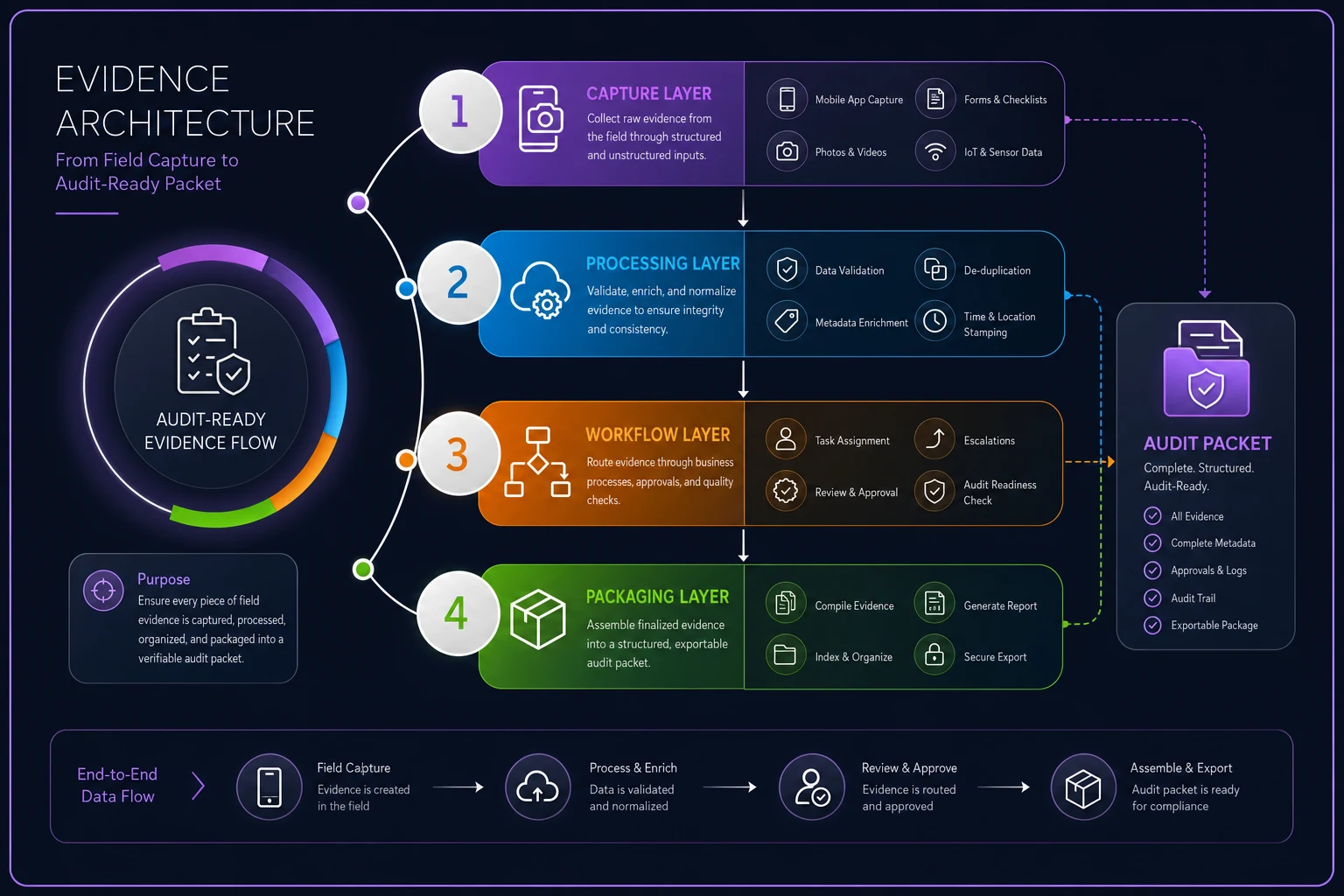
The architecture needs to handle varying audit requirements without rebuilding from scratch. OSHA wants injury and illness records with specific data elements. DOT wants driver qualification files and hours of service compliance. Customer audits might focus on site-specific training and equipment certifications. The same underlying evidence gets packaged differently for each audience.
Real Scenario: How Automated Evidence Packets Saved a $2.3M Contract
A commercial refrigeration company with roughly 45 techs almost lost their largest customer—a national grocery chain worth $2.3M annually—due to a failed safety audit. Not because they had safety problems, but because they couldn't quickly produce organized evidence during a surprise audit.
The grocery chain's insurance company required quarterly safety audits for all contractors. The refrigeration company had always passed, but their documentation lived across multiple systems—incidents in email, training in spreadsheets, corrective actions in a project management tool, photos in personal phones.
When the auditor asked for evidence of corrective actions from a refrigerant leak incident six months prior, it took three people four hours to piece together the story. They had done everything right—immediate response, proper cleanup, root cause analysis, procedure updates, retraining—but proving it required searching through hundreds of emails and files.
They passed that audit, barely, but knew the manual process wouldn't hold. They were adding 8-10 techs per year and expanding into more regulated markets. The safety manager was already spending 15-20 hours per week just organizing documentation.
They rebuilt their entire incident management flow around creating audit-ready evidence packets from the start. When techs report incidents through a mobile app, it automatically captures all required data elements plus GPS location and photos. The supervisor review triggers investigation workflows with mandatory evidence upload points. Corrective actions can't close without verification photos and sign-offs. Training completion automatically links back to the triggering incident.
Now when auditors ask for incident documentation, they pull up complete packets in minutes. Each packet includes the full timeline from initial report through verification of effectiveness, with all supporting evidence organized and cross-referenced. Their audit preparation time dropped from 40+ hours to under 4 hours per audit.
And their actual safety performance improved too. With clear workflows and automatic tracking, corrective actions that used to stall for months now complete within 30 days. Training gaps that went unnoticed now trigger automatic alerts. The same system that creates audit evidence also drives better safety outcomes.
When This Framework Makes Sense (And When It's Overkill)
This level of systematic incident management and evidence packaging makes sense under a few specific conditions.
You need it when customer contracts include safety audit requirements. Enterprise clients, government contracts, and regulated industries often require quarterly or even monthly compliance reviews. Manual documentation assembly becomes unsustainable at that frequency.
You need it when you're operating in multiple jurisdictions with varying regulations. A regional HVAC company might deal with different state safety requirements, local licensing boards, and federal transportation rules. Keeping these straight manually while maintaining proper documentation becomes nearly impossible past a certain scale.
You need it when your technician count exceeds what one safety manager can personally oversee—usually around 30-40 techs, depending on geographic spread and work complexity.
You probably don't need this framework if you're running under 15 techs in a single market with minimal regulatory oversight. The overhead of maintaining formal evidence architecture might exceed the actual compliance risk. A simple incident log, basic training records, and an organized file system might be enough.
You also might not need it if your work is low-hazard with minimal regulatory exposure. Basic residential service work with standard vehicles and common tools faces far less scrutiny than specialized industrial work involving hazardous materials and complex equipment.
The Hidden Cost of Compliance Scrambles
The real cost of poor incident documentation isn't just audit failures—it's the operational disruption when compliance scrambles happen. When an audit notice arrives, operations basically stop while everyone searches for documentation. Managers pull techs from the field for interviews, supervisors spend days organizing records, and actual safety improvements get postponed while everyone manages the audit.
A mechanical contractor in Dallas calculated they lost roughly $67,000 in billable hours annually just from audit preparation—300+ hours per year gathering documentation for OSHA, DOT, customer safety reviews, and insurance inspections. That's not counting actual audit time, just the scramble to find and organize evidence beforehand.
Beyond the direct costs, compliance scrambles destroy operational rhythm. Jobs get rescheduled while supervisors handle audit requests. Training gets postponed because everyone's buried in paperwork. Actual safety improvements take a backseat to documentation cleanup.
There's also the reputation damage from messy audits. Even if you ultimately pass, auditors remember companies that struggle to produce documentation. They spend more time on-site, dig deeper into records, and return more frequently. Your company gets labeled as "disorganized" even when your actual safety performance is solid.
Implementation Roadmap: From Chaos to Audit-Ready
Moving from scattered incident management to systematic evidence packaging requires staged implementation. Trying to transform everything at once creates confusion and resistance. Here's the rollout sequence that works:
-
Standardize Intake (Weeks 1–4) — Pick one reporting method—mobile app, web form, or call-in hotline—and route everything through it. Don't try to be perfect, just be consistent. Capture the basics: what happened, when, where, who was involved, immediate actions taken. Train supervisors on rapid review and classification so every incident gets looked at within 24 hours.
-
Structure Investigations (Weeks 5–12) — Build investigation templates for different incident types. Minor near-misses might need just a quick supervisor review. Injuries require full root cause analysis. Vehicle incidents need specific DOT documentation. Implement investigation assignments and due dates, then start tracking completion rates. This reveals bottlenecks before you add more complexity.
-
Systematize Corrective Actions (Weeks 13–20) — Create corrective action workflows with clear ownership. Each action needs an owner, due date, and verification method. Link corrective actions back to incidents—every action should clearly reference its triggering event. This creates the evidence trail auditors are looking for.
-
Integrate Training Loops (Weeks 21–28) — Connect incident-driven training needs to your training management system. When investigations identify training gaps, these should automatically create requirements for affected personnel. Move beyond attendance sheets to actual competency verification—quiz scores, practical demonstrations, or supervisor sign-offs on observed safe practices.
-
Package for Audits (Weeks 29–36) — Build standard audit packets for common requests. Most audits ask for similar information: incident logs, investigation reports, corrective action status, training records. Create templates that pull this information automatically. Then test the system with internal mock audits before external auditors arrive.
Start with the highest-risk or most frequent incident types when standardizing intake to get early wins and buy-in.
Working through this phased approach, most field service companies reach a functional evidence architecture within 8-9 months without disrupting day-to-day operations.
The Technology Layer That Ties It Together
You can theoretically manage this framework through spreadsheets and shared drives, but the manual overhead becomes crushing as you scale. The constant copying between systems, chasing updates, and assembling documentation burns hours that should go toward actual safety improvements.
Modern field service safety compliance benefits significantly from AI-powered operational software that connects incident reporting through to evidence packaging. When a tech reports an incident, the platform can automatically extract key information, classify severity, trigger appropriate workflows, and begin assembling the audit packet immediately—without anyone manually routing it.
The investigation process speeds up when the system helps identify patterns across similar incidents, suggests root causes based on historical data, and surfaces corrective actions that worked in comparable situations. Instead of starting from scratch each time, investigators build on what the organization has already learned.
Corrective action tracking improves when the platform automatically monitors progress, sends reminders based on complexity and urgency, and escalates stalled items before they become compliance failures. Training management becomes more proactive too—by analyzing incident patterns and near-miss reports, the system can flag competency gaps before they turn into incidents.
Most importantly, audit preparation stops being a scramble. All evidence lives in one place with proper linkages, metadata, and verification trails. When auditors ask for documentation, you generate comprehensive packets in minutes rather than hours.
This isn't about replacing human judgment in safety management. It's about automating the documentation and tracking burden that prevents safety managers from focusing on actual safety improvements. The technology handles evidence management while people handle the complex decisions about risk, prevention, and culture.
From Reactive Scrambles to Proactive Compliance
Field service safety compliance doesn't have to be a constant fire drill. When you build incident management workflows that automatically create evidence packets, compliance becomes a natural output of good safety management rather than a separate burden layered on top of it.
The companies that excel at field service safety compliance aren't necessarily running the safest operations—they're just better at proving their safety management works. They capture incidents consistently, investigate systematically, implement corrections verifiably, and package evidence efficiently.
This framework—connecting incident intake through evidence packaging with proper KPI gates—shifts compliance from reactive to proactive. Instead of dreading audit notices, you can welcome them as an opportunity to show how your system actually works.
Start with sustainable intake processes that techs will actually use. Build investigation and correction workflows that create evidence automatically. Integrate training loops that prove organizational learning. Maintain the whole thing through KPI gates that catch drift before it becomes a problem.
The companies that get this right spend less time managing audits and more time actually improving safety—which is what compliance was supposed to achieve in the first place.
Ready to optimize your field operations?
Join 2,000+ service teams using Romrly to boost productivity, reduce downtime, and enhance customer satisfaction.