
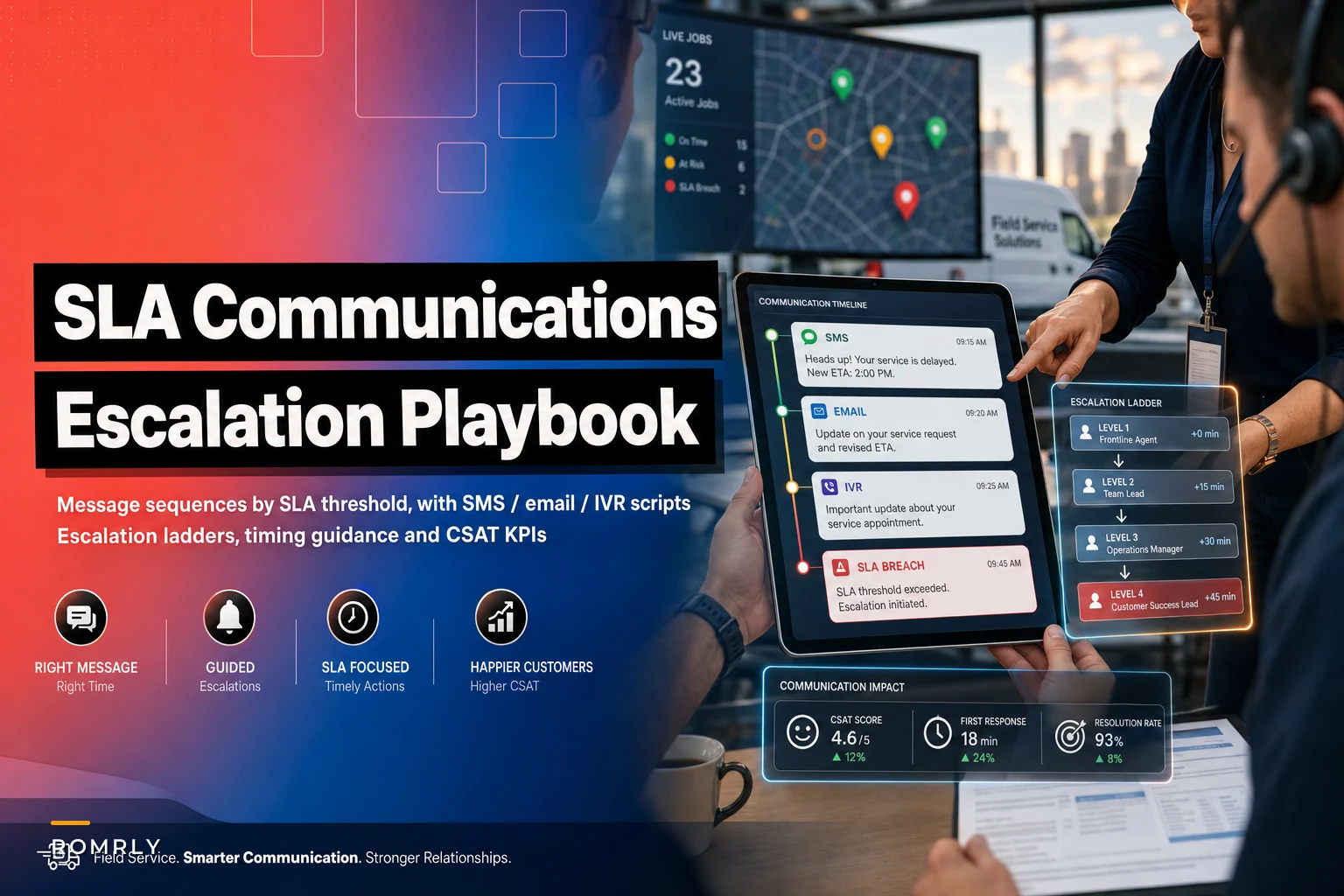

Nobody tells you this upfront, but customers usually forgive the missed SLA. What they don't forgive is finding out about it after the technician didn't show. A four-hour response window that slips to six hours is annoying. A four-hour window that slips silently—where the customer calls you at hour five asking where everybody is—that's the one that ends up in a churn report.
This isn't really about hitting SLAs. It's about the messaging that runs alongside the miss. The sequences, the scripts, the escalation ladder, and the KPIs that tell you whether any of it moved the needle on satisfaction. Most comms owners are flying blind here—they send some apologetic emails, hope for the best, and have no idea whether the communication helped or just added noise.
The core idea: tie every message to a threshold, not to a feeling
The mistake that shows up constantly: dispatch or the comms owner decides in the moment whether a job is "late enough" to warrant a heads-up. That judgment call means some customers get warned early, some get warned late, and some get a panicked call at the last second because nobody was watching the clock.
The fix is to pre-decide. You map message triggers to percentages of the SLA window, not to someone's gut read. If your response SLA is 4 hours, the system—or the dispatcher—knows:
-
At 50% elapsed with no tech assigned → send a "we're on it" reassurance
-
At 75% elapsed with risk flagged → send a proactive "running tight" warning
-
At 100% breached → send the apology + new committed time + escalation contact
This is the difference between communication that feels controlled and communication that feels like scrambling. The customer can sense which one they're getting.
The trigger points matter more than the words. A beautifully written apology sent 20 minutes after the breach still lands worse than a plain, clumsy warning sent 45 minutes before it.
A threshold-to-message map you can steal
Here's the structure most field service teams can run with. Adjust the percentages to your contract tiers, but keep the logic.
Eliminate field service chaos with Romrly.
Romrly helps you assign, track, and complete service jobs efficiently and on time.
- Unified job scheduling
- Technician dispatch & tracking
- Customer notifications & updates
No credit card required
| SLA elapsed | Job status | Channel | Message intent | Who owns it |
|---|---|---|---|---|
| 0% (booking) | Confirmed | SMS + email | Set expectation, give window | Automated |
| 50% | On track | — (silence) | No message unless risk flagged | — |
| 50% | At risk | SMS | Soft reassurance, no alarm | Dispatcher |
| 75% | At risk | SMS + IVR callback offer | Proactive warning, new ETA | Dispatcher |
| 100% | Breached | Phone call + email | Apology, firm new time, contact | Team lead |
| 125% | Still open | Phone call | Manager escalation, remedy offer | Ops manager |
| 150%+ | Critical | Phone call + written | Account-level recovery | Account owner |
The row people skip is the 50% silence row. Teams love to over-communicate, and they'll fire off a "just checking in, still on schedule!" message that does nothing but remind the customer they're waiting. If the job is genuinely on track, say nothing. Save the customer's attention for when it actually matters.
The row people get wrong is the 75% warning. That's the highest-leverage message in the entire ladder. Sent well, it converts a future complaint into a customer who feels looked after. Skipped, it guarantees the breach feels like a surprise.
Sample scripts by channel
Write these down and get them approved before a bad day happens. The worst time to draft an apology is while three jobs are breaching simultaneously.
SMS scripts
50% at-risk reassurance: > Hi [Name], quick update on your [service] appointment—our tech is finishing a job nearby and we're keeping you in the window. We'll text again if anything changes. Reply HELP to reach us.
75% proactive warning: > Hi [Name], heads up—we're running tighter than planned today. Your tech is now expected between [time]–[time]. Sorry for the shift. Want a call to confirm? Reply CALL and we'll ring you.
100% breach apology: > Hi [Name], we missed our committed window and that's on us. Your tech is now confirmed for [time] today. Your direct contact is [name] at [number] if you need anything before then.
Email script (breach)
> Subject: Update on your [service] appointment—new time confirmed > > Hi [Name], > > We didn't meet the response window we committed to for your service today, and I want to apologize directly for that. Here's where things stand: > > - New committed arrival: [time] > - Your technician: [name] > - Your direct contact: [name], [phone], [email] > > We've also applied [credit / priority flag / whatever your remedy is] to your account for the inconvenience. If the new time doesn't work, reply here or call and we'll rearrange around you. > > Thanks for your patience, > [Name], [Role]
IVR / callback script (breach)
> "Thanks for calling [Company]. We know your service today ran past the time we promised, and we're sorry. If you're calling about appointment [reference], press 1 to hear your updated arrival time, or press 2 to speak with the team lead handling your account directly."
One pattern worth flagging: IVR works best as a pull channel for breaches—customers who are already upset enough to call. SMS and email are your push channels. Trying to deliver bad news through IVR to someone who didn't initiate contact tends to backfire.
The escalation ladder—who gets pulled in and when
A message sequence without an escalation ladder is just automated noise. As the breach deepens, a more senior human needs to step in. Customers read seniority as a signal that you're taking it seriously.
-
0–100% (within window, at risk) Dispatcher owns comms. Keeps the customer updated, no apology needed yet, just transparency.
-
At breach (100%) Team lead takes over. First actual apology, firm new commitment, becomes the named contact. Dispatcher is hands-off on comms for this job from here.
-
125% (breach deepening) Ops manager calls personally. Offers a concrete remedy—credit, priority on next visit, waived fee. Doesn't wait for the customer to ask.
-
150%+ or repeat breach Account owner or GM engages. This is relationship-repair territory, especially for contract accounts where SLA credits and renewal risk are on the table.
The rule that keeps this clean: handoffs must be explicit. When the team lead takes over at breach, the dispatcher stops messaging. Nothing confuses a frustrated customer faster than getting a reassuring text from one person and an apologetic call from another, with neither referencing the other.
This connects to how you handle disruption more broadly. When same-day emergencies are crashing into planned work, SLA breaches tend to cluster—and that's exactly when your escalation ladder earns its keep, because you can't personally call every affected customer.
Measuring whether any of this works
Almost everyone skips this part, which is why most comms programs stay habits rather than becoming systems.
The KPIs that actually matter
-
CSAT on breached-but-communicated jobs vs. breached-but-silent jobs. This is the single most important comparison. If your proactive sequence works, breached-communicated jobs should score noticeably higher.
-
Time-to-first-notification after risk flag. How fast did the customer hear from you once risk was identified? Target: under 15 minutes.
-
Proactive ratio. What percentage of breaches did the customer learn about from you before they had to ask? This is your early-warning health metric. Aim to push this above 80%.
-
Escalation completion rate. Of jobs that hit 125%, how many actually got the manager call they were supposed to? Ladder adherence rots fast without this metric.
-
Re-contact rate. How often did the customer have to chase you after the breach message? High re-contact means your messages aren't answering their real questions.
A simple measurement plan
-
Tag every breach with a flag
communicated-proactively, communicated-late, or silent.
-
Trigger a short CSAT survey 24–48 hours after job close on all breached jobs—one or two questions, not a ten-question form.
-
Segment the results by the tag from step 1 every week.
-
Track the proactive ratio as a trend, not a snapshot. One good week means nothing.
-
Review escalation adherence monthly—pull the 125%+ jobs and check whether the manager call actually happened.
A mid-size HVAC operation running roughly 60–70 SLA breaches a month had a proactive ratio somewhere around 35% before mapping messages to thresholds—most customers found out by calling in. CSAT on breached jobs sat noticeably below their overall average. After six to eight weeks of running the threshold map and tracking the proactive ratio weekly, proactive notifications climbed to the low 80s, and CSAT on communicated breaches came within a few points of their non-breached jobs. The breaches didn't drop much. The reaction to them did.
Here's a simple visual of the measurement workflow.
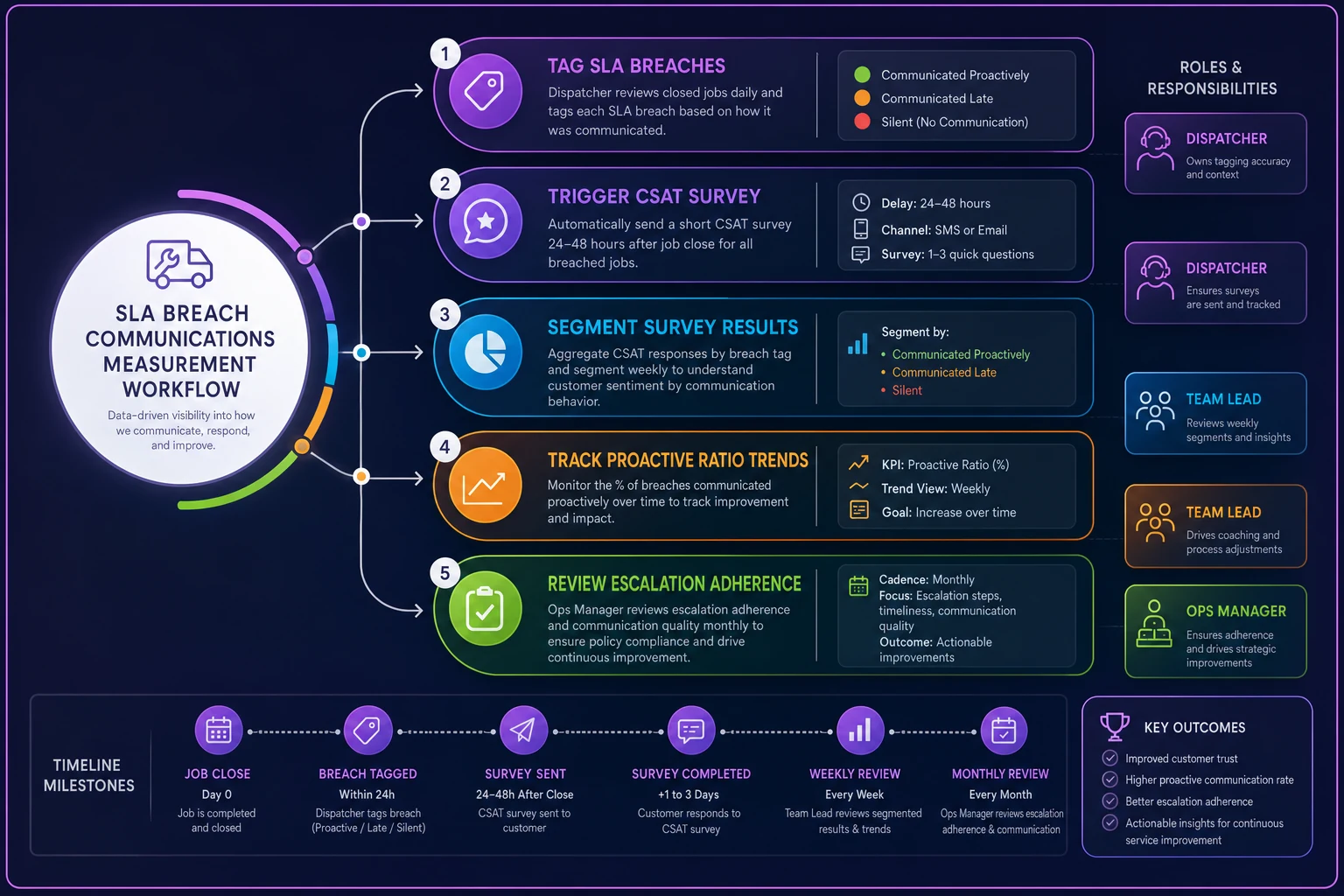
Use the visual to align roles and timing so measurement actually happens and doesn't become another admin checkbox.
Where this quietly falls apart in practice
A few failure patterns worth flagging—they're common, and they're all preventable.
-
The dispatcher gets buried. During a rough stretch, the person supposed to send the 75% warnings is simultaneously re-routing six trucks. The warnings don't go out. This is why early-stage messages need to be automated off SLA timers, not left to a human who's already underwater.
-
Scripts drift. Someone edits the breach SMS to sound "warmer" and accidentally removes the new committed time. Lock your scripts and version them.
-
No one owns the proactive ratio. It's everyone's job, so it's no one's job. Assign it to the comms owner and put it on a weekly review.
-
The remedy is vague. "We'll make it right" means nothing. The 125% call needs a concrete offer the manager is authorized to give on the spot.
-
Measurement never starts. Teams build the whole sequence and never tag breaches, so they can't tell if it worked. Set up the tagging first, even before the scripts are finalized.
The admin load behind all of this is real, and worth being honest about. If your team is already drowning in manual coordination, layering a comms ladder on top can backfire. It's worth looking at where your technician and dispatcher hours are actually going before you add another process—because a communication ladder only works if someone has the bandwidth to run it, or if the early rungs are automated off the clock.
When this is overkill—and when it's non-negotiable
Skip the full ladder if: you're running a small residential operation with loose, informal windows and customers who aren't tracking the clock. A single friendly text when you're running late does the job. Building a seven-row threshold map for that is over-engineering.
Run the full thing if: you have contractual SLAs with credits attached, B2B accounts that measure your performance, or any situation where a silent breach shows up in a quarterly business review. In those cases the communication is the product almost as much as the service is.
The middle ground—which is most field service businesses—should at minimum nail three things: the 75% proactive warning, the breach apology with a firm new time, and breach tagging so you can measure. Everything else can be layered in later.
Bottom line
Missing an SLA is an operational event. Handling the communication badly is a relationship event—and the second one is far more expensive. The teams that come out of a breach with the account intact aren't the ones who never miss. They're the ones who warned the customer before the miss, apologized with a real plan, escalated to a human the customer could name, and then measured whether any of it actually helped.
Map your messages to thresholds. Write the scripts before the bad day. Make your handoffs explicit. Tag every breach so you're not guessing. Do that consistently, and the occasional miss stops being a churn risk and starts being, weirdly, a moment where customers end up trusting you more—because they saw exactly how you handle things when they go sideways.
Map your messages to thresholds. Write the scripts before the bad day. Make your handoffs explicit. Tag every breach so you're not guessing. Do that consistently, and the occasional miss stops being a churn risk and starts being, weirdly, a moment where customers end up trusting you more—because they saw exactly how you handle things when they go sideways.
Ready to optimize your field operations?
Join 2,000+ service teams using Romrly to boost productivity, reduce downtime, and enhance customer satisfaction.