

Most field service teams don't lose high-value claims because they're wrong. They lose because the evidence shows up disorganized, incomplete, or three weeks late — by which point the insurer's adjuster has already built a narrative and the vendor has stopped answering emails.
A $40k equipment failure claim and a $400 warranty chargeback get treated the same way inside most operations: a few photos dumped in a shared drive, a technician's note typed from memory, maybe a timestamp if you're lucky. That works fine until money and lawyers are involved. The moment a claim crosses into "high-value" or "legal escalation" territory, the rules change completely — and almost nobody adjusts their packaging to match.
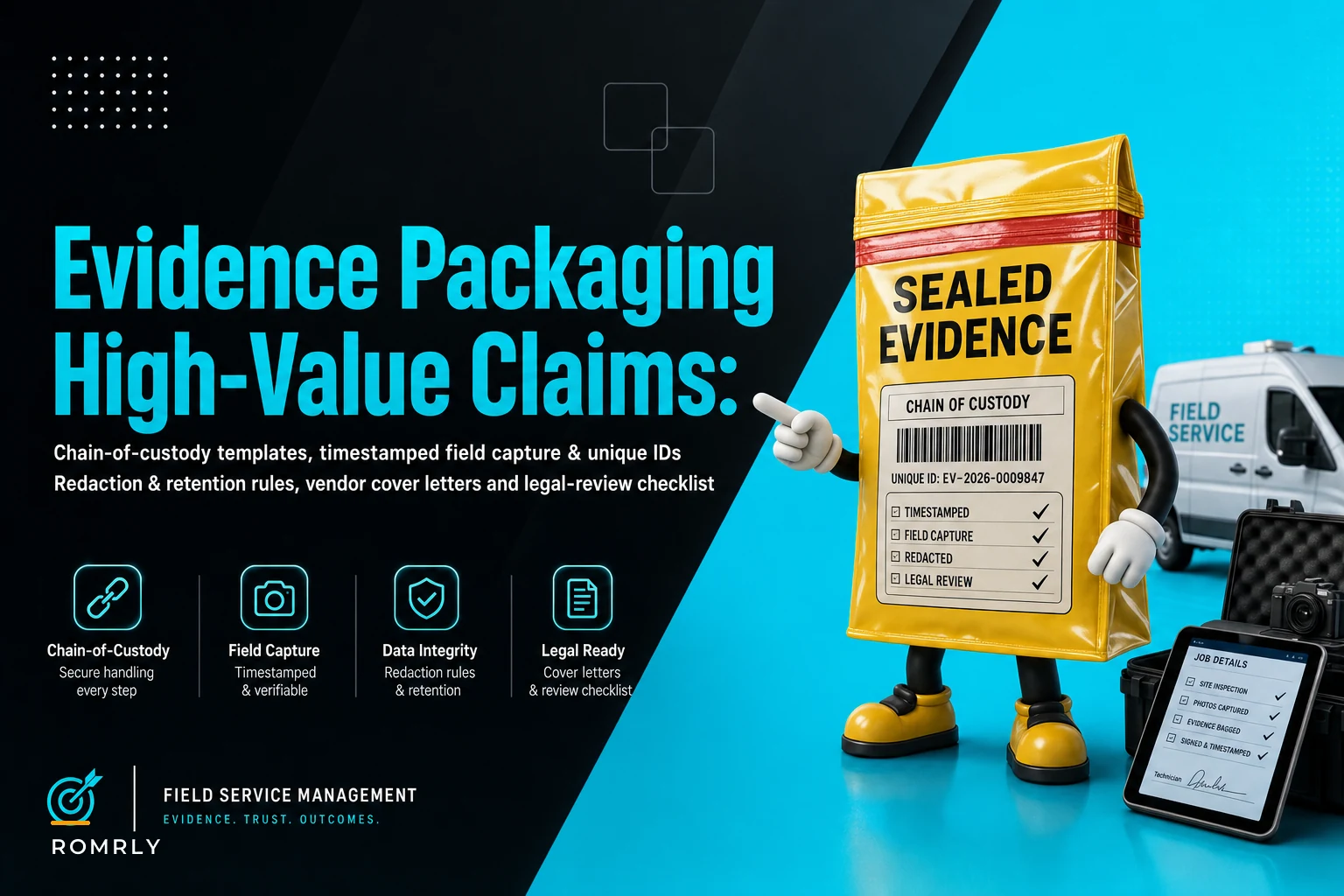
This is specifically about the mechanics of evidence packaging for high-value claims in field service: how to assemble a packet that survives scrutiny, holds up chain-of-custody, protects you on redaction and retention, and gets vendors and insurers to settle faster instead of dragging things out.
What a "high-value" claim actually requires that a normal one doesn't
The difference isn't more photos. It's provenance.
A normal warranty claim asks: did this part fail? A high-value claim or legal escalation asks: can you prove this part failed, under these conditions, at this time, handled by these people, and that nothing was altered along the way? Those are different evidentiary bars, and the second one trips up field teams constantly.
In real operations, the breakdown usually looks like this. A commercial HVAC compressor fails and takes down a tenant's server room. The tenant files a business-interruption claim. Suddenly your field notes — written casually, meant for internal use — are discoverable documents. The technician wrote "looked like it was running hot for a while, probably the known issue." That one sentence can cost you the entire defense, because it implies prior knowledge of a defect you didn't act on.
High-value evidence packaging is about controlling what you capture, how you store it, and how you hand it over. You're not trying to hide anything. You're trying to make the true story legible and tamper-evident so the other side can't reframe it.
The chain-of-custody template (and why most field teams don't have one)
Chain-of-custody sounds like a courtroom term, but in field service it's just a disciplined log answering four questions for every piece of evidence: who collected it, when, where it's been, and who touched it since.
Eliminate field service chaos with Romrly.
Romrly helps you assign, track, and complete service jobs efficiently and on time.
- Unified job scheduling
- Technician dispatch & tracking
- Customer notifications & updates
No credit card required
| Field | What goes in it | Why it matters |
|---|---|---|
| Evidence ID | Unique tag per item (photo set, failed part, log file) | Lets you reference specific items without ambiguity |
| Collected by | Technician name + role | Establishes a competent, identifiable source |
| Collection timestamp | Date, time, timezone | Timezone matters more than people think in disputes |
| Location | GPS or site address + asset ID | Ties evidence to the specific unit, not a similar one |
| Condition at collection | Short factual description | Prevents "it was already damaged" arguments |
| Transfer log | Each handoff: from → to, date, reason | The actual "chain" — gaps here kill credibility |
| Storage location | Physical bin / digital folder path | Shows nothing floated around unsecured |
| Hash / file integrity | For digital files, a checksum | Proves the file wasn't edited after capture |
The transfer log is the part everyone skips. A failed part gets pulled, tossed in a truck, left at the shop for two weeks, photographed by someone else, then shipped to the vendor. Four handoffs, zero documentation. The vendor's counsel points out there's no way to prove the part shipped is the part that failed. Claim weakened, sometimes dead.
The fix is boring but effective: every time physical evidence changes hands or location, someone logs it. Two lines. Date, from-whom-to-whom. That's the whole discipline.
Log every handoff with date and initials; two lines is all it takes.
Visualizing the chain-of-custody workflow can clarify who does what at each step.
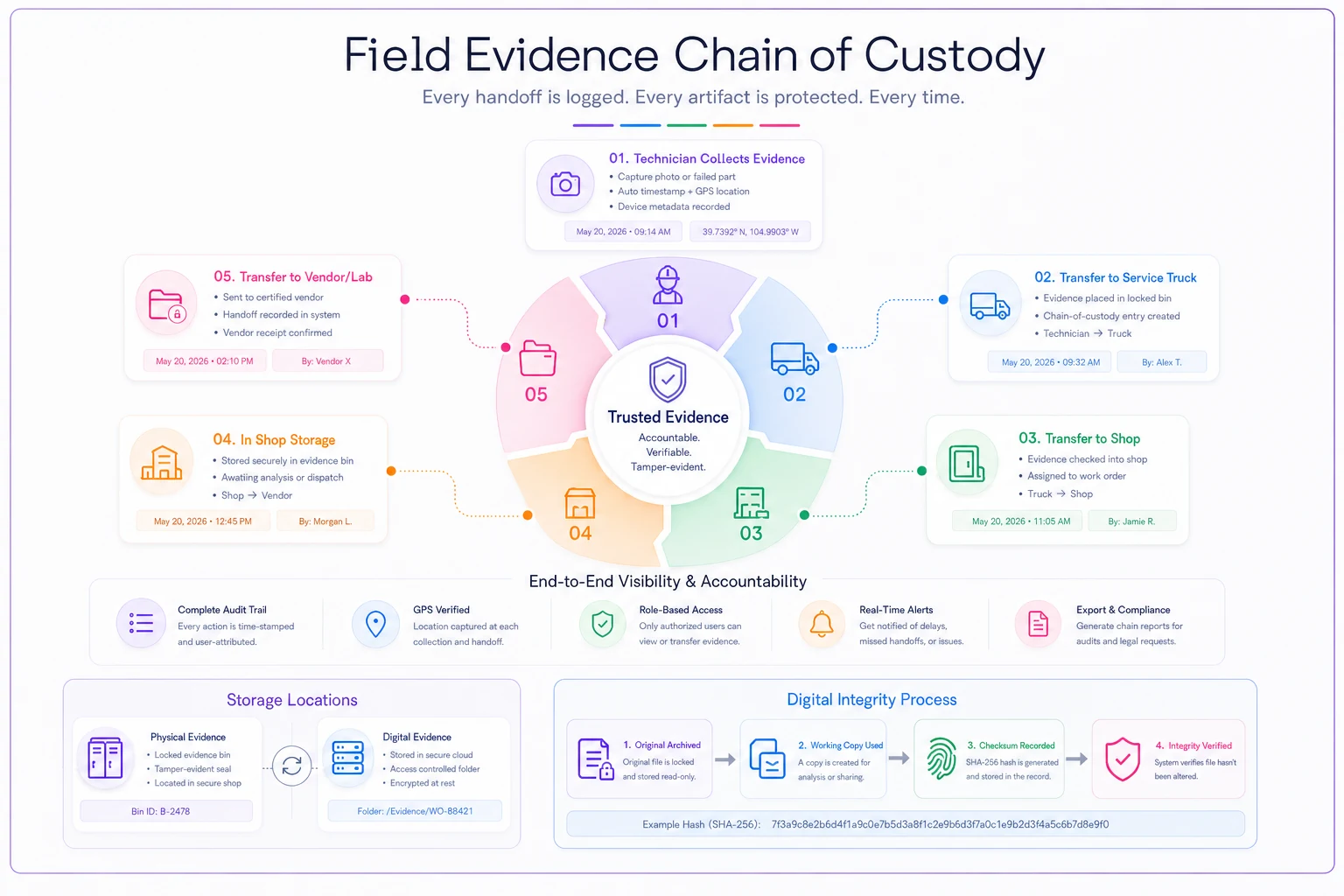
One pattern worth naming — digital evidence needs integrity protection, not just backup. A photo stored on a phone and later "cleaned up" (cropped, brightened) looks like tampering even when it's innocent. Capture once, store the original untouched, and work from copies. If your mobile workflow overwrites or compresses originals, fix that before you need it.
Redaction and retention: the two rules that quietly cause the most damage
Redaction and retention pull in opposite directions, and field teams usually get both wrong.
Redaction — teams over-share or under-redact. A packet sent to an insurer includes the technician's full internal thread, pricing margins, unrelated customer PII from a batch export, and an offhand Slack message. None of that helps the claim; all of it creates exposure. The opposite mistake is heavy-handed redaction that blacks out something material, which reads as hiding evidence.
-
Redact anything not relevant to the specific claim
other customers' data, unrelated job references, internal pricing and margin figures.
-
Redact personal contact details unless they're the claim's subject.
-
Never redact timestamps, asset IDs, or technician identities on evidence you're relying on — that's the stuff that proves your case.
-
Keep an unredacted master internally, locked, with a note explaining each redaction. If challenged, you can show the logic was consistent and not selective.
Retention is the sleeper problem. Most high-value disputes surface months after the job — sometimes after the normal data purge already ran. Teams discover the dashcam footage, the diagnostic logs, or the original photos were auto-deleted on a 90-day cycle. Now you're defending a claim with a hole in it you created yourself.
Set retention by claim risk, not by default storage policy:
-
Standard jobs follow normal retention.
-
Any job involving injury, property damage, a high-value asset, or a difficult customer gets flagged for extended hold at the time of service.
-
Once a claim or legal escalation is live, a litigation hold freezes everything related — no deletion, no overwrites — until it's formally released.
The flag-at-time-of-service step is what saves you. You don't know which jobs become claims, but you can usually sense the risky ones in the moment. Train techs and dispatchers to trip the flag early.
Sample cover letters that make vendors and insurers move faster
A packet without a cover letter gets triaged to the bottom of the pile. A good cover letter tells the recipient exactly what they're looking at, what you're asserting, and what you want — which removes their excuse to sit on it.
Two templates cover most situations.
> Re: Warranty claim [Claim ID] — [Asset/Model], failure date [date] > > Attached is the complete evidence packet for the above failure, including the failed component, chain-of-custody log, diagnostic readings, and installation records. > > Based on the enclosed documentation, we're asserting this failure falls under warranty coverage per [contract/section]. The chain-of-custody log confirms the component has been handled and preserved in its post-failure condition. > > We're requesting [replacement / reimbursement of $X / RMA authorization] and a response within [X business days]. Please direct questions to [name] at [contact].
> Re: Claim [number] — [incident], [date], [location] > > Enclosed is our evidence packet documenting the incident referenced above: incident timeline, site photos with timestamps and asset IDs, technician statements, maintenance history, and chain-of-custody records. > > This documentation establishes [the factual position — e.g., the unit was serviced to spec on X date and the failure originated from Y]. We've organized the packet by exhibit for your adjuster's review. > > We'd appreciate confirmation of receipt and an estimated review timeline. Please contact [name] for clarification or additional records.
Two things make these work. First, they state your assertion plainly instead of leaving the recipient to infer it. Second, they set a response expectation, which creates a soft deadline you can reference in follow-ups. Vague packets with no clear ask are the ones that disappear into someone's inbox.
Never speculate, never apologize, never editorialize in a cover letter. State what the evidence shows. The letter becomes part of the record too.
The legal-review checklist that shortens disputes
Before any high-value packet leaves your hands, run it through a short review. This is the step that separates teams who settle in weeks from teams who grind for months. The goal is to catch the gaps the other side would exploit — before they do.
-
[ ] Every piece of evidence has a chain-of-custody entry with no unexplained gaps
-
[ ] Timestamps are consistent across photos, logs, and notes (and in the same timezone)
-
[ ] Asset IDs match across all documents — failed part, work order, maintenance history
-
[ ] Original digital files preserved; packet uses copies, integrity verifiable
-
[ ] Redactions applied consistently; unredacted master retained with redaction log
-
[ ] No speculative, blaming, or "known issue" language in technician notes
-
[ ] Maintenance and installation history included and complete through the failure date
-
[ ] Retention/litigation hold confirmed active on all related data
-
[ ] Cover letter states the assertion, the ask, and a response timeline
-
[ ] A second person — ideally outside the job — has reviewed the packet cold
That last item matters more than it looks. The technician who did the work has blind spots about their own evidence. A fresh reviewer catches the missing timestamp, the contradictory note, the file that won't open. Thirty minutes of cold review saves weeks of back-and-forth.
This discipline connects directly to the broader evidence-first chargeback workflow for warranty reimbursements — same instinct, higher stakes. And if your underlying capture practices are shaky, the safety, compliance and incident framework with audit-ready evidence packs is worth tightening first, because a legal packet is only as good as the raw data feeding it.
A real scenario: the claim that settled in 18 days instead of six months
A mid-sized commercial refrigeration company serviced a grocery chain's walk-in cooler. The unit failed overnight, the store lost roughly $22k in inventory, and the chain filed a claim alleging negligent maintenance.
The first instinct was the usual scramble: dig through phones for photos, ask the tech to recall the last visit, email the manufacturer. The problem was the last service was four months earlier, and their photo retention had already purged most of it. What survived was disorganized and undated.
-
Before scattered evidence, no custody log, technician notes full of hedging language ("seemed okay but older unit"), service history reconstructed from memory. That first claim dragged for close to six months and they ended up splitting the loss just to make it go away.
-
After on a later similar incident, the risky job had been flagged for extended retention at time of service. The packet included a timestamped service record, the compressor's full maintenance history, diagnostic logs with a verifiable integrity hash, a clean chain-of-custody on the failed component, and a cover letter stating plainly that the unit had been serviced to manufacturer spec with the records to prove it.
The adjuster had almost nothing to contest. The claim resolved in about 18 days, and the company didn't eat the loss because the evidence showed the failure wasn't a maintenance miss. Same type of incident, completely different outcome — driven entirely by how the evidence was packaged, not by what actually happened on site.
When this level of rigor makes sense — and when it doesn't
Full chain-of-custody and legal-review packets are overhead. Applying them to every $200 warranty swap would bury your team.
When it makes sense:
-
Claim value crosses a threshold you set (many teams use $5k–$10k)
-
Any incident involving injury or third-party property damage
-
A customer who's already litigious or disputing aggressively
-
Anything where a lawyer or insurer is formally involved
When it's overkill:
-
Routine warranty replacements with cooperative vendors
-
Low-value disputes where the cost of packaging exceeds the claim
-
Internal quality issues with no external liability
Who should not try to shortcut this: teams operating in high-liability work — electrical, gas, commercial refrigeration, anything near life-safety. For those operations, the "risky job" flag should trip often, because the downside of an unprepared packet is measured in six figures, not hundreds.
Where tooling quietly helps
None of this requires software to work — a disciplined team with good templates can do it on paper. But the failure points are almost always operational: originals get overwritten, retention purges fire on a timer, custody logs don't get filled in because it's one more manual step at the end of a long day.
That's where an operational platform earns its keep. When your field app captures the original photo untouched, auto-stamps location and time, keeps the asset ID attached, and lets a dispatcher flag a job for extended hold in one tap, the evidence packet mostly assembles itself. The litigation hold becomes a status that freezes deletion automatically instead of relying on someone remembering to do it.
The teams that win high-value disputes aren't the ones with the best lawyers. They're the ones whose evidence was already clean, organized, and defensible before the dispute ever started — because they built the discipline into how every risky job gets documented, long before anyone threatened to escalate.
The teams that win high-value disputes aren't the ones with the best lawyers. They're the ones whose evidence was already clean, organized, and defensible before the dispute ever started — because they built the discipline into how every risky job gets documented, long before anyone threatened to escalate.
Ready to optimize your field operations?
Join 2,000+ service teams using Romrly to boost productivity, reduce downtime, and enhance customer satisfaction.