

Most field service operations don't fail because one vendor is bad. They fail because nobody can answer a simple question: who owns this, and against what standard?
When you're running work through four or five partners — an HVAC specialist for the heavy jobs, two staffing firms for seasonal overflow, a regional subcontractor covering territory you can't reach, and a parts vendor doing installs on the side — the governance gaps aren't dramatic. They're quiet. A missed SLA clock here. A QC check nobody ran there. A month-end invoice that doesn't match the jobs you thought got done.
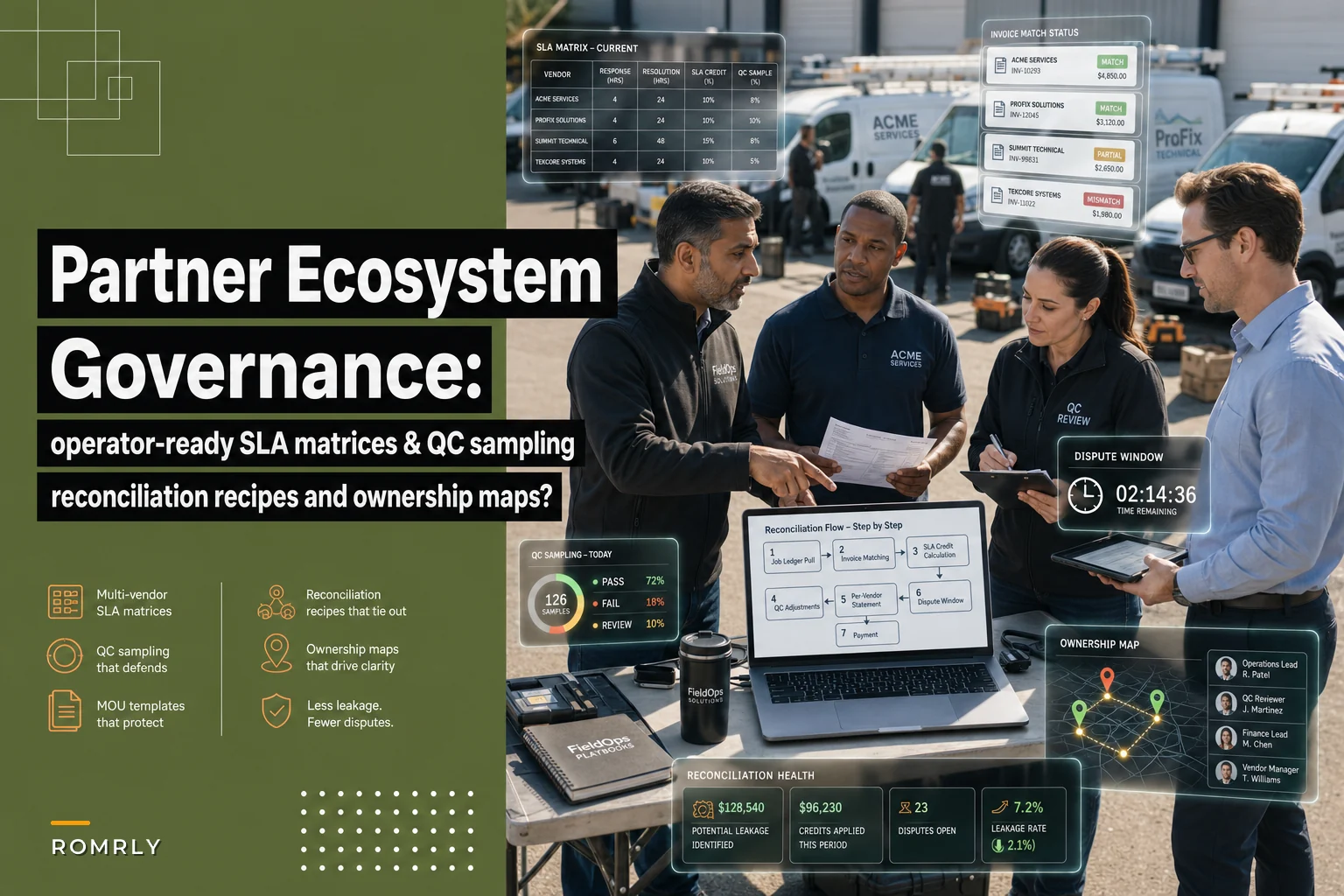
This post is about the operator-facing side of that: the actual matrices, sampling plans, MOU language and reconciliation recipes that keep a multi-vendor ecosystem honest. Not the onboarding side — if you need that, the subcontractor governance onboarding and QC spot-audit guide covers it. This is what happens after everyone's onboarded and you've got real volume flowing through people who don't work for you.
Why multi-vendor governance breaks differently than single-vendor
With one subcontractor, you can hold the whole relationship in your head. You know their techs, their quirks, their average turnaround. Governance is basically a conversation.
Add a second and third vendor and something shifts that most operators underestimate: the standards stop being comparable. Vendor A measures response time from dispatch. Vendor B measures it from when their tech accepts the ticket. Vendor C doesn't measure it at all and just tells you "same day." When a customer escalates, you're suddenly trying to compare three numbers that were never the same number to begin with.
The breakdown isn't about vendor quality. It's about definition drift. Everybody's hitting their version of the target. Nobody's hitting yours, because yours was never written down in a way all of them signed off on.
More oversight doesn't fix this. A shared governance map does — one that forces every partner onto the same definitions, the same QC sampling, and the same month-end close.
The multi-vendor SLA matrix (and why one SLA document doesn't work)
Handing a single SLA template to five vendors is the most common mistake I see. Different vendors do different work at different risk levels. A staffing partner filling a routine PM slot shouldn't be on the same escalation clock as the specialist handling emergency gas leaks.
Eliminate field service chaos with Romrly.
Romrly helps you assign, track, and complete service jobs efficiently and on time.
- Unified job scheduling
- Technician dispatch & tracking
- Customer notifications & updates
No credit card required
The tool that actually works is a tiered SLA matrix — rows for work category, columns for the metrics that matter, and a cell for each vendor's committed target. The point isn't to make everyone identical. It's to make every commitment visible and comparable on one page.
Here's a stripped-down version of what that looks like in practice:
| Work category | Response target | On-site target | First-time-fix target | QC sample rate | Credit trigger |
|---|---|---|---|---|---|
| Emergency / safety | 30 min ack | 4 hrs | 85% | 15% of jobs | Miss on-site = 10% invoice credit |
| Priority repair | 2 hrs ack | Next business day | 80% | 10% of jobs | 2 misses/month = review |
| Routine PM | Same business day ack | Within SLA window | 90% | 5% of jobs | Pattern-based only |
| Install / project | 1 business day | Scheduled | N/A (punch-list) | 20% of jobs | Punch-list > 3 items |
A few things that make this matrix actually work instead of becoming shelf-ware:
-
Every metric has a single agreed definition written in an appendix. "Response" means time-to-acknowledge from your dispatch timestamp, not the vendor's. No exceptions, no "well, we measure it differently."
-
Credit triggers are mechanical, not negotiable. The moment you make a credit subject to a meeting, it stops happening. If the condition is met, the credit applies and you discuss it at month-end — not before.
-
QC sample rate scales with risk. Emergency and install work gets sampled heavily. Routine PM gets light sampling because the downside of a miss is lower.
The matrix becomes the single source of truth every vendor signs against. When Vendor C says "we did same-day," you point at the row and ask which timestamp they're measuring from. The conversation gets short.
QC sampling plans that catch problems before the customer does
You can't inspect all subcontracted work, and if you try, your QC cost eats whatever margin the subcontracting was supposed to save you. The game is sampling smart — checking enough to catch systemic problems early, not so much that you're essentially re-doing the work yourself.
The mistake most operators make is sampling randomly and uniformly — pulling 10% of every vendor's jobs regardless of context. That feels fair but it's inefficient. A vendor who's been clean for six months doesn't need the same scrutiny as one you added last week.
A better approach is risk-weighted, trigger-aware sampling. Set a baseline rate per work category, then adjust based on signals:
-
Baseline by category. Start every vendor at the category's default sample rate.
-
Boost new vendors. First 60–90 days, double the sample rate regardless of category. You're still learning their failure patterns.
-
Trigger on complaints. Any customer complaint auto-escalates that vendor's next 10 jobs to 100% QC until they clear a clean streak.
-
Decay on good performance. Three consecutive clean months on a category? Drop the sample rate by a third. Reward the vendors who make QC boring.
-
Spot-check the self-reports. Audit a slice of jobs the vendor marked "complete, no issues" — because that's exactly where quiet corner-cutting hides.
What this catches that uniform sampling misses: the vendor whose work is fine on average but has one specific tech or one specific job type that's consistently off. Random sampling washes that out. Trigger-aware sampling zooms in on it.
A practical note on evidence. QC sampling only works if the vendor's field evidence is standardized — photos from consistent angles, meter readings, timestamps, before/after shots. If every vendor submits evidence in their own format, your QC reviewer spends more time deciphering than inspecting. Lock the evidence format into the MOU and reject submissions that don't meet it. That one rule does more for QC efficiency than almost any amount of extra sampling.
Lock the evidence format into the MOU and reject submissions that don't meet it to keep QC reviewers focused on quality, not decoding attachments.
When heavy sampling actually makes sense
-
New vendor relationships (first 90 days)
-
High-liability work (gas, electrical, anything safety-rated)
-
Any vendor coming off a complaint cluster
-
Work that's hard to re-inspect later (buried, sealed, covered)
When heavy sampling is a waste
-
Mature vendors with a long clean record on routine work
-
Low-stakes PM where a miss is annoying but not expensive
-
Cases where you already have strong remote telemetry confirming the outcome
What this catches that uniform sampling misses: the vendor whose work is fine on average but has one specific tech or one specific job type that's consistently off. Random sampling washes that out. Trigger-aware sampling zooms in on it.
MOU templates: the clauses that actually prevent disputes
Most vendor MOUs are copy-pasted legal boilerplate that nobody reads until there's a fight. The clauses that actually matter for day-to-day operations are usually the ones missing.
Based on where disputes tend to land, these are the sections worth getting right:
Definitions appendix. Boring, but it's the clause that ends the "we measure it differently" argument. Every SLA metric, every status label ("complete," "on hold," "parts pending"), every timestamp source — defined once, referenced everywhere.
Evidence and documentation standard. What constitutes proof of completion. Photo requirements, data fields, format. Tie payment to evidence completeness, not just job-marked-done. This is probably the single most effective anti-dispute clause you can write.
QC and remediation terms. Who re-does failed work and on whose dime. The default should be: vendor remediates QC failures at no charge within a defined window, and repeat failures trigger a formal review. Spell out what "repeat" means numerically.
SLA credit mechanics. Reference the matrix directly. Credits are automatic when conditions are met. State that credits apply at reconciliation, not that they're "available to discuss."
Reconciliation and dispute window. How long after month-end a vendor has to dispute a credit or chargeback. Keep it tight — 10 business days works. After that, the number stands. Open-ended dispute windows are how reconciliation turns into a permanent negotiation.
Data and ownership. Who owns the job data, customer info, and photos. In a multi-vendor setup, you want all of it flowing back to you in a standard structure, not sitting in five different vendor portals.
The pattern worth noting: MOU clauses that prevent disputes are almost all about defining things in advance that feel obvious right up until money is on the line. The vendor who swears a handshake is enough is exactly the vendor you'll end up arguing with in month four.
The month-end reconciliation recipe
This is where multi-vendor governance either holds together or quietly bleeds money. Reconciliation across several partners isn't one task — it's a sequence, and the sequence matters because each step feeds the next.
The failure mode is predictable: invoices arrive from five vendors in five formats, someone eyeballs them against a dispatch log, the numbers roughly match, and they get approved because chasing every discrepancy would take all week. The gaps that slip through are small per-job but relentless across hundreds of jobs a month.
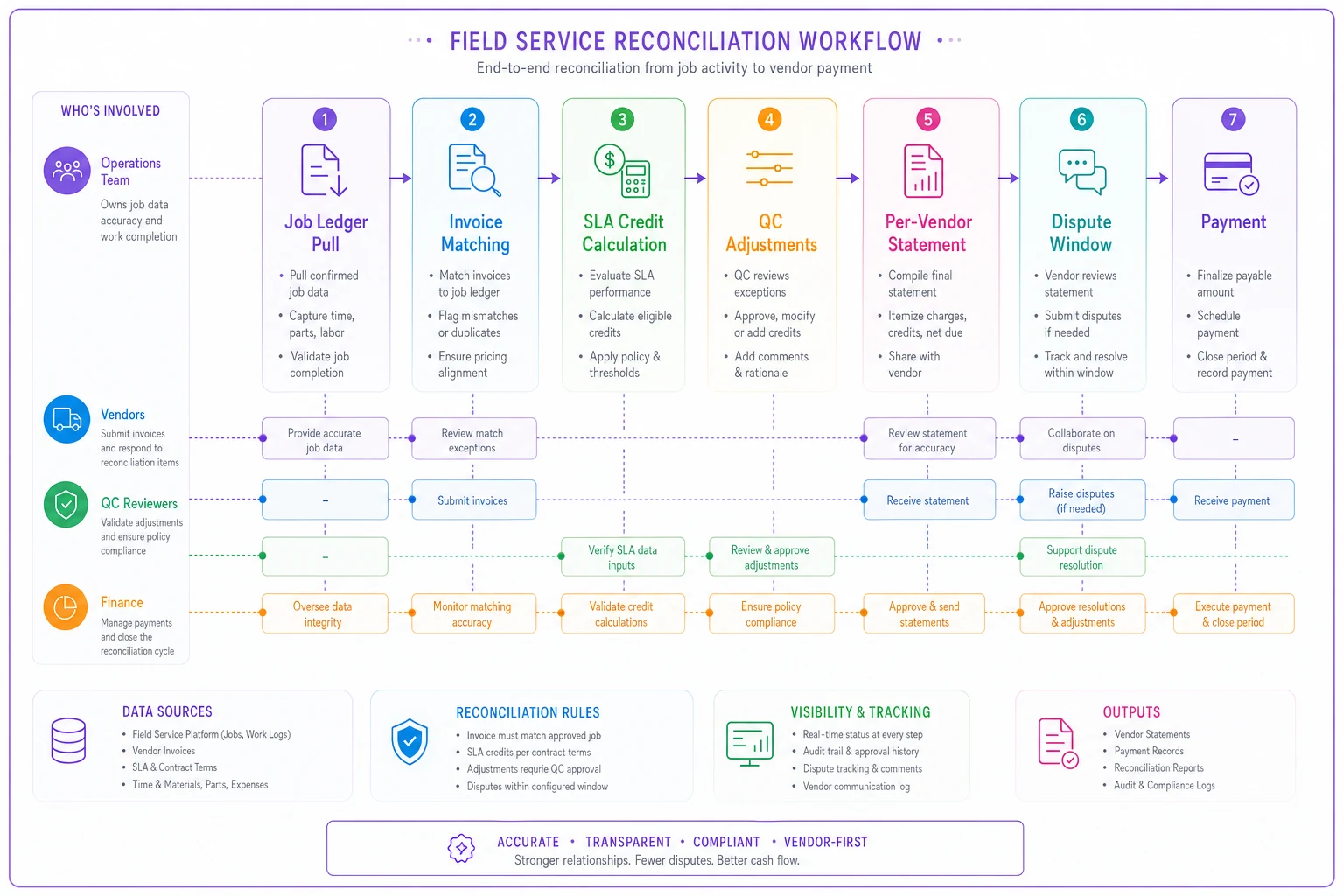
Here's a reconciliation sequence that actually closes the loop:
-
Pull the job ledger first, not the invoices. Start from your record of what work was dispatched, to whom, and what status each job landed in. This is your source of truth. Invoices get checked against it — never the other way around.
-
Match invoices to jobs line by line. Every invoiced line should map to a job in your ledger. Unmatched invoice lines get flagged immediately — those are either jobs you have no record of, or double-bills.
-
Apply the SLA matrix automatically. For every matched job, check the committed targets against actuals. Misses that hit a credit trigger get calculated and deducted. No meeting, no debate — the matrix already settled this.
-
Run the QC adjustments. Any job that failed QC and required remediation shouldn't be paid twice. Net out the re-work.
-
Produce one reconciliation statement per vendor. It shows jobs completed, amount invoiced, SLA credits applied, QC adjustments, and net payable. The vendor sees exactly how the number was built.
-
Open the dispute window. Vendor has their defined window to challenge specific lines with evidence. Everything undisputed gets paid on schedule.
The discipline that makes this work is starting from your ledger. Operators who start from vendor invoices are essentially letting each vendor define the truth, then trying to argue it back down. Operators who start from their own job ledger are checking vendor claims against facts they already own. Same data, completely different power dynamic.
Here's a quick visual of that reconciliation sequence.
If you're also running warranty or chargeback flows through these vendors, the reconciliation cadence should sync with that process — the evidence-first chargeback and finance reconciliation workflow pairs naturally here, since both depend on the same clean job-and-evidence ledger.
> Reconciliation flow (simplified)
>
> Job ledger pull → Invoice matching → SLA credit calculation → QC adjustments → Per-vendor statement → Dispute window → Payment
Clear ownership: the RACI nobody writes for vendors
Internal RACI charts are common. Vendor-facing ownership maps are rare, and that gap is where multi-vendor coordination quietly dies. When a job spans your dispatch team, a staffing partner's tech, and your own QC reviewer, "whose job was that" becomes a genuine question at exactly the wrong moment.
A simple ownership map per work type clears most of it up. For a subcontracted priority repair, it might look like:
-
Dispatch & assignment — your ops team (owns it, accountable)
-
On-site work & evidence capture — vendor tech (owns it)
-
Evidence review & QC sampling — your QC reviewer (owns it)
-
Customer communication — your ops team (owns it; vendor does not talk to the customer about scope or scheduling)
-
Remediation of QC failures — vendor (owns it, on their dime)
-
Reconciliation & credits — your finance/ops (owns it)
The non-obvious line that saves the most grief is the customer communication one. When multiple vendors are allowed to talk to your customers directly about scope, timing or pricing, you lose control of the relationship and the commitments made in your name. Lock that down. Vendors do the work; you own the customer.
A real scenario
A regional mechanical contractor was running overflow work through three subcontractors during their busy season — roughly 180–220 subcontracted jobs a month at peak. Their reconciliation was invoice-first: subs sent statements, an ops coordinator checked them against a dispatch spreadsheet, and anything that looked close got approved.
The leaks were everywhere once they looked. SLA credits they were contractually owed almost never got applied, because catching a miss meant cross-referencing timestamps nobody had time to pull. A couple of jobs a month got double-billed across two subs when work got reassigned mid-ticket. QC on subcontracted work was basically "did the customer complain," which meant they were paying full price on jobs with punch-list issues that came back as callbacks weeks later.
They rebuilt it around a shared SLA matrix, a risk-weighted sampling plan, and a ledger-first reconciliation. Nothing fancy — the matrix lived in a shared sheet at first, and QC sampling was a disciplined checklist run by one person. Within about two months, applied SLA credits went from basically zero to somewhere in the low four figures monthly. Double-bills got caught at the matching step instead of after payment. Callback rates on subcontracted work dropped noticeably once the subs knew 10–20% of their jobs were actually getting checked. Total recovered and avoided cost landed somewhere around $4k–$6k a month — most of which had been quietly leaking the whole time.
The interesting part: no vendor got fired. The same three subs performed better once the standards were visible and the credits were mechanical. Clarity did the work that nagging never could.
Where tooling helps — and where it doesn't
You can run all of this in spreadsheets, and plenty of operators do at first. The matrix is a sheet, the sampling plan is a checklist, the reconciliation is a monthly grind. It works until volume climbs, and then the manual matching and timestamp-pulling becomes the bottleneck that kills the discipline.
Where an operational platform earns its place is in the boring, repetitive parts: automatically matching vendor invoices against your job ledger, flagging unmatched lines, applying SLA credit calculations from the matrix without someone computing them by hand, and surfacing which vendor-and-category combinations are trending toward trouble so your QC sampling can focus there. The judgment stays with you. The mechanical cross-referencing — the stuff that gets skipped when everyone's busy — is exactly what should be automated, because it's precisely the work that falls apart under pressure.
The point isn't the software. It's that governance only holds when routine enforcement doesn't depend on someone having a slow week to run it.
Who should not build this yet
If you're running work through a single subcontractor at low volume, this is overkill. A conversation and a simple invoice check are enough. The full matrix, sampling plan and reconciliation recipe start paying off once you've got three or more active partners or enough subcontracted volume that manual checking is already slipping.
Likewise, if your vendor relationships are genuinely one-off — a specialist you call twice a year — don't build governance scaffolding around them. Reserve this for the partners carrying real, recurring volume where small per-job leaks compound into real money.
The thing worth remembering
Multi-vendor governance isn't about distrust. The best-run ecosystems treat it the opposite way — the standards are so clear that good vendors like working inside them, because they get paid predictably and never get surprised by a chargeback.
The whole system comes down to three things being written down and enforced: what the standard is (the matrix), how you check it (the sampling plan), and how the money settles against it (the reconciliation recipe). Get those three aligned and pointing at the same definitions, and the arguments mostly disappear. Leave any one of them vague, and you'll spend your month-ends negotiating what should have been settled on day one.
The whole system comes down to three things being written down and enforced: what the standard is (the matrix), how you check it (the sampling plan), and how the money settles against it (the reconciliation recipe). Get those three aligned and pointing at the same definitions, and the arguments mostly disappear. Leave any one of them vague, and you'll spend your month-ends negotiating what should have been settled on day one.
Ready to optimize your field operations?
Join 2,000+ service teams using Romrly to boost productivity, reduce downtime, and enhance customer satisfaction.