

You know that sinking feeling when dispatch calls about unit 1847 again. The rooftop unit at the medical plaza that's eaten 12 service calls since March. Your tech spent three hours there yesterday replacing the same contactor that failed two weeks ago. The property manager's threatening to cancel the contract, your parts budget is shot, and everyone's pointing fingers about why nobody caught this earlier.
Most field service operations track individual work orders just fine but completely miss the pattern when assets start failing repeatedly. Your system shows each ticket closed successfully, but nobody's connecting the dots that the same piece of equipment is consuming 20% of your monthly truck rolls.
The real damage from chronic asset failures goes way beyond obvious repair costs. One HVAC company I worked with found a single problematic chiller was responsible for roughly $47,000 in unnecessary service visits over six months—not counting customer credits or the contract they eventually lost. Their techs knew something was wrong (they joked about their "weekly visit" to that site), but management only ever saw closed tickets.
The detection problem: why repeat failures hide in plain sight
Field service data naturally fragments across different systems and timeframes. Dispatch software tracks today's calls, the work order system shows completed jobs, billing handles invoices—but nobody's watching for patterns across these silos.
A repeat-failure asset policy needs to catch problems that span weeks or months, not just back-to-back failures. The compressor that fails every six to eight weeks looks like isolated incidents in weekly reports. The control board that only glitches during peak summer loads disappears in off-season metrics. These patterns only become visible when you deliberately look for them across longer timeframes.
The challenge gets worse with contractor or warranty work. Your tech fixes something under warranty, a contractor handles the callback, then your tech goes back out—that's three failures that might never get connected in your reporting. Each provider closes their ticket, but the customer keeps experiencing the same problem.
Manual detection fails because it relies on human memory. Your senior dispatcher might remember that problematic unit, but what happens when they're on vacation? What about patterns across 500 other assets you're servicing? The tech who notices they've been to the same site three times might mention it, or might not. Even when someone flags an issue, it often takes weeks of email chains before anyone decides what to do.
Building detection algorithms that actually catch chronic failures
Effective detection starts with simple frequency thresholds adjusted by asset criticality. A basic rule might flag any asset with 3+ failures in 30 days or 5+ failures in 90 days. But a hospital's backup generator might trigger review after just 2 failures in 60 days, while a non-critical comfort cooling unit might not flag until 4 failures in 30 days.
Eliminate field service chaos with Romrly.
Romrly helps you assign, track, and complete service jobs efficiently and on time.
- Unified job scheduling
- Technician dispatch & tracking
- Customer notifications & updates
No credit card required
Here's a practical scoring matrix that's worked across different operations:
| Asset Type | Critical Score | Frequency Threshold | Time Window | Auto-Escalate |
|---|---|---|---|---|
| Life Safety | 10 | 2 failures | 60 days | Immediate |
| Production Critical | 8 | 3 failures | 30 days | 24 hours |
| Revenue Impact | 6 | 3 failures | 45 days | 48 hours |
| Comfort/Standard | 3 | 4 failures | 30 days | Weekly review |
| Non-Critical | 1 | 5 failures | 45 days | Monthly review |
Your detection algorithm should also weight failure types differently. A complete breakdown counts more than a minor adjustment. Repeated failures of the same component score higher than unrelated issues. Customer complaints attached to service calls multiply the severity score.
Beyond simple failure counts, look at timing patterns. An asset that fails every Monday morning is worth investigating even if it's only happened three times. A unit that only fails when outdoor temperature exceeds 95°F tells you something different than random failures. These contextual patterns often point toward root cause before you even start formal RCA.
Time-decay factors keep detection relevant. A failure from six months ago shouldn't carry the same weight as one from last week. A simple decay formula might reduce impact scores by around 20% per month, so recent patterns trigger alerts while older history fades appropriately.
Creating 'hot triggers' that force action
Detection means nothing without action triggers. Your hot-list policy needs automatic escalation paths that bypass the normal "we'll look into it" delays.
When an asset hits your chronic threshold, three things should happen immediately.
First, automatic work order blocking. The system prevents standard maintenance tickets from being created for that asset. No more band-aid fixes—any new issues require supervisor approval and must reference the chronic failure status. One operation reduced repeat visits by around 40% just by forcing this pause-and-review step.
Second, customer notification with specific language. Not a vague "we're investigating" but something direct: "This asset has experienced 4 failures in 30 days and has been escalated to our engineering team for root cause analysis. We'll provide a remediation plan within 72 hours." This preempts angry calls and shows you're taking ownership of the pattern.
Third, automated data package creation. When an asset gets flagged, the system compiles the full service history, parts consumption, technician notes, any sensor data, and environmental conditions during failures. That package goes directly to whoever owns the RCA, saving hours of manual gathering.
Quick visual of the hot-trigger workflow:
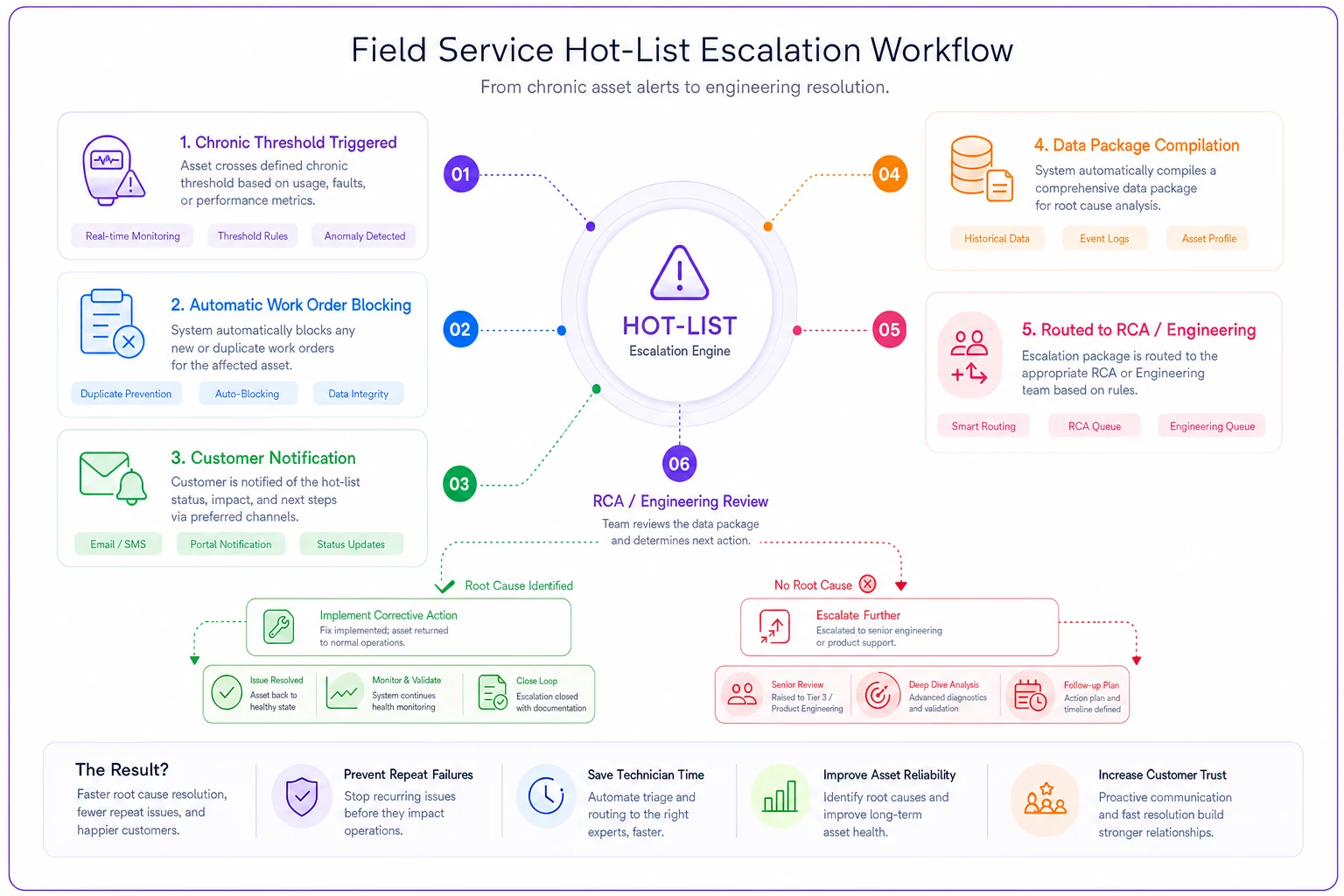
The key is making these triggers non-negotiable. Too many operations have guidelines about escalating repeat failures that get ignored during busy periods. When it's automated, that problematic chiller can't slip through the cracks just because everyone's focused on emergency calls.
RCA ticket templates that drive real investigation
Most RCA processes fail because they start with a blank page and good intentions. Chronic failure tickets need structured templates that guide investigation while capturing actionable findings.
A functional RCA template for field assets includes specific sections:
Failure Pattern Summary: Not just counting failures, but categorizing them. Same component failing repeatedly? Failures tied to specific operating conditions? Time between failures shortening? This section should auto-populate from your detection algorithm's findings.
Technical Investigation Requirements: Specific diagnostic steps based on the failure pattern. Electrical component failing repeatedly might require megger testing, harmonic analysis, and voltage monitoring. Mechanical failures might specify vibration analysis, alignment checks, lubrication sampling.
Cost Impact Analysis: Automated calculation of total service cost, parts consumption, labor hours, travel time, and any customer credits or penalties. Include the soft costs—customer satisfaction impact, contract risk, effect on tech utilization. One template I've seen effectively tracks "cost per day of operation," which really highlights how much chronic failures drain resources.
Environmental and Operational Factors: Templates should prompt investigation of external factors. Is the asset undersized for its application? Power quality issues at the site? Is the customer operating outside design parameters? These findings often reveal solutions beyond just fixing the equipment.
The template must require specific outputs: root cause identification (not just symptoms), recommended permanent fix, implementation timeline, and success metrics. If the investigation can't identify root cause, escalation to engineering or vendor support is mandatory—not optional. "Unable to determine cause" doesn't close the ticket.
Customer messaging that preserves relationships during chronic failures
How you communicate about repeat failures often determines whether you keep or lose the account. Customers experiencing chronic asset problems are already frustrated, and generic updates make it worse.
Your messaging strategy needs three distinct communication tracks:
Initial escalation message (sent automatically when hot-list triggered): "We've identified a pattern of recurring issues with [specific asset]. This has been escalated to our technical team for comprehensive review. You'll receive a preliminary assessment within [timeframe]. During this review period, we'll handle any emergency issues immediately while working toward a permanent solution."
Investigation update cadence: Don't wait for customers to ask for updates. Set automatic triggers every 48-72 hours during active RCA. These updates should include what you've investigated, what you've ruled out, and next steps. Even "we've eliminated X and Y as potential causes and are now looking at Z" is better than silence.
Resolution messaging with prevention focus: When presenting the fix, frame it around preventing future failures, not just solving the current problem. "Based on our analysis, inadequate ventilation is causing premature component failure. The recommended solution includes [specific fix], which will prevent similar failures and reduce your overall maintenance costs by an estimated [amount] annually."
For significant chronic failures, proactive credit or accommodation offers can make a real difference. One operation reduced customer churn by roughly 60% by automatically issuing service credits when assets hit the hot list—before customers even complained. The gesture showed accountability and bought time for proper resolution.
Engineering and vendor handoff criteria
At some point, chronic failures exceed what field service can reasonably solve. Your policy needs clear criteria for escalating to engineering or equipment vendors, along with documentation that actually gets results.
Asset replacement decisions often emerge from these escalations, but first you need the vendor or engineering team to acknowledge the systemic issue. That requires data packages that tell an undeniable story.
Vendor escalation packages should include:
-
Complete failure history with dates, symptoms, and attempted repairs
-
Parts consumption data showing repeated component failures
-
Environmental data (operating conditions, power quality, usage patterns)
-
Cost impact summary—your costs, not just parts under warranty
-
Specific request for action (engineering review, design modification, replacement authorization)
Timing triggers for escalation typically follow this pattern: after 3 similar component failures, engage vendor technical support. After 5 total failures or 2 failed RCA attempts, demand vendor engineering involvement. If the asset is under warranty or service contract, those thresholds might be lower.
The handoff documentation should make the vendor's job straightforward while protecting your interests. Serial numbers, installation dates, modification history, previous vendor communications—all of it. But also document your losses: customer satisfaction impact, technician hours consumed, contract cancellation risk. Vendors respond differently when they see the full business impact, not just technical details.
For internal engineering teams, the handoff might include design review requests, application assessment, or system integration analysis. Engineering involvement should be mandatory at certain thresholds, not optional based on availability.
Prevention strategies that break the cycle
The best chronic failure programs prevent assets from ever hitting the hot list. This requires connecting your detection system to preventive maintenance scheduling, parts inventory, and replacement planning.
When an asset shows early warning signs—maybe 2 failures in 60 days, below your hot-list threshold—automatically adjust its PM schedule. Increase inspection frequency, add specific checks related to the failure type, or flag it for senior tech assignment only. This kind of early intervention prevents roughly 30% of assets from ever becoming chronic problems.
Parts strategy matters too. Repeated failures of the same component across multiple assets is a different problem than isolated chronic failures. One operation discovered a batch of defective capacitors causing widespread issues—they proactively replaced them across all susceptible units and avoided dozens of potential chronic failures.
Your remote diagnostics capability becomes genuinely valuable for assets approaching chronic status. Instead of waiting for the next failure, you can monitor deteriorating conditions and intervene before breakdown. This works particularly well for problems that build gradually, like refrigerant leaks or bearing wear.
When an asset shows early warning signs—maybe 2 failures in 60 days—automatically adjust its PM schedule to add targeted inspections and senior tech assignments.
Your remote diagnostics and parts strategies combined can stop many chronic issues before they start, and make your hot-list backlog much smaller.
Implementation timeline and resource requirements
Rolling out a repeat-failure asset policy typically takes 60-90 days for full implementation, though benefits show up within the first few weeks.
Weeks 1-2: Define detection thresholds and scoring matrix. Pull historical data to identify current chronic failures—there are probably 5-10 hiding in your system right now. Set up basic reporting to track failure frequency.
Weeks 3-4: Build RCA templates and establish escalation triggers. Train supervisors on the investigation process. Create customer communication templates. Start with basics and refine based on actual use.
Weeks 5-6: Implement automatic detection and alerts. This might be daily reports initially, evolving to real-time alerts as you refine the process. Begin working through your backlog of existing chronic failures.
Weeks 7-8: Establish vendor and engineering handoff processes. Create standard escalation packages. Set up tracking for RCA outcomes and success metrics. Start measuring impact on repeat visit rates.
Weeks 9-12: Refine thresholds based on initial results. Expand detection to include pattern recognition beyond simple frequency. Integrate with PM scheduling and parts planning. Build dashboards for ongoing monitoring.
Resource requirements are more modest than most people expect. The biggest need is analytical ownership—someone needs to own the detection and investigation process. This might be a senior dispatcher, operations analyst, or technical manager spending around 25% of their time initially, dropping to roughly 10% once the system runs smoothly.
Measuring success and adjusting thresholds
Your repeat-failure policy succeeds when chronic problems get solved, not just identified. Track these metrics to validate your approach:
Repeat visit rate: Percentage of assets requiring multiple visits within 30/60/90 days. Target reduction of 30-40% within six months.
Mean time between failures (MTBF): For assets that do experience multiple failures, this should extend by at least 50% after RCA implementation.
Chronic failure resolution time: Average days from hot-list trigger to permanent solution. Target under 14 days for critical assets, 30 days for standard.
Contract retention: Specifically for accounts with chronic asset issues. Proper handling should improve retention by 20-30%.
Tech utilization impact: Reduction in time spent on repeat failures. This freed capacity often equals adding half to one full-time tech without actually hiring.
Threshold adjustments will be necessary. Initial settings might be too sensitive (flagging normal maintenance patterns) or too loose (missing obvious problems). Monthly reviews for the first quarter, then quarterly adjustments based on patterns you observe.
Some operations need seasonal adjustments too. HVAC companies might tighten thresholds during peak cooling season when any repeat failure is critical. Manufacturing services might have different thresholds for production versus scheduled downtime periods.
The compound effect of systematic chronic failure management
The same pattern shows up consistently after implementing structured repeat-failure policies: the benefits compound over time. Month one saves a few truck rolls. Month six shows a real reduction in emergency calls. Year two brings fundamental improvement in asset reliability and customer satisfaction.
The real shift happens when your team moves from reactive firefighting to actually solving problems. Techs start documenting issues differently when they know patterns get analyzed. Dispatchers think twice before sending someone out for another band-aid fix. Customers start trusting that you'll solve problems permanently.
One regional HVAC service company tracked their results over 18 months: chronic failures dropped from affecting roughly 12% of managed assets to under 3%. Their average contract value increased by about 15% as customers recognized the value in proactive problem resolution. They stopped losing contracts to "failure fatigue" and started winning new business based on their approach to reliability.
The operational discipline built through chronic failure management also strengthens everything else. The same detection logic catches training gaps, parts quality issues, and preventive maintenance opportunities. The RCA skills developed for asset failures apply to other operational problems. The customer communication frameworks work for other service challenges.
Modern operational software makes the difference between manual tracking that eventually gets abandoned and systematic improvement that actually scales. AI-powered workflow automation handles pattern detection across thousands of assets and work orders, triggers escalation workflows automatically, and keeps things from slipping through the cracks. But the strategy—your thresholds, your investigation process, your resolution standards—that's what actually converts chronic failures from profit drains into solved problems.
Every chronic asset failure represents both immediate cost and a symptom of something systemic. With proper detection, investigation, and resolution processes, you can turn those problem assets into proof points for your service value. The same unit that almost cost you the contract becomes the story of how your approach to reliability makes you different from every other provider in the market.
Start by pulling your service data from the last 90 days and flagging any asset with 3+ visits. That list is your immediate opportunity—and the beginning of a shift from reactive repairs to real reliability.
Ready to optimize your field operations?
Join 2,000+ service teams using Romrly to boost productivity, reduce downtime, and enhance customer satisfaction.