


Most sustainability programs in field service fail for a boring reason: they start with targets instead of measurements. Somebody in a meeting commits to "net zero by 2030" or "a 20% reduction in fleet emissions," and then six months later nobody can tell you what the baseline actually was. The trucks still roll. The parts still get air-freighted. And the whole thing quietly dies as a slide deck.
The programs that actually stick do the opposite. They refuse to set a single target until they've measured where emissions come from, which activities drive them, and which interventions pay for themselves. For a field-service business, that's not abstract environmental accounting — it's the same data you already use to run dispatch, parts, and fleet. Carbon and cost sit on top of the same operational facts.
This is a walkthrough of how to build that program from the measurement layer up: what a usable baseline looks like, which interventions are low-friction enough to survive contact with a busy dispatch board, how to handle the spare-pool and supplier decisions underneath, and how to wire the reporting so it ties to the KPIs you already track.
Why most field-service sustainability efforts never leave the spreadsheet
The core problem is that emissions in field service are diffuse. You don't have a single smokestack to monitor. You have 40 vans driving unpredictable routes, a parts warehouse that air-freights the occasional emergency component, subcontractors with their own fleets, and job sites that each pull a little power. The emissions are spread across every corner of the operation, which means no single person owns them.
What tends to happen is sustainability gets assigned to someone with no operational authority — an office manager, a compliance person, sometimes an outside consultant. They produce a report. The report is technically accurate and operationally useless, because the levers that actually move emissions (routing density, first-time-fix rates, parts sourcing, replacement timing) are controlled by the ops team, and the ops team was never in the room.
The second failure is measuring the wrong things with heroic precision. People spend weeks calculating the exact carbon footprint of office paper while ignoring that 80–90% of a field-service company's footprint is fuel burned by vehicles. If your baseline doesn't start with fleet miles and fuel, you're polishing a rounding error.
So the whole thing hinges on a baseline that's good enough to act on, owned by the people who can actually act, and tied to metrics they already care about.
Building a baseline you can actually use
A baseline isn't a carbon audit. It's an operational model that converts the activity data you already collect into emissions, so you can see where the mass sits and watch it move.
Eliminate field service chaos with Romrly.
Romrly helps you assign, track, and complete service jobs efficiently and on time.
- Unified job scheduling
- Technician dispatch & tracking
- Customer notifications & updates
No credit card required
| Emission source | Where the data lives | Rough share of footprint | How to estimate |
|---|---|---|---|
| Fleet fuel (Scope 1) | Fuel cards, telematics, odometer logs | 70–85% | Liters/gallons × emission factor, or miles × vehicle factor |
| Purchased energy (Scope 2) | Utility bills for depot/warehouse | 5–15% | kWh × local grid factor |
| Parts, freight, subcontractors (Scope 3) | Purchasing records, carrier invoices | 10–25% | Spend-based or weight-based factors |
The mistake here is over-engineering Scope 3. For a first baseline, a spend-based estimate for parts and freight is fine. You're not filing a regulatory disclosure — you're trying to find out whether emergency freight is a rounding error or a real driver. You can tighten it later.
-
Total fleet miles and total fuel consumed, broken out by vehicle class
-
Depot and warehouse kWh
-
Parts spend split into "planned replenishment" vs "emergency/expedited"
-
Freight spend split by mode (ground vs air)
-
Subcontractor job count and their rough mileage
What makes this useful rather than decorative is attaching emissions to a denominator you already report. Carbon per completed job. Carbon per mile. Carbon per dollar of revenue. Those ratios are what let you tell whether you're actually improving or just doing less business. A smaller company with fewer jobs will have lower total emissions and worse efficiency — the intensity metric catches that.
A simple workflow to convert operational data into an emissions baseline:
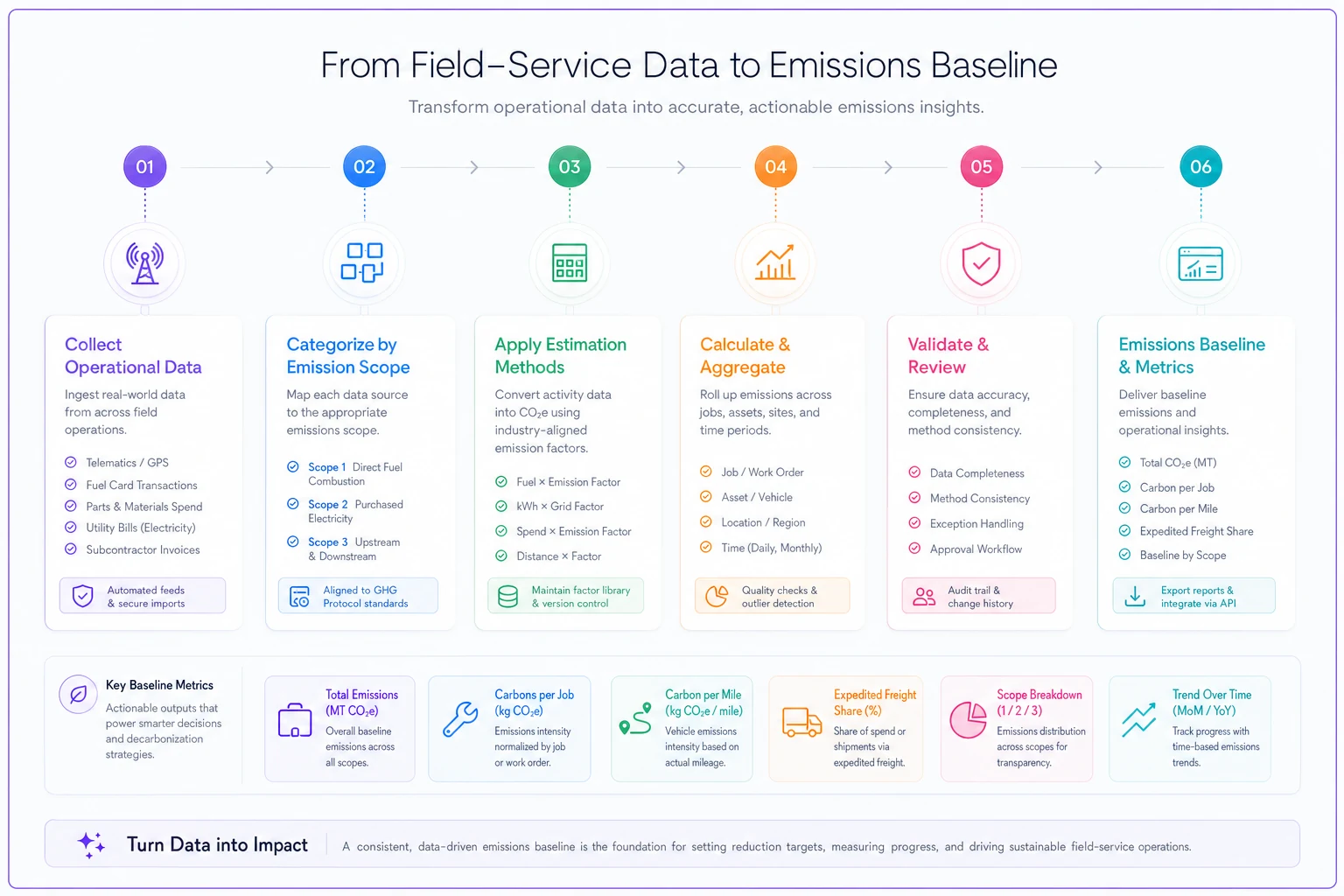
This diagram shows the key steps from raw operational inputs to the intensity metrics ops can use.
For a first baseline, use spend-based estimates for parts and freight to avoid over-engineering Scope 3 and get to action faster.
Keep paragraph text attribute value as markdown, including markdown links. Don't remove any markdown from the paragraph text attribute. make sure you bring over the markdown formatting already present in the input markdown content
Low-friction interventions: clustering and route density first
Once the baseline shows fuel dominating, the cheapest emissions reduction available is almost always better job clustering. Not new technology — just denser routing. Every mile a technician drives between jobs is pure cost and pure carbon with zero value delivered to the customer.
Clustering sounds obvious, and most dispatch teams think they're already doing it. In practice, they're optimizing for the next job, not the day. A dispatcher under pressure accepts an emergency across town, then backfills around it, and the route turns into a star pattern radiating out from the depot instead of a tight loop. Over a month, the deadhead miles add up to real fuel.
Territory structure matters more than daily heroics here. If your territories are drawn badly, no amount of clever same-day routing fixes the underlying geometry. Getting the boundaries right so workload and travel are balanced is foundational — worth reading alongside a proper approach to service territory design to balance workload and SLAs, because clustering only works when the territory it operates inside is sane.
The other high-leverage, low-friction lever is first-time-fix. Every return visit is a second truck roll for one job — double the miles, double the fuel, for the same revenue. A big chunk of return visits come from parts: the technician shows up without the right component, diagnoses, leaves, orders it, comes back. Fixing the parts-on-truck problem is simultaneously a sustainability intervention and a profitability one. If technicians are repeatedly driving back for components, the fix is structural — building proper van stock around kit SKUs and replenishment rules that lift first-time-fix will cut return trips, and those avoided trips show up directly in your carbon-per-job number.
That's the pattern worth internalizing: the best early sustainability wins are things you'd do anyway to run a tighter operation. Nobody has to be convinced to reduce wasted miles.
When clustering is a bad idea
There's a failure mode here. If you cluster so aggressively that you start missing SLAs or stacking all the hard jobs on one technician, you've traded carbon for customer satisfaction and burnout. Density has to respect skill-matching, appointment windows, and crew mix. Clustering is a constraint to optimize within, not a goal to maximize at all costs.
The EV pilot: mechanics that don't blow up your route reliability
EVs come up in every sustainability conversation, and most field-service managers are rightly nervous about them. That nervousness is well-founded — a badly scoped EV pilot can tank route reliability. But a well-scoped one teaches you a lot and often saves money per mile.
EV suitability is route-shaped, not opinion-shaped. Some of your routes are perfect for electric vehicles and some are not, and the baseline data you already built tells you which is which.
-
Segment routes by daily mileage. Pull 60–90 days of telematics. Routes that consistently run under roughly 120–150 miles a day with predictable return-to-depot patterns are your candidates. Long-haul or unpredictable routes are not.
-
Check the depot charging reality. Can you actually install chargers where vans park overnight? Overnight depot charging is cheap and reliable. Depending on public fast-charging mid-shift is how pilots fail.
-
Pick 2–3 vehicles, not the whole fleet. You're buying information, not replacing the fleet. A small pilot tells you real-world range in your climate, with your load, on your routes.
-
Match the vehicle to the payload. A van loaded with heavy parts and a lift gate has very different range than the brochure. Test with real kit.
-
Track cost per mile against the diesel equivalent. Energy cost, maintenance, downtime. EVs usually win on energy and maintenance; the question is whether that offsets the purchase premium over the hold period.
-
Set a kill switch. Define in advance what failure looks like — missed jobs from range anxiety, charging downtime above a threshold — so the pilot ends cleanly instead of limping along and poisoning the idea.
A realistic outcome from a pilot like this: a company runs three electric vans on short urban routes, finds energy costs running roughly 40–60% below diesel per mile, maintenance drops because there's less to service, but one route occasionally spikes past safe range in winter. The answer isn't "EVs don't work" — it's "that route stays diesel, these two go electric." That's exactly the nuance a pilot is supposed to surface.
Who should NOT run an EV pilot yet
If your routes are long and unpredictable, if you can't install depot charging, or if your fleet turnover is years away, an EV pilot is premature. Put the energy into routing and first-time-fix instead — bigger carbon reduction, far less capital, no charging infrastructure to build.
Spare-pool and replacement decisions as carbon decisions
Most sustainability programs miss this angle entirely: how you manage spare parts and asset replacement has real emissions consequences, and the operationally smart choice is usually the lower-carbon one too.
Emergency freight is the obvious culprit. When a part isn't available locally, somebody air-freights it, and air freight carries a carbon cost many times that of ground shipping. If your baseline split parts spend into "planned" vs "expedited," you'll see how much of your Scope 3 is coming from poor forward-stocking. The fix — holding the right spares closer to where they're consumed — reduces both expedite cost and expedite emissions at the same time.
Then there's the replace-versus-keep question on your own equipment and vehicles. Running an asset into the ground isn't automatically greener, and replacing it early isn't automatically wasteful. An old van burning extra fuel and needing frequent repairs can emit more over its remaining life than the manufacturing footprint of its replacement. These aren't gut calls — they're the same failure-mode and lifecycle decisions you'd make for pure cost reasons. A structured approach like a failure-mode decision matrix and multi-year rollout plan for mixed-fleet asset replacement gives you the framework; the sustainability program just adds an emissions column to a decision you're already making.
The spare-pool configuration that balances all this is usually tiered: core high-turn parts stocked on vans and at forward locations, mid-tier parts at the regional depot, and only genuinely rare items left to expedite. The tighter that tiering, the fewer emergency air-freight events, and the lower both your cost and your carbon.
Supplier criteria without the greenwashing
Scope 3 from suppliers is where sustainability programs get vague fast. Companies send out long questionnaires, suppliers return glossy PDFs, and nobody acts on any of it. If supplier criteria don't connect to a real purchasing decision, they're theater.
Keep supplier evaluation operational. A usable supplier scorecard for a field-service business looks at:
-
Delivery mode and lead time — can they supply by ground reliably, or do they force you into expedited freight? This has the biggest direct carbon and cost impact.
-
Local or regional stocking — distance from supplier warehouse to your depots directly affects freight emissions.
-
Packaging and returns — do they take back cores and packaging, or does it all go to landfill?
-
Basic emissions data availability — can they give you product-level or at least category-level factors, so your Scope 3 estimate improves over time?
-
Reliability of supply — a supplier who stocks out and triggers emergency sourcing elsewhere is a carbon problem disguised as a service problem.
Most of these are things a good procurement person weighs anyway. That's the point. Supplier sustainability bolted on separately gets ignored; supplier sustainability woven into normal vendor evaluation sticks, because it's scored alongside price and reliability instead of competing with them.
Reporting that ties to operations, not to a separate report
The last place these programs break is reporting. If carbon lives in a quarterly sustainability document that nobody in ops ever opens, behavior won't change. The reporting has to appear next to the operational KPIs that dispatchers, fleet managers, and the service manager already look at.
Express emissions as intensity ratios attached to existing dashboards:
-
Carbon per completed job (next to first-time-fix and jobs-per-tech)
-
Fuel/carbon per mile (next to route efficiency and utilization)
-
Expedited freight as a share of parts spend (next to parts cost and stockout rate)
-
EV vs diesel cost-per-mile (next to fleet cost metrics)
When carbon sits beside the numbers people are already managed on, it stops being a separate initiative and starts becoming a property of running the business well. A dispatcher who sees carbon-per-job move when routes get denser understands the connection immediately — it's the same lever that moves their efficiency numbers.
This is where having operational data already centralized pays off. Most of the baseline inputs — miles, fuel, parts spend, job counts — are things a field-service management platform is already capturing. The value of pulling emissions reporting into the same system you use for dispatch and parts isn't that it's greener software; it's that the carbon numbers update automatically from live operational data instead of being hand-assembled once a quarter from exports that are already stale. A report that refreshes itself is a report people actually use.
A real scenario: a 32-van HVAC and plumbing service
Consider a regional HVAC and plumbing company running about 32 vans, doing somewhere in the range of 400–450 jobs a week. No formal sustainability program — just rising fuel bills and a couple of commercial clients starting to ask about emissions in their contracts.
They started with a measure-first baseline over a quarter. The numbers weren't surprising once they saw them: fuel was close to 80% of their footprint, and expedited freight on parts was a bigger slice of Scope 3 than anyone expected — driven by technicians not carrying the right stock and the parts desk air-freighting replacements to hit same-day commitments.
The interventions were deliberately unglamorous. They tightened route clustering within better-defined territories, which trimmed deadhead miles. They rebuilt van stock around their most common jobs, which lifted first-time-fix and cut return visits. And they ran a three-van EV pilot on their densest urban routes.
Over the following two quarters, carbon-per-job dropped a meaningful amount — most of it from the routing and first-time-fix work, not the EVs. The EV pilot roughly broke even on cost in year one but set them up for a sensible replacement path. The expedited-freight share of parts spend fell by a bit more than a third once van stock improved, which quietly saved real money. And when the commercial client asked about emissions, they had actual intensity numbers trending the right direction instead of a promise.
The outcome worth noting: nothing they did was purely for carbon. Every intervention also made the operation cheaper and more reliable. The sustainability program was really just operational discipline with an emissions column added.
Bringing it together
A field-service sustainability program works when it starts from measurement, targets the small number of activities that actually drive emissions, and rides on top of the operational levers you'd pull for profit anyway. Fuel first, because that's where the mass is. Clustering and first-time-fix first, because they're low-friction and pay for themselves. EV pilots scoped to the routes that fit, with a kill switch. Spare-pool and replacement decisions treated as the cost-and-carbon decisions they already are. Suppliers scored on the criteria procurement cares about. Reporting wired straight into the KPIs ops already lives by.
Do it in that order and sustainability stops being a slide deck somebody has to defend and starts being a side effect of running a tight, well-coordinated operation. The companies that get this right aren't the ones with the loudest targets — they're the ones who measured first, acted on the big levers, and let the carbon numbers follow the operational ones down.
Do it in that order and sustainability stops being a slide deck somebody has to defend and starts being a side effect of running a tight, well-coordinated operation. The companies that get this right aren't the ones with the loudest targets — they're the ones who measured first, acted on the big levers, and let the carbon numbers follow the operational ones down.
Ready to optimize your field operations?
Join 2,000+ service teams using Romrly to boost productivity, reduce downtime, and enhance customer satisfaction.