

Most predictive maintenance programs don't fail because the model was wrong. They fail because nobody owned what happened after the model made a call. The data feeding it drifted, the labels stopped matching reality, and six months later a dispatcher is rolling a truck to an asset that was never going to fail — while the one that actually did fail wasn't flagged because its sensor had been dead for weeks.
That gap between "we built a model" and "we run a governed program" is where most of the money leaks. And it's a governance problem, not a data science problem.
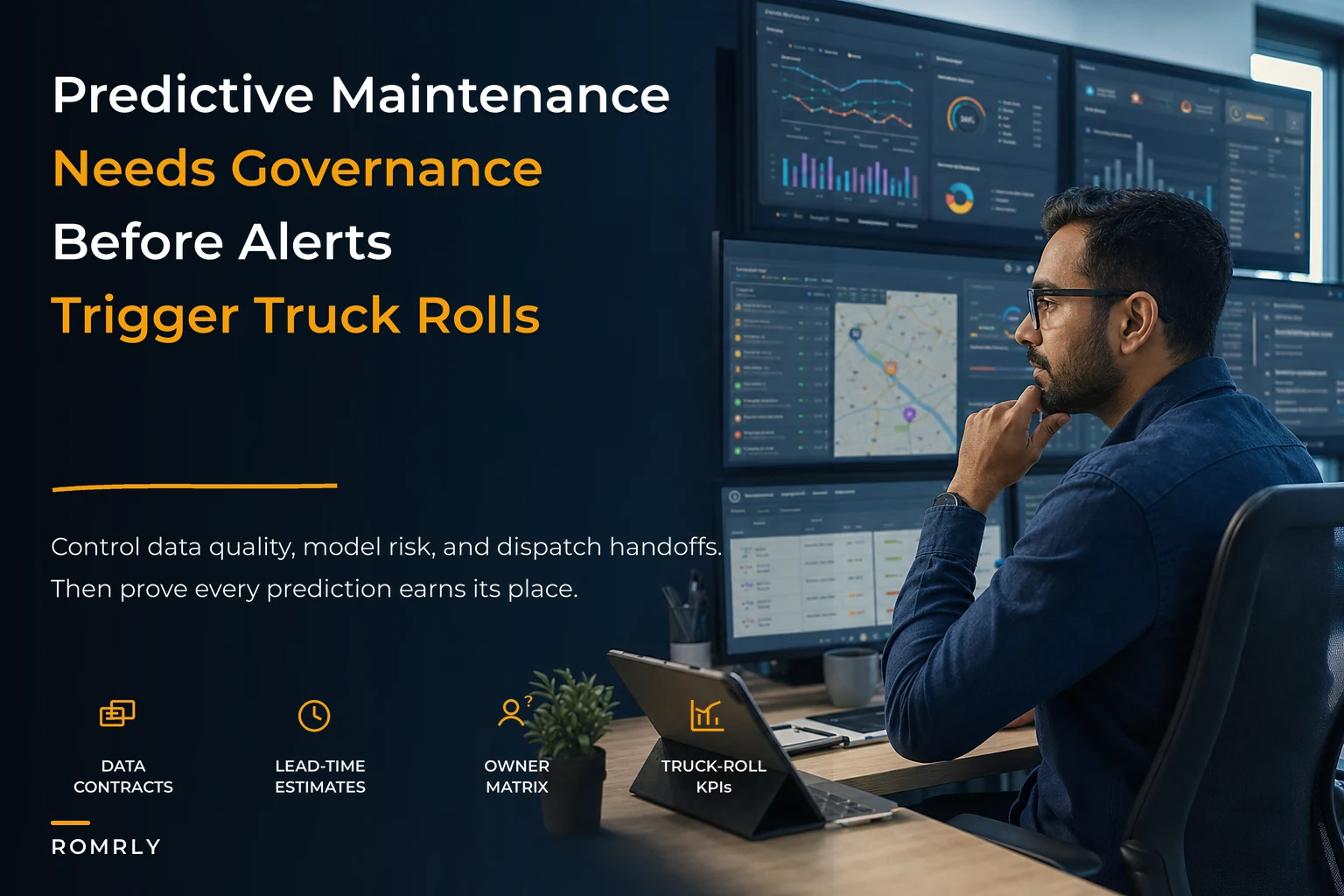
This post is about the operational scaffolding around predictive maintenance — the ingestion contracts, label quality process, metrics that actually map to truck rolls and first-time-fix, and the deployment gates that stop a bad model version from quietly costing you a quarter's worth of margin. If you already run remote diagnostics or IoT alerting, this is the layer that keeps it honest as you scale.
Why predictive maintenance quietly rots
A predictive model starts degrading the day it goes live. Nobody notices for a while.
-
A firmware update changes how a sensor reports vibration, so the feature the model relied on now means something slightly different.
-
A new asset model gets added to the fleet, but nobody retrained on it, so the model is essentially guessing on hardware it's never seen.
-
Technicians stop closing work orders with accurate failure codes because the dropdown is annoying, so your "ground truth" labels slowly turn to mush.
-
One customer site gets a batch of new sensors, skewing the data distribution the model was tuned on.
None of these are dramatic. That's the problem. It's drip-by-drip, and because predictive maintenance operates in the future ("this will fail in 14 days"), the feedback loop is slow. By the time you feel it — rising truck rolls, falling first-time-fix, technicians grumbling that the alerts are "always wrong" — the program has been degrading for months.
The core insight: in field service, the model is the easy part. The hard part is that predictions get consumed by dispatchers and technicians making expensive physical decisions. A 3% drop in precision isn't an abstract metric — it's a real van, a real tech, real fuel, and a real customer whose day you interrupted for nothing.
What actually breaks at scale
At one or two pilot sites, you can babysit a model manually. Someone checks it every week, eyeballs the alerts, corrects the obvious mistakes. Governance is basically "Dave keeps an eye on it."
Eliminate field service chaos with Romrly.
Romrly helps you assign, track, and complete service jobs efficiently and on time.
- Unified job scheduling
- Technician dispatch & tracking
- Customer notifications & updates
No credit card required
-
Ingestion drift happens per-sensor, per-vendor, per-firmware-version. You can't eyeball a thousand data streams.
-
Label quality decays differently across regions because different crews have different closeout habits.
-
Model performance varies wildly by asset class — the model might be great on chillers and useless on rooftop units, and the blended average hides it.
-
Ownership diffuses. When something goes wrong, everyone agrees "the model made a bad call," but who exactly is responsible for catching that? Dispatch blames data, data blames the vendor, the vendor blames the sensors.
Most field service orgs have no real idea what their live predictive precision actually is right now. They know what it was at launch. Those are very different numbers.
The three contracts that hold a program together
Governing predictive maintenance comes down to three things you have to make explicit and enforce: what data comes in, how you know if a prediction was right, and who's allowed to push a model into production.
1. Ingestion contracts (the data has to promise something)
An ingestion contract is a written, enforced agreement about what each data feed must deliver before it's allowed to influence a prediction. Not a nice-to-have — a gate. If a feed violates its contract, the model shouldn't be scoring off it, or at minimum the prediction should be flagged as low-confidence.
-
Freshness — how recent must the reading be? A vibration reading that's 8 days old shouldn't drive a "fails in 5 days" prediction.
-
Completeness — what percent of expected readings arrived? If a sensor dropped 40% of its packets this week, that's a broken input.
-
Range sanity — physical bounds. A temperature reading of -400° is a sensor fault, not a signal.
-
Schema stability — units, field names, and encodings that don't silently change.
-
Provenance — which firmware version, which sensor model, so you can trace drift back to a source.
This connects directly to how your data is modeled in the first place. If you haven't nailed down a canonical structure for assets, readings, and work orders, ingestion contracts have nothing stable to attach to. Worth getting your canonical object model and sync rules sorted before you try to enforce data quality on top of it — otherwise you're policing a shape that keeps changing.
2. Label quality (your ground truth is a workflow, not a fact)
This is the one that quietly kills more programs than any modeling mistake.
Your model learns from what actually happened — did the asset fail, and was the prediction right? That "what actually happened" comes from technicians closing out work orders. And in real operations, closeout data is messy. Techs pick the fastest dropdown option. "General repair" gets used for everything. A failure the model correctly predicted gets logged in a way that makes it look like a false alarm.
-
A defined, short list of failure codes that map cleanly to what the model predicts.
-
Required fields at closeout for any asset the model flagged — did the predicted condition exist, yes or no?
-
A weekly audit of a sample of closeouts, comparing tech-entered outcome against the actual repair performed.
-
A feedback path so techs understand their closeout data drives whether they get useful alerts going forward. Techs enter better data when they see it come back as fewer junk dispatches — this matters more than most people expect.
Require the minimal closeout fields only for assets the model flags so techs don't see the workflow as extra busywork.
3. Deployment and rollback gates (nobody ships a model on a Friday and hopes)
Every model version that reaches production should pass through gates, and every version should be reversible in minutes, not days.
-
Offline validation — the new version beats the current one on a held-out set, per asset class, not just blended average.
-
Shadow mode — the new version scores real live data in parallel for a set period, but its predictions don't drive dispatch. You compare what it would have done against what the live model did.
-
Canary rollout — the new version goes live for one region or one asset class only.
-
Full rollout — only after the canary holds its metrics.
-
Rollback trigger — a pre-defined condition ("precision on chillers drops below X for 3 consecutive days") that automatically reverts to the last known-good version.
The mistake here is treating rollback as an emergency procedure instead of a normal operation. If reverting a model is a scary, all-hands event, people avoid deploying improvements at all, and the program stagnates.
The gate stack above is also a forcing function for documentation. Every step produces a record — what the model scored in shadow mode, what the canary showed, why full rollout was approved. That record is what makes the next cycle faster.
How predictions flow through operations
Understanding where governance actually intercepts the prediction lifecycle helps clarify what you're protecting. The flow looks roughly like this:
Sensor / IoT Feed ↓ Ingestion Contract Check (freshness, completeness, range, schema) ↓ Model Scoring ↓ Confidence + Lead-Time Estimate ↓ Alert Triage Layer (routing rules, priority bands) ↓ Dispatcher / Dispatch Queue ↓ Work Order Created → Technician Dispatched ↓ Closeout Data (failure code, outcome) ↓ Label Quality Audit ↓ Model Validation Loop (monthly) ↓ Hold / Retrain / Rollback Decision
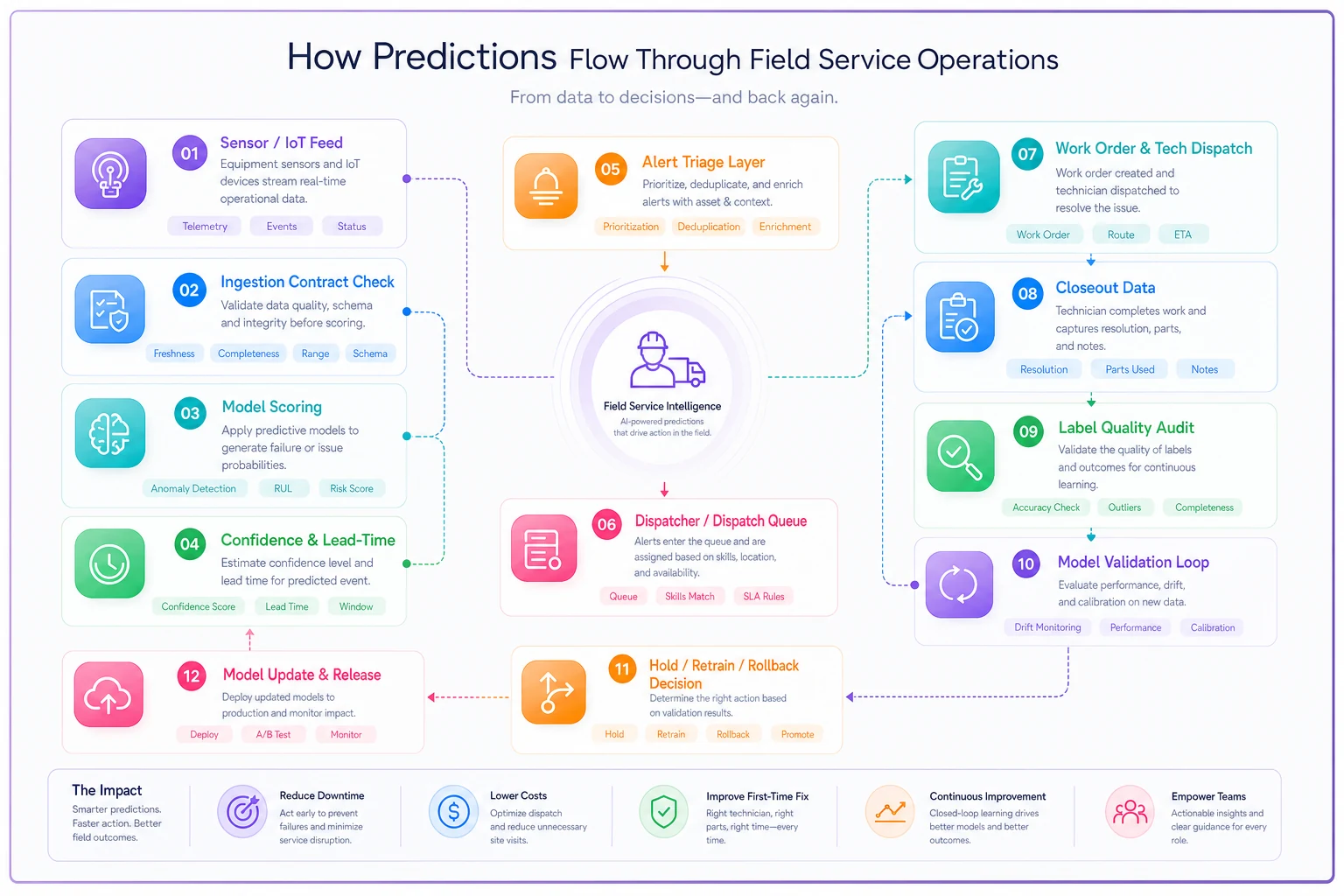
Every governance mechanism in this post maps to one of those nodes. An ingestion contract failure short-circuits at step two. A label quality problem poisons the bottom of the loop. A missing rollback trigger leaves you with no clean exit when step nine shows something wrong. The flow isn't complicated — the hard part is that most orgs are only actively managing two or three nodes and calling the whole thing "governance."
Mapping model metrics to KPIs that ops actually cares about
Data science metrics and field service KPIs live in different languages. Nobody on the ops floor cares about F1 score. They care about truck rolls and first-time-fix. The governance layer's job is to translate between the two.
| Model metric | What it really means | Ops KPI it drives | What happens when it slips |
|---|---|---|---|
| Precision | Of the assets we flagged, how many actually needed work | Wasted truck rolls | Techs sent to healthy assets; fuel + labor burned; "the alerts are always wrong" |
| Recall | Of the assets that failed, how many we caught | Emergency/reactive calls | Missed failures become after-hours emergencies and SLA breaches |
| Lead-time accuracy | How close the "fails in N days" estimate is | Scheduling efficiency | Too early = premature part swaps; too late = failure before the visit |
| Calibration | Whether "80% likely" is actually 80% | Dispatch prioritization | Dispatchers can't trust the ranking, so they ignore it |
The pattern worth internalizing: precision protects your cost, recall protects your SLA. A program tuned for high recall catches more failures but generates more false alarms and more truck rolls. A program tuned for high precision keeps trucks off the road but misses failures that come back as emergencies. There's no universally correct setting — there's a setting that matches your cost structure, and it should be a deliberate, reviewed decision, not a default the model happened to land on.
This is also where predictive maintenance connects to your alerting discipline. A high-recall model with no triage layer produces noise, and noise produces alert fatigue that trains dispatchers to ignore the system. Governance isn't only about model accuracy — it's about whether the output arrives in a form a human can actually act on.
ROI gating: don't let a model into production that can't pay for itself
A model can be statistically solid and still be a bad business decision. The gate that separates the two is ROI, and it should be explicit before rollout.
-
Value of a correct catch = cost of the reactive/emergency call avoided (parts + emergency labor + SLA credit exposure + customer goodwill).
-
Cost of a false positive = the truck roll you didn't need (fuel + tech time + opportunity cost of the planned job you displaced).
-
Cost of a miss = the emergency you didn't prevent.
A simple ROI gate: the model only ships if the expected value of acting on its predictions clears a defined margin over acting on a simple time-based schedule. If a calendar-based PM schedule gets you 80% of the benefit at a fraction of the complexity, the fancy model doesn't deserve production.
A realistic scenario: a mid-size HVAC service company running roughly 40 predictive alerts a week. At around 70% precision, that's about 12 wasted rolls weekly. At a loaded cost somewhere in the $150–$220 range per unnecessary roll, that's in the ballpark of $1,800–$2,600 a week in waste — call it $90k–$130k a year, before counting the misses. Pushing precision up to the low 80s through better label quality and tighter ingestion contracts cut the wasted rolls by roughly a third. That improvement didn't come from a better algorithm. It came from governance.
The owner matrix: someone owns every failure mode
The single most useful artifact in a governed program is a matrix that names an owner for each part of the pipeline. When precision drops, there should be zero ambiguity about who investigates.
| Component | Owner | Responsible for | Escalates to |
|---|---|---|---|
| Sensor / data feeds | Field ops / IoT lead | Ingestion contract compliance, sensor health | Vendor management |
| Label quality | Dispatch / QA lead | Closeout accuracy, failure-code discipline | Ops manager |
| Model performance | Analytics owner | Precision/recall by asset class, drift detection | Program owner |
| Deployment gates | Program owner | Rollout/rollback decisions, canary sign-off | Ops director |
| KPI impact | Ops manager | Truck-roll and FTF trends tied to model | Ops director |
Without named owners, a performance drop triggers a week of "not my area" before anyone actually looks at the data. The matrix prevents that loop. It's also worth reviewing quarterly — owners change, roles shift, and a matrix with stale names is about as useful as no matrix at all.
A validation recipe you can run every month
You don't need a research pipeline. You need a repeatable monthly check that anyone competent can execute:
-
Pull the last 30 days of predictions and their actual outcomes from closeout data.
-
Compute precision and recall per asset class, not blended. The blend hides the failures.
-
Read a sample of 20–30 "false positives" by hand. Confirm how many were actually mislabeled catches. This tells you whether the problem is the model or the labels.
-
Check ingestion contract violations — how many predictions this month scored off stale or incomplete data?
-
Compare truck-roll and FTF trends against the model's confidence bands. Are high-confidence alerts actually converting to real work?
-
Log drift — has the input data distribution shifted from what the model was trained on?
-
Decide hold, retrain, or roll back — and write down why.
That last step matters more than people give it credit for. Half the value of governance is the written record of why you made a call, so that when performance moves next quarter you're not starting from scratch.
Production handoff checklist for ops owners
When a model moves from "the analytics team's project" to "something running in production that ops depends on," this is what should be true before you accept the handoff:
-
- [ ] Ingestion contracts are defined and monitored for every feed the model uses
-
- [ ] Failure-code list is finalized and mapped one-to-one to what the model predicts
-
- [ ] Closeout fields required for flagged assets are live in the mobile workflow
-
- [ ] Precision/recall targets are set per asset class, with agreed floors
-
- [ ] Rollback trigger conditions are written down and technically wired
-
- [ ] The owner matrix is filled in with real names, not roles
-
- [ ] ROI gate is documented — the model has demonstrated it beats a simple schedule
-
- [ ] Monthly validation recipe has an owner and a calendar slot
-
- [ ] Dispatchers know what confidence levels mean and how to act on them
-
- [ ] There's a feedback path so techs see their closeout data improve alert quality
If you can't check these off, you don't have a governed program. You have a model somebody hopes is still working.
When predictive maintenance governance makes sense — and when it doesn't
It makes sense when: you're running predictions across enough assets that manual oversight is impossible, your truck-roll costs are high enough that false positives hurt, and you have a real closeout data stream to validate against. That's where the discipline pays for itself. It's a bad fit when: you're at pilot scale with a handful of assets. Heavy governance at that point is overhead — a weekly manual review is fine, and building gates and matrices for 30 assets is theater. Who should hold off entirely: teams whose work-order closeout data is a mess. If your ground truth is unreliable, no governance sophistication saves you — you'll be governing garbage. Fix label quality first. It's almost always a workflow-and-incentive fix, not a technology one.
The same applies to teams still standing up remote diagnostics. Governance is the layer above a working prediction pipeline. If you're earlier in the journey, the sequencing in a proper remote diagnostics pilot with defined ROI checkpoints comes first — then you wrap governance around what proves out.
Where good tooling quietly helps
None of this requires exotic software, but it does require a system where your predictions, work orders, sensor feeds, and closeout data live in one connected model. Governance is really just being able to see what your program is doing and act on it quickly. Ingestion contract violations, per-asset-class metrics, label audits, and rollback triggers are only enforceable if the data isn't scattered across five disconnected tools.
An operational platform that ties predictions back to the actual jobs, technicians, and outcomes they generated is what makes monthly validation a 30-minute task instead of a two-day data-wrangling exercise. AI-powered operational software helps here specifically because it can surface ingestion anomalies, flag label inconsistencies, and track model performance trends without someone manually stitching together exports from three different systems. The point isn't the tooling — it's that governance you can't easily execute is governance that won't happen.
The bottom line for field service leaders
Predictive maintenance is not a model you deploy and forget. It's a program you run, with the same operational rigor you'd apply to inventory or dispatch. The organizations that get real, durable value out of prediction aren't the ones with the fanciest algorithms — they're the ones who wrote down what their data must deliver, who owns each failure mode, how they'll know when the model drifts, and what they'll do about it.
Get the contracts, the labels, and the gates right, and the model mostly takes care of itself. Skip them, and you'll have a very sophisticated way of sending trucks to healthy equipment while the failures you meant to catch slip through.
Ready to optimize your field operations?
Join 2,000+ service teams using Romrly to boost productivity, reduce downtime, and enhance customer satisfaction.