



Most field-service contracts get written by two teams who never really talk to each other. Sales scopes the SLA to win the deal. Ops inherits a set of numbers they had no hand in and gets told to hit them. Then somewhere around month four, a customer files for credits, and everyone scrambles to figure out whether the contract even lets them dispute it.
The core problem isn't that people are lazy. It's that the contract was built as a legal document first and an operating document never. The SLAs live in one section, the pricing lives in another, and there's no math connecting a missed response window to a dollar figure your dispatch board can actually see coming.
This piece is about wiring those pieces together — mapping measurable ops metrics to pricing bands, building credit math that both sides understand before signing, and setting escalation gates so disputes get caught while they're still fixable. Not for audit defense. For the handoff between the commercial team and the people who actually run the work.
Why the ops-to-commercial handoff breaks
The failure pattern is pretty consistent. A contract gets signed with a "4-hour emergency response" SLA and a flat monthly service fee. Nobody translated what a 4-hour response actually costs to guarantee in a given territory. Nobody defined what "response" even means — is it dispatch acknowledgment, technician on-site, or first meaningful action? And nobody wrote down what happens to the price if the customer wants that window tightened later.
So you end up with contracts that are technically clear and operationally useless. The dispatcher looks at the job and has no idea whether missing this one triggers a credit, how big that credit is, or whether there's a grace mechanism. Finance finds out about the exposure when the customer's procurement contact emails a credit demand with a spreadsheet attached.
Something that comes up repeatedly with service businesses is the same SLA language getting copy-pasted across wildly different account sizes. A tier where you charge $2,800 a month and a tier where you charge $19,000 a month end up with identical response commitments and identical credit formulas. That's not a pricing strategy. That's a template.
The other quiet killer is credit math that isn't bounded. If your contract says "5% credit per missed SLA event" with no cap and no aggregation window, a bad month with a parts backorder can wipe out an entire quarter's margin on that account. And because nobody modeled it, nobody saw it coming.
Start from measurable KPIs, not SLA prose
Before you touch pricing, you need KPIs that a system can actually measure without human interpretation. "Prompt response" is not a KPI. "Time from ticket creation to technician on-site, business hours only, measured from the ops platform timestamp" is a KPI.
Eliminate field service chaos with Romrly.
Romrly helps you assign, track, and complete service jobs efficiently and on time.
- Unified job scheduling
- Technician dispatch & tracking
- Customer notifications & updates
No credit card required
The distinction matters because everything downstream — pricing bands, credit triggers, dispute gates — depends on a number both parties agree is real. If the metric is ambiguous, every credit becomes a negotiation, and you lose whether you're right or wrong.
The metrics that actually anchor a field-service contract:
-
Response time — ticket-open to on-site, with the clock definition spelled out (business hours vs. 24/7, holidays excluded or not)
-
Resolution time — on-site to job-closed, separated from response so you can price them independently
-
First-time-fix rate — measured over a rolling window, not per-visit
-
Uptime / availability — for asset-based contracts where you're maintaining equipment
-
Scheduled PM completion — percentage of preventive visits completed within the agreed window
-
Escalation response — separate, tighter clock for jobs flagged critical
Define the clock (business hours vs 24/7) inside the KPI so the metric needs no later interpretation.
The mistake most teams make is stuffing all six into one SLA with one credit formula. Each of these has a different cost to guarantee and a different sensitivity to price. Response time in a dense metro costs almost nothing to tighten. The same commitment in a rural territory might mean a dedicated on-call tech, which is a real line item.
Getting these metrics clean and consistently captured is its own discipline — if the timestamps your credit math depends on are unreliable, the whole framework collapses. This is exactly why a field-service data governance checklist with audit trails matters before you go anywhere near contract terms. Bad data doesn't just cost you disputes; it makes the pricing model dishonest from the start.
Mapping SLA levels to pricing bands
The whole point of an operational pricing framework is that a tighter commitment should carry a defensible price delta — one that traces back to what it actually costs you to deliver.
Each SLA tier is a capacity commitment. A 2-hour emergency response doesn't cost you more per job; it costs you in reserved capacity, on-call coverage, and reduced route density. So the price band should reflect the standing cost of holding that promise, not just the per-event cost.
Here's a simplified version of how a response-time SLA maps to a price band on a mid-sized commercial HVAC maintenance contract:
| SLA Tier | Response Commitment | Coverage | Monthly Base Multiplier | What it actually costs you |
|---|---|---|---|---|
| Standard | Next business day | Business hours | 1.0x (baseline) | Normal routing, no reserved capacity |
| Priority | 4 hours | Business hours | ~1.25x–1.35x | Some route protection, buffer capacity |
| Critical | 2 hours | Business hours | ~1.6x–1.8x | Reserved slot, tighter territory assignment |
| Emergency | 2 hours | 24/7/365 | ~2.2x–2.6x | On-call rota, after-hours premium, standby |
The multipliers aren't magic numbers — they're derived from your own unit economics. If you don't have a clear per-job cost basis, you're guessing, and the bands will either leave margin on the table or lock you into losses. Building that foundation first is why a per-job profitability worksheet belongs upstream of any pricing conversation. You can't set a defensible band without knowing your fully-loaded cost per visit.
One pattern worth flagging: the jump from business-hours to 24/7 coverage is almost always underpriced. Teams tend to add maybe 20–30% for around-the-clock coverage when the real standing cost — rota fatigue management, premium pay, standby capacity — is closer to double. That gap doesn't show up in month one. It shows up when you've sold six emergency-tier contracts and your on-call bench can't cover them all.
Credit math that doesn't bleed you dry
Credit formulas are where good intentions turn into margin leaks. Three things separate a survivable credit clause from a dangerous one:
-
A measurement window. Credits aggregate over a period — monthly is typical — not per individual event. This prevents one bad week from cascading.
-
A credit cap. Total credits in any period can't exceed some percentage of the period's fee. 10–15% is a common ceiling. Without this, a parts crisis can zero out an account.
-
A grace band. The first N misses in a window, or misses within X minutes of the target, don't trigger credits. This absorbs normal operational noise.
Here's a worked example. Say you've got a Critical-tier contract at $8,400/month, 2-hour response commitment, and this credit structure:
-
Grace band
first missed event per month, plus any miss within 20 minutes of target
-
Credit per qualifying miss
3% of monthly fee
-
Monthly cap
12% of monthly fee
In a month with five missed responses:
-
One falls in the grace band (first miss) → no credit
-
One was 15 minutes late → within grace, no credit
-
Three qualifying misses × 3% × $8,400 = $756 credit
-
That's 9% of the fee, under the 12% cap → paid in full
Now compare the naive version: 5% per miss, no grace, no cap. Five misses × 5% × $8,400 = $2,100 — nearly triple the exposure. And if it were seven misses, you'd be handing back 35% of the fee on an account probably running at 20–30% margin. You'd be paying the customer to lose money.
The grace band and cap aren't giveaways to the customer. They're what makes the commitment sane enough to actually offer. A contract with unbounded credits isn't a strong SLA — it's a landmine that eventually goes off.
Escalation gates: catching disputes while they're still fixable
The biggest missed opportunity in service contracts is treating credits as a scoreboard tallied at month-end. By then, the misses already happened, the customer's already annoyed, and you're negotiating from behind.
Escalation gates flip this. You define trigger thresholds during the month that force action before the credit event fully crystallizes.
A workable gating flow looks like this:
Gate 1 — Internal alert. When an account hits 50% of its monthly credit cap, ops gets flagged. Not finance, not sales — the people who can still change the outcome by reprioritizing the next few jobs on that account.
Gate 2 — Account review. At 75% of cap, the account owner and ops lead do a short review. Is this a parts issue? A territory coverage gap? A one-off? The answer determines whether you throw resources at it or accept the credit.
Gate 3 — Proactive customer contact. Before the customer files, you reach out. "We've had a rough stretch on your account, here's what happened, here's the credit we're applying, here's what we're changing." A credit you volunteer preserves the relationship. A credit you fight and lose damages it twice.
The dispute-gating rules matter just as much on the defensive side. Your contract should define exactly what evidence supports or invalidates a credit claim, and a clock on how long the customer has to file. A common, fair structure:
-
Customer must submit credit claims within 30 days of the period close
-
Claims must reference specific ticket IDs and timestamps
-
The platform record of record governs (this is why clean data is non-negotiable)
-
Disputes over the record go to a defined review, not open-ended email threads
Without a filing window, you carry indefinite exposure — a customer three quarters later "discovering" a batch of missed SLAs is a real thing that happens, usually right before a renewal negotiation.
When this framework makes sense — and when it doesn't
This level of structure is worth building when you've got contracts with real SLA teeth, credits large enough to hurt, and enough account volume that ad-hoc handling is eating your team's time. If you're running dozens of contracted accounts across varying tiers, the framework pays for itself in disputes avoided and margin protected.
It's overkill if you're doing mostly transactional, break-fix work with no ongoing SLA commitments. A one-time repair job doesn't need a credit-aggregation window. Forcing this structure onto a business that's 90% time-and-materials just adds friction nobody uses.
It's also a bad idea to roll this out before your measurement is trustworthy. If your response-time data is half-guessed because techs update their status hours after the fact, every credit calculation is fiction. Fix the data capture first, then build the pricing logic on top of it.
And if your commercial team won't sit with ops during contract design, the framework won't hold. This is a coordination system, not a document. The field service adoption approach with stakeholder maps and KPI gates applies directly — you're changing how two departments hand off work, and that's a rollout, not a memo.
A real scenario
A regional commercial refrigeration company — around 40 contracted accounts, mostly grocery and food-service clients — was quietly losing money on their emergency-tier contracts. Every account carried the same "2-hour emergency response, 24/7" SLA regardless of size, and the credit clause was a flat 5% per miss with no cap.
The exposure surfaced during a bad stretch: a compressor supplier had a backorder problem, response times slipped across several accounts, and they ended up crediting back close to $30k in a single quarter. On some accounts, credits exceeded the margin for the period entirely.
The fix wasn't complicated, but it took getting ops and their sales lead in the same room. They rebuilt the tiers so 24/7 coverage carried roughly a 2.3x multiplier over standard instead of the ~1.4x they'd been charging. They added a grace band and a 12% monthly credit cap. And they set internal escalation gates so ops got flagged when an account crossed half its cap mid-month.
Over the following two quarters, credit payouts dropped by more than half — partly from the cap, but a bigger chunk from catching struggling accounts early enough to reprioritize. The tier repricing also meant accounts that genuinely needed 24/7 coverage were finally paying what it cost to hold that promise. A couple of price-sensitive accounts downgraded to Critical business-hours tier, which was fine — those were the accounts where the emergency commitment had never been profitable anyway.
Bringing it together
An operational pricing framework works because it stops treating the SLA, the price, and the credit math as three separate documents owned by three separate people. The response commitment maps to a price band derived from real delivery cost. The credit formula is bounded so a bad month can't erase a quarter. The escalation gates catch problems while ops can still fix them. And the dispute rules define what evidence counts before anyone's arguing.
The teams that get this right don't have fancier contracts. They have contracts where the person dispatching the job, the person who signed the deal, and the person reconciling the credits are all reading the same numbers and drawing the same conclusions. That alignment — not the legal language — is what protects the margin.
If you're rewriting service agreements this year, start with the metric definitions and the cost basis. Everything else hangs off those two things. Get them clean, and the pricing bands, credit math, and escalation gates almost design themselves.
Below is a simple visual of the workflow tying metrics to pricing to credits and gates.
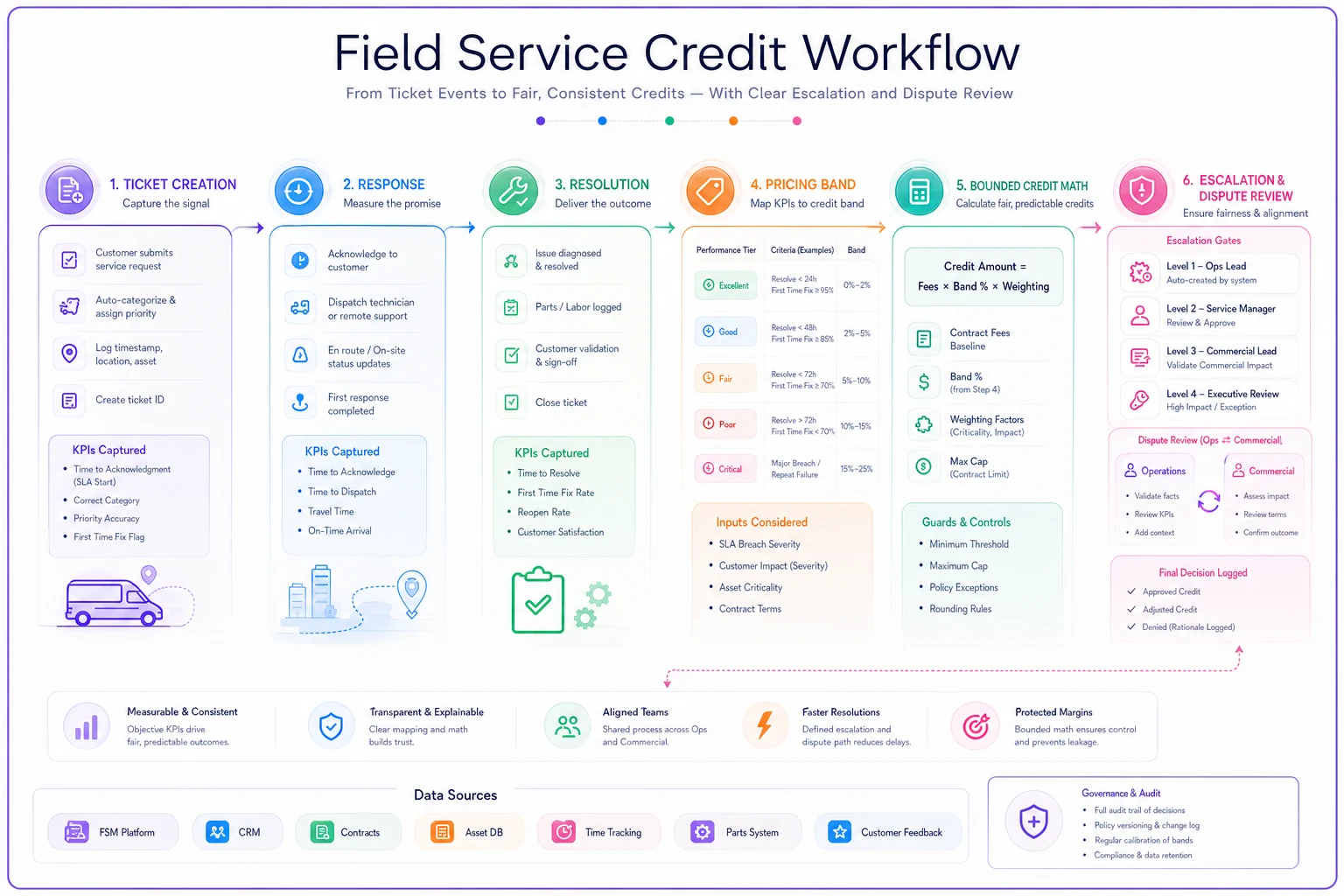
The visual emphasizes the handoff: defined metrics feed the pricing band, the pricing band defines credit exposure, and escalation gates let ops fix issues before credits crystallize.
If you're rewriting service agreements this year, start with the metric definitions and the cost basis. Everything else hangs off those two things. Get them clean, and the pricing bands, credit math, and escalation gates almost design themselves.
Ready to optimize your field operations?
Join 2,000+ service teams using Romrly to boost productivity, reduce downtime, and enhance customer satisfaction.