


Most field service businesses don't lose margin in one dramatic moment. They lose it slowly, in the gap between what operations promises and what finance can actually prove. A dispatcher commits to a four-hour response. A tech closes the job. The invoice goes out. And somewhere in that chain, an SLA breach quietly triggers a credit that nobody calculated, a warranty claim that never got filed, or a vendor chargeback that finance absorbs because ops couldn't produce the evidence in time.
Each of these leaks looks small in isolation. A $200 credit here. A rejected warranty line there. But when ops and finance run on separate systems with separate definitions of "done," those small leaks compound into a margin problem that nobody can point to on a single report.
This is a governance problem, not an accounting problem. The businesses that fix it stop treating ops and finance as two departments and start treating the handoff between them as a system with owners, rules, and evidence requirements. That's what ops finance governance in field service actually means — making the money side and the work side agree on the same facts, before disputes happen.
Where the two sides stop talking
Operations measures activity. Finance measures dollars. The two rarely reconcile on the same clock.
Operations knows a job took six hours, needed two truck rolls, and blew the response SLA by 40 minutes. Finance knows the customer was invoiced a flat rate, a credit memo showed up 11 days later, and the margin on that account looks fine on paper. Neither side sees the full picture because the SLA terms live in a contract, the performance data lives in a dispatch system, and the credit lives in accounting. Three systems, three owners, zero automatic connection.
At low volume, this doesn't cause obvious problems. When you're running 40 jobs a week, someone in the office can hold the whole thing in their head — they remember which accounts have penalty clauses, they eyeball the credits, they chase warranty claims manually. The system is a person.
Then volume doubles, a second territory opens, a third contract type gets added with different SLA tiers. The person who used to hold it all together is now approving credits they don't have time to verify, and finance starts issuing them just to keep customers happy. That's the moment margin governance quietly collapses — not because anyone made a bad decision, but because nobody owns the wiring between the SLA and the dollar.
The four connection points that actually matter
If you map where ops and finance need to agree, it comes down to four wiring points. Most businesses have at least two of them broken.
Eliminate field service chaos with Romrly.
Romrly helps you assign, track, and complete service jobs efficiently and on time.
- Unified job scheduling
- Technician dispatch & tracking
- Customer notifications & updates
No credit card required
| Connection point | What ops controls | What finance controls | What breaks when they're not wired |
|---|---|---|---|
| SLA → price | Response/resolution performance | Contract rate & penalty terms | Credits get issued without checking whether the SLA was actually missed |
| Job cost → invoice | Labor, parts, truck rolls | Billing rate, margin target | Underpriced jobs invoiced at flat rate, real cost never surfaces |
| Warranty → recovery | Failure evidence, parts data | Claim filing, reimbursement | Claims expire; ops never knew finance needed the photos |
| Vendor chargeback → dispute | Field evidence, timestamps | Dispute filing, credit tracking | Company eats chargebacks it could have won with a packet |
Same pattern every time: ops holds the evidence, finance holds the money, and neither has a clean, timed handoff of what the other actually needs. The credit goes out before anyone confirms the breach. The warranty window closes before the photos get pulled. The chargeback deadline passes because the dispute packet was "being worked on."
SLA → price wiring: stop paying for breaches you didn't cause
The first place to tighten is the link between SLA performance and the credit that flows from it. In most operations, this happens backwards — the customer's AP team flags a missed SLA, finance issues a credit to protect the relationship, and only later, if ever, does anyone check whether the breach was real or whether a customer-caused delay should have paused the clock.
A cleaner approach treats every credit as something that has to be earned by the data, not requested by the customer. That means:
-
The SLA clock definition lives in one place, tied to the contract, with clear rules for what pauses it (customer no-access, parts backorder, site safety hold).
-
A breach only becomes credit-eligible after pause exceptions are applied automatically.
-
The credit amount is calculated from the contract's penalty formula, not negotiated ad hoc.
A significant share of "valid" SLA credits are actually invalid once you apply the pause rules. A tech shows up in three hours but can't get on site because the customer's contact didn't answer. The clock kept running in the customer's system; it should have stopped in yours. Without wiring, you can't prove it, so you pay.
Getting the pricing side right depends on having your rate and penalty structure clearly defined in the first place. If your contract terms are fuzzy, the credit calculation has nothing solid to reference. A well-built operational pricing framework for field-service contracts pays for itself here — the penalty math is only as good as the pricing logic underneath it.
Automated credit-calculation recipes
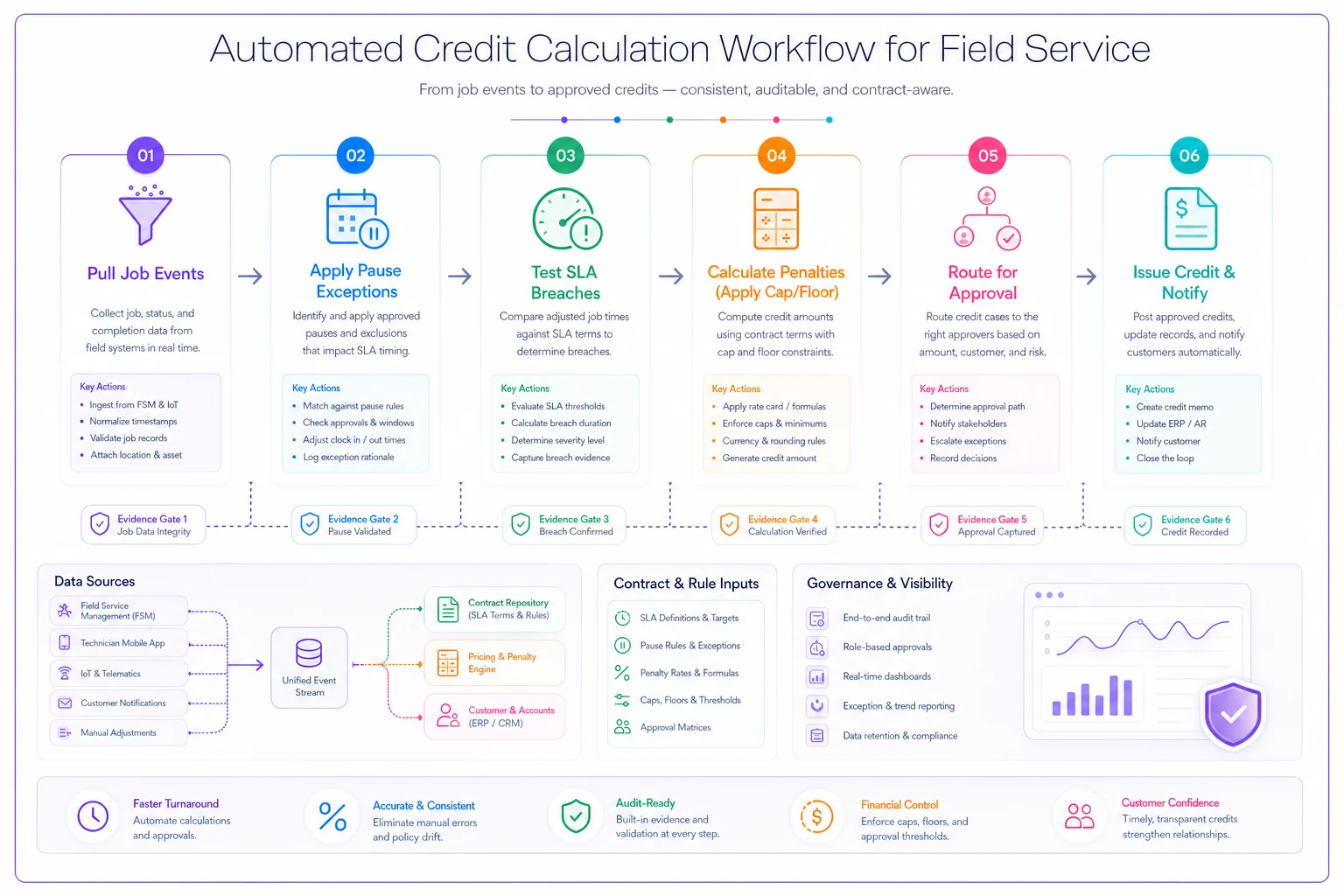
Once the SLA clock and pause rules are defined, the credit itself should be a recipe, not a judgment call. A recipe means a fixed input-to-output rule that produces the same answer every time, regardless of who runs it.
A typical credit recipe works like this:
-
Pull the event. Job ID, contracted SLA tier, actual response/resolution timestamps.
-
Apply pause exceptions. Subtract customer-caused and force-majeure holds from elapsed time.
-
Test the breach. Compare adjusted elapsed time to the SLA threshold. If under, stop — no credit.
-
Calculate the penalty. Apply the contract formula (flat, tiered, or percentage of monthly fee).
-
Cap and floor. Enforce the contract's monthly credit cap so one bad month doesn't trigger runaway credits.
-
Route for approval. Anything above a set threshold goes to a named approver with the evidence attached.
The reason this needs to be a documented process rather than a spreadsheet someone maintains: at scale, the person maintaining the spreadsheet becomes the single point of failure. They go on vacation, credits stall or get rubber-stamped, and the whole control breaks. When the calculation is a defined process pulling inputs directly from job records, it survives staff turnover and volume growth.
One thing worth flagging — businesses that automate the calculation but not the cap still bleed. The cap is often the most valuable line in the contract, and it's the one people forget to enforce because it only matters in a bad month, which is exactly when everyone's too busy to check.
Evidence-first chargeback packets
Vendor chargebacks and warranty recoveries run in the opposite direction — instead of you owing the customer, someone owes you, or is trying to charge you for something disputed. The businesses that win these consistently are the ones assembling evidence before the dispute exists.
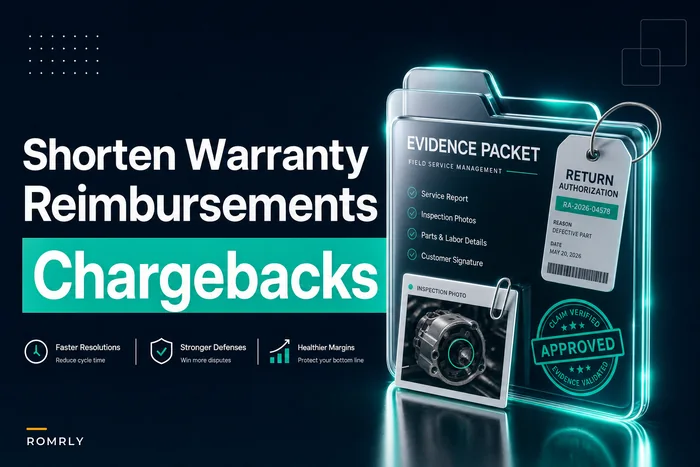
An evidence-first packet means every job that could later generate a chargeback or claim already has its proof attached at close: timestamped photos, part serial numbers, failure codes, technician notes, signed completion record. When the vendor rejects a warranty line or a customer disputes a charge 30 days later, the packet is already built. Nobody scrambles.
The failure mode is predictable. A tech closes a job, moves to the next one, and the photos live on their phone. Three weeks later finance needs them for a claim and they're gone, unlabeled, or the tech has left. The claim gets denied not because the work was wrong but because the evidence couldn't be produced in time.
If you're building the recovery side of this — warranty reimbursements specifically — there's a full workflow for the evidence-first chargeback workflow and finance reconciliation cadence that pairs directly with this governance model. Short version: capture the evidence at the moment of work, tag it to the job, and make it non-optional to close the ticket.
The monthly reconciliation cadence
Wiring and recipes prevent leaks going forward. Reconciliation catches the ones that slip through. And this is where most field service businesses have nothing — no regular session where someone lines up SLA performance against credits issued, warranty claims filed against claims recovered, chargebacks disputed against chargebacks absorbed.
A workable monthly cadence looks like this. In the first week after month close, finance produces three lists: credits issued, warranty claims outstanding, and chargebacks in dispute. Ops produces matching evidence for each. Both sides sit in one 60–90 minute session and reconcile line by line. Anything where the numbers don't match becomes an exception with a named owner and a due date.
Track the reason for each credit in the reconciliation so you can spot repeat causes quickly.
The point isn't to catch fraud. It's to surface systemic leaks — the account that keeps generating credits because its SLA tier was set too aggressive, the vendor that rejects every claim missing one specific field, the territory where truck rolls run high enough that flat-rate pricing is underwater. Those patterns don't show up in a single transaction. They only appear when you reconcile monthly and watch the same problem repeat.
Worth tracking: why each credit was issued, not just that it was. After three months you'll have a distribution, and it usually shows a small number of accounts or root causes driving most of the leakage. That's your fix list.
Owner RACI: the part everyone skips
None of the above works if ownership is fuzzy. The most common reason governance fails is that everyone assumes someone else owns the handoff. Ops thinks finance verifies the credit. Finance thinks ops confirmed the breach. Both are wrong, and the credit goes out unverified.
-
SLA breach confirmation — Responsible
dispatch lead. Accountable: ops manager. Consulted: finance. Informed: account owner.
-
Credit calculation & cap enforcement — Responsible
finance analyst. Accountable: finance manager. Consulted: ops. Informed: sales/account owner.
-
Warranty evidence capture — Responsible
technician. Accountable: ops manager. Consulted: finance. Informed: warranty coordinator.
-
Chargeback dispute filing — Responsible
finance analyst. Accountable: finance manager. Consulted: ops. Informed: nobody until resolved.
-
Monthly reconciliation — Responsible
both leads. Accountable: whoever owns margin (often the owner or GM). Consulted: —. Informed: leadership.
The non-obvious part: the Accountable role for reconciliation should sit with whoever owns overall margin, not with finance or ops individually. If finance owns it, they optimize for clean books. If ops owns it, they optimize for customer relationships. Only the person who owns the P&L has the incentive to protect margin across both sides.
A real scenario
A mid-size HVAC and refrigeration contractor running commercial maintenance contracts — around 300–350 jobs a month across two territories, roughly 18 techs. They had SLA penalty clauses on most commercial accounts but no wiring between dispatch performance and credits issued.
The problem showed up when they finally reconciled a full quarter. Credits issued: close to $14k. Credits that were actually valid once pause rules were applied: a little under half. The rest had been issued to keep customers happy without anyone checking whether the breach was real. On top of that, somewhere in the range of $6k–$8k in warranty claims had expired because failure photos never made it off the techs' phones.
The fix wasn't complicated, but it was structural. They defined SLA pause rules, built a fixed credit recipe with a monthly cap, made evidence capture mandatory at job close, and started a monthly ops–finance reconciliation. Within two quarters the invalid credits mostly disappeared, and warranty recovery climbed because the evidence was actually there when finance needed it. The total protected margin ran in the low five figures per quarter — not from selling more, just from stopping the leaks.
Underlying all of it was better job-cost visibility. You can't tell whether a flat-rate contract is worth defending unless you know what each job actually costs to run. Getting that clear with a per-job profitability worksheet and SLA guardrails is what let them see which accounts were generating credits and running underwater on cost — the ones worth renegotiating rather than just defending.
When this makes sense — and when it doesn't
This level of governance is worth building when you have contracts with real penalty exposure, more than one SLA tier, or vendor relationships that generate regular chargebacks and warranty claims. If SLA credits, expired warranties, and eaten chargebacks together add up to a meaningful slice of margin, the wiring pays back fast.
It's overkill when you're small, running flat-rate residential work with no penalty clauses, and one person can still hold the whole thing in their head accurately. Building formal RACI and reconciliation cadence for 30 jobs a week is process for process's sake.
Who should not do this yet: businesses whose contracts are so vaguely written that there's no clean SLA definition or penalty formula to reference. Fix the contracts first. Governance can only enforce rules that actually exist — if the terms are ambiguous, you'll just automate the ambiguity, and every credit dispute will still come down to a negotiation nobody can win with data.
Pulling it together
The businesses that stay profitable as they scale aren't always the ones with the best techs or the tightest routes. Plenty of well-run shops still leak margin at the ops–finance seam. The difference is they've stopped treating the handoff between the work and the money as something that just happens, and started treating it as a system with defined rules, clear owners, and evidence attached before disputes arise.
Start with whichever connection point is leaking most — usually SLA credits or expired warranties. Wire the calculation, assign the owner, and put the monthly reconciliation on the calendar. The first reconciliation will probably surprise you with how much was slipping through. That surprise is the point. You can't govern what you've never actually looked at line by line.
Start with whichever connection point is leaking most — usually SLA credits or expired warranties. Wire the calculation, assign the owner, and put the monthly reconciliation on the calendar. The first reconciliation will probably surprise you with how much was slipping through. That surprise is the point. You can't govern what you've never actually looked at line by line.
Ready to optimize your field operations?
Join 2,000+ service teams using Romrly to boost productivity, reduce downtime, and enhance customer satisfaction.